
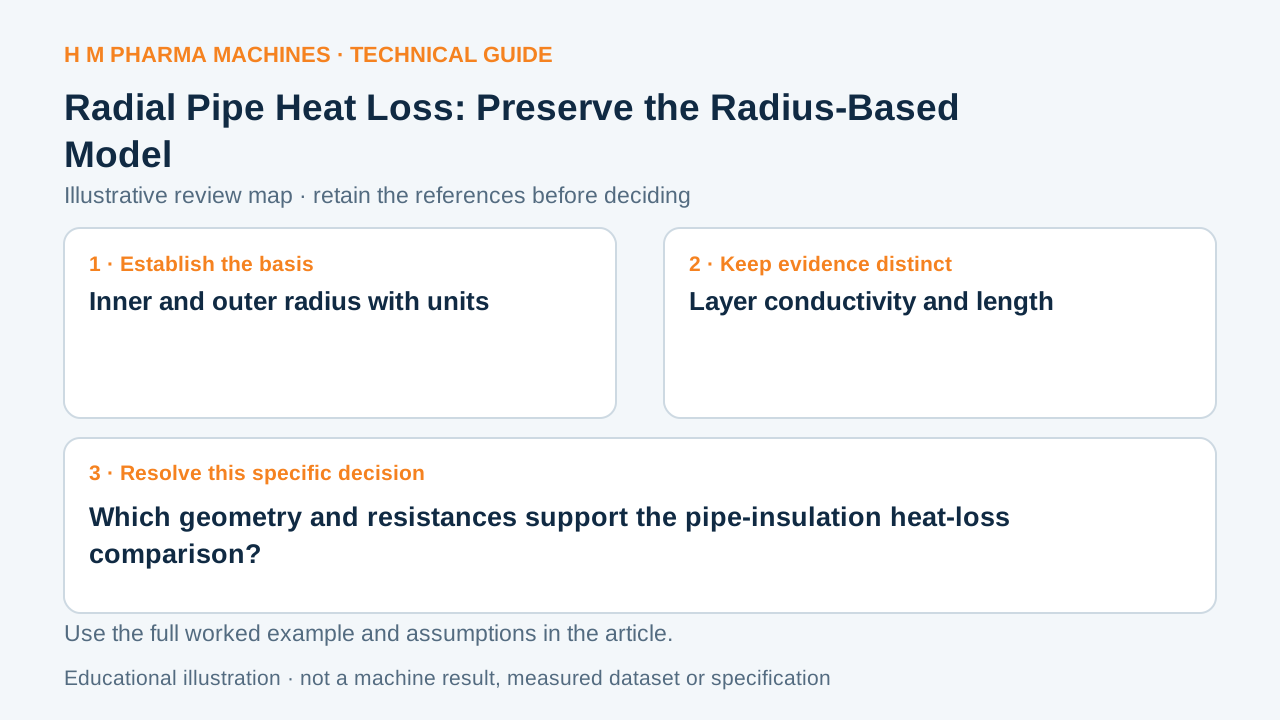
An insulation layer around a pipe has a changing heat-flow area. A flat-wall thickness calculation can miss that geometry.
Define the Thermal Model
For steady radial conduction through a cylindrical layer, R = ln(r₂/r₁)/(2πkL). MIT’s cylindrical-shell lesson develops the logarithmic geometry. The specified inner and outer temperatures define this resistance calculation; external convection and other layers must be added separately when modeling a complete pipe.
Compare a Hypothetical Case
Take invented radii r₁ = 0.025 m and r₂ = 0.050 m, length 1 m and k = 0.05 W/(m·K). Across a specified 40 K layer difference, conduction is about 18.13 W. A flat approximation using the inner area and 25 mm thickness gives 12.57 W. The discrepancy comes from assigning one constant area to a curved layer.
Complete the Engineering Review
Record radii rather than confusing diameter with radius. State the length and which surface temperatures belong to the layer. When extending the sheet to ambient air, add the boundary resistance at the appropriate outer area. Keep the comparison’s temperature boundary fixed so that changing geometry is not mixed with changing conditions.
For a processing-tank transfer route, obtain the actual pipe and insulation specification. The illustrative conductivity is not a recommended insulation material. Joints, supports and ends can introduce additional heat paths that the one-dimensional cylindrical calculation does not represent.
Which geometry and resistances support the pipe-insulation heat-loss comparison?
This blank worksheet is for your own project. It contains no H M machine trial result.
| Review field | Reference or result | Responsible person |
|---|---|---|
| Inner and outer radius with units | To complete | To complete |
| Layer conductivity and length | To complete | To complete |
| Specified surface temperature difference | To complete | To complete |
| Outer convection and bypass paths | To complete | To complete |
Customer Questions
Can diameter be inserted for r?
Use radii consistently.
Is outer area equal to inner area?
They differ for a cylindrical layer.
Does this compute total ambient loss?
Only after the other thermal paths are included.
Related Equipment References
Review the actual offered equipment and application separately from this educational example.
Primary References
These references support the technical principles discussed in this guide. The worked examples and review questions are educational.
Discuss Your Machine Requirement
Share your product, container, required output and the evidence needed for your technical review.
Request a Technical Review