
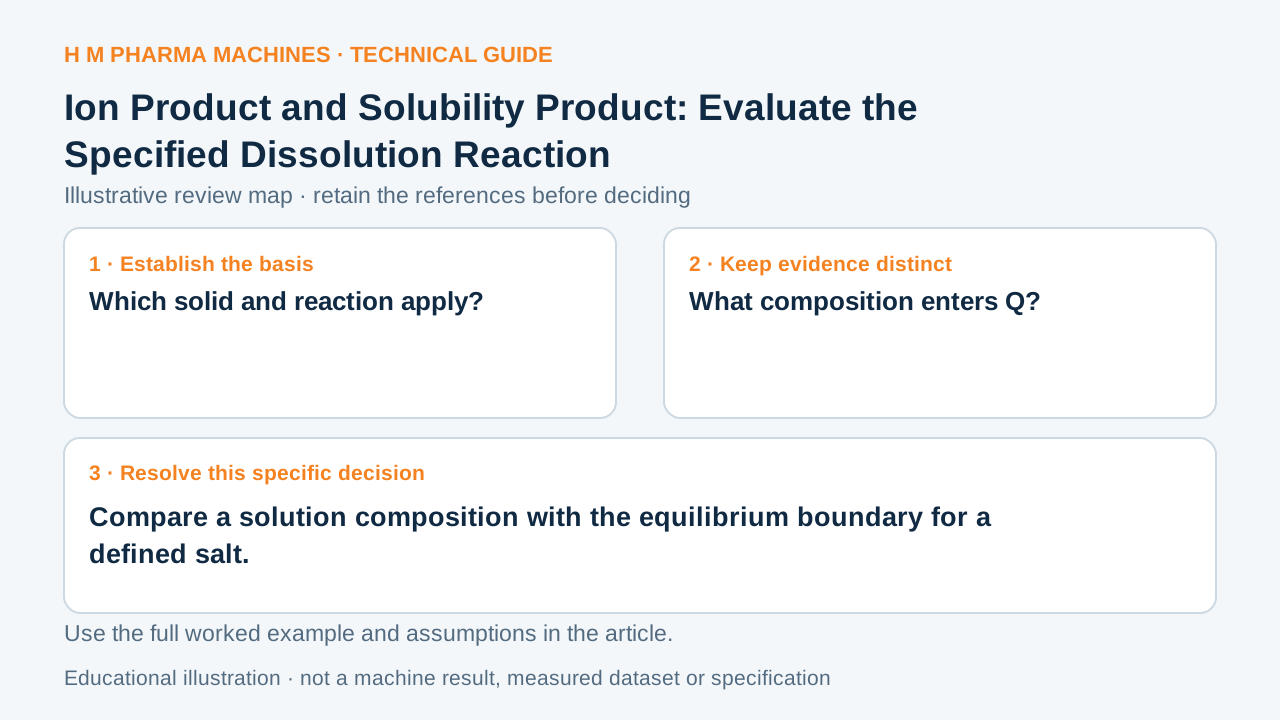
A salt’s solubility boundary belongs to its written dissolution equilibrium. A composition comparison needs the matching ion-product expression and the same equilibrium convention.
Write the dissolution expression
For a defined salt dissolution reaction, the reaction quotient uses the participating dissolved-ion activities with their stoichiometric powers. The solubility product is the equilibrium value of that expression for the stated solid phase and conditions. A quotient above it indicates supersaturation for that model. Primary reference 1. Primary reference 2.
Compare a fictional ion product
Construct MX(s) ⇌ M⁺ + X⁻ with hypothetical Ksp = 1.00 × 10⁻⁸. Supply dimensionless activities aM = 1.00 × 10⁻⁴ and aX = 2.00 × 10⁻⁴. Their ion product is Q = aM aX = 2.00 × 10⁻⁸, giving Q/Ksp = 2.00.
That model favors movement toward the solid-bearing equilibrium. It does not predict when visible particles appear, their size or the nucleation barrier. A salt with a different ion ratio would require a different expression, so the product of two numbers is not a universal solubility test.
Distinguish equilibrium tendency from observed solids
Prepare an original equilibrium comparison with solid identity, written reaction, relevant activities and temperature basis. Keep an observed solid or turbidity record separately. If concentrations substitute for activities, retain the explicit approximation and whether complexes or other species affect the free-ion amounts.
The invented Ksp does not describe a real deposit, water specification or cleaning chemistry. Its decision is whether the reported composition has been compared with the right equilibrium boundary. Actual fouling behavior and machine compatibility require supporting observations beyond this thermodynamic ratio.
Solution review worksheet
This blank worksheet is for your own project. It contains no H M machine trial result.
| Question | Record to retain |
|---|---|
| Which solid and reaction apply? | Defined phase and dissolution stoichiometry |
| What composition enters Q? | Free-ion activities on the chosen convention |
| What was physically observed? | Separate particle, deposit or solution record |
Customer Questions
What is the fictional ion product?
2.00 × 10⁻⁸.
What is its ratio to the supplied Ksp?
2.00.
Does this supply a precipitation time?
No.
Primary References
These references support the technical principles discussed in this guide. The worked examples and review questions are educational.
Discuss Your Machine Requirement
Share your product, container, required output and the evidence needed for your technical review.
Request a Technical Review