
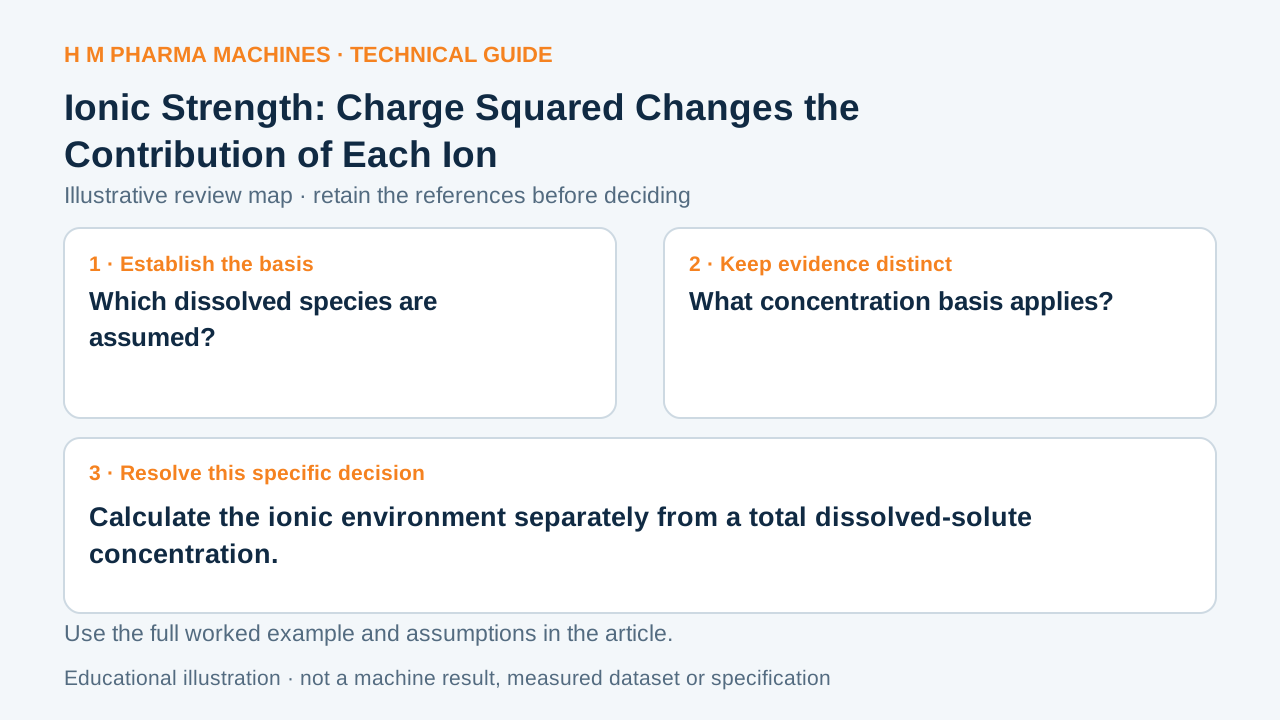
A divalent ion contributes differently from a monovalent ion to ionic strength. Summing dissolved concentrations without charge weighting misses that distinction.
Include each dissolved ion and charge
Concentration-based ionic strength is one half of the sum of each ionic concentration multiplied by the square of its charge number. The charge square makes both positive and negative ions contribute positively. Neutral dissolved species do not enter that ionic sum. Primary reference.
Calculate two hypothetical salt models
Assume an idealized fully dissociated 10 mmol/L NaCl solution. Its 10 mmol/L sodium and 10 mmol/L chloride give I = (10 × 1² + 10 × 1²)/2 = 10 mmol/L. A separate fully dissociated 10 mmol/L CaCl₂ model has 10 mmol/L calcium and 20 mmol/L chloride.
The second sum is (10 × 2² + 20 × 1²)/2 = 30 mmol/L. Both salt formula-unit concentrations are 10 mmol/L, yet their calculated ionic strengths differ. Complete dissociation is an express teaching assumption, not a measured species result for every solution.
Preserve the species inventory
Prepare an original ion table listing the included species, concentration and signed charge, followed by the squared-charge contribution. Check electroneutrality separately: the calcium example has 20 mmol/L positive-charge equivalents and the same negative-charge equivalents.
The calculation does not supply an activity coefficient, conductivity reading or corrosion prediction. Those require additional models or evidence. Its immediate use is to distinguish the ionic environment calculated from a stated species inventory from the concentration printed for a dissolved salt.
Solution review worksheet
This blank worksheet is for your own project. It contains no H M machine trial result.
| Question | Record to retain |
|---|---|
| Which dissolved species are assumed? | Ion names and dissociation model |
| What concentration basis applies? | Concentration for each ion |
| How does charge enter? | Squared charge in ionic strength; signed charge in electroneutrality |
Customer Questions
What is the constructed NaCl ionic strength?
10 mmol/L.
What is the constructed CaCl₂ ionic strength?
30 mmol/L.
Does this determine conductivity?
No. Conductivity requires other information.
Primary References
These references support the technical principles discussed in this guide. The worked examples and review questions are educational.
Discuss Your Machine Requirement
Share your product, container, required output and the evidence needed for your technical review.
Request a Technical Review