
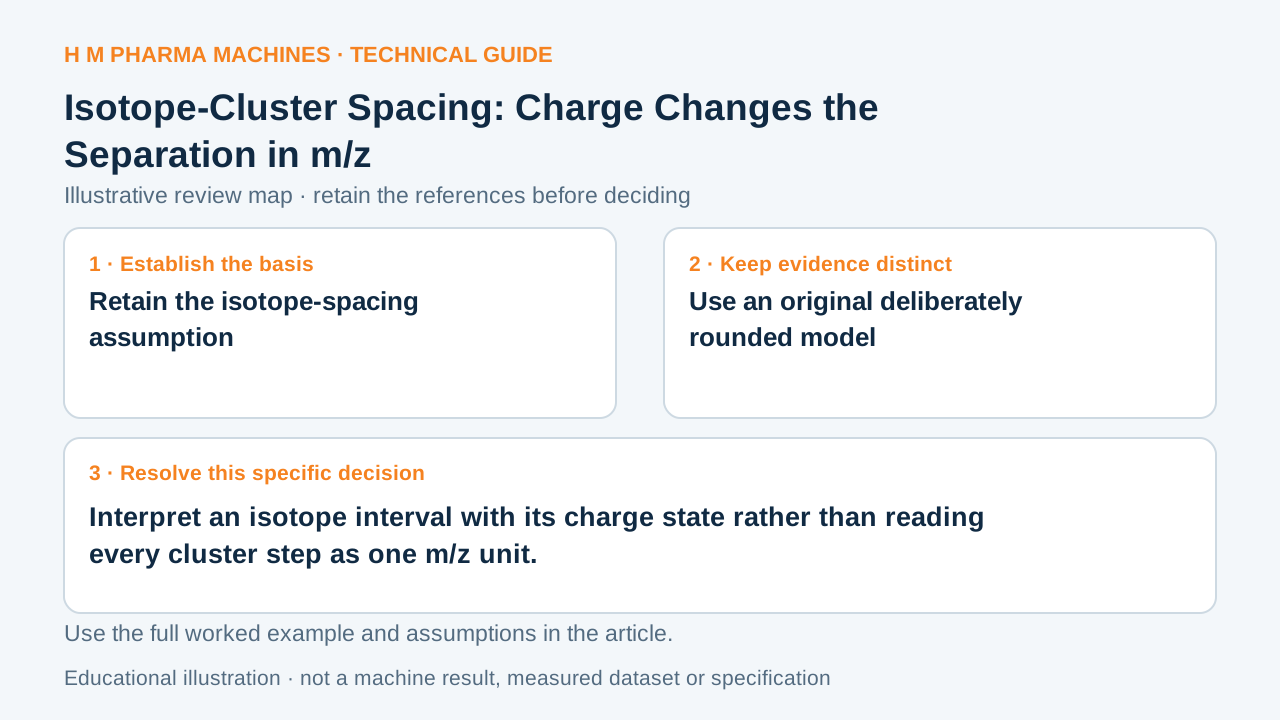
Adjacent isotope-envelope features can carry charge information only when the assumed mass spacing and resolved peak evidence are appropriate.
Retain the isotope-spacing assumption
Research on charge-state assignment uses resolved isotope-envelope spacing as one source of information. For a fixed charge magnitude, an ion-mass difference maps to a smaller m/z difference by that charge magnitude. The relevant isotopic spacing and envelope association must be established rather than treating any two adjacent peaks as equivalent. Primary reference: Pavek and colleagues: isotopic charge-state assignment.
Real envelopes can be crowded, unresolved or contain competing assignments. A reciprocal gap calculation alone does not validate which peaks belong together. The specified mass difference is also an approximation whose basis should remain visible instead of being silently rounded to one in all applications.
Use an original deliberately rounded model
Define a fictional envelope whose adjacent ion-mass differences are exactly 1.000 in the model. At charge magnitudes 1, 2 and 4, adjacent coordinate gaps are 1.000, 0.500 and 0.250 respectively. Three stipulated peaks at 300.000, 300.500 and 301.000 are consequently compatible with charge 2 under that rounded spacing model.
Those numbers do not assert the exact mass difference of any actual isotope. A pair at 300.000 and 300.250 could instead represent another envelope, interference or a different association. The toy calculation is conditional and is not a replacement for a validated charge-assignment procedure.
Record the candidate envelope evidence
Make columns for assigned peak group, observed gaps, assumed ion-mass spacing, candidate charge and the checks supporting that group. Keep the original spectrum accessible and distinguish resolved observations from simulated peaks. State whether a rounded or exact isotopic model is used.
Before using a charge in a mass reconstruction, review the associated evidence and competing explanations. A convenient reciprocal should not hide an uncertain envelope assignment. This guide explains the spacing transformation and provides no compound identity, software accuracy claim or guaranteed mass-spectrometer resolving performance.
Customer Questions
Is 1.000 an exact isotope mass difference?
It is stipulated only for this toy model.
What charge fits its 0.500 gap?
Charge magnitude 2 under that assumption.
Do any two adjacent peaks prove an envelope?
Their association still requires evidence.
Primary References
These references support the technical principles discussed in this guide. The worked examples and review questions are educational.
Discuss Your Machine Requirement
Share your product, container, required output and the evidence needed for your technical review.
Request a Technical Review