
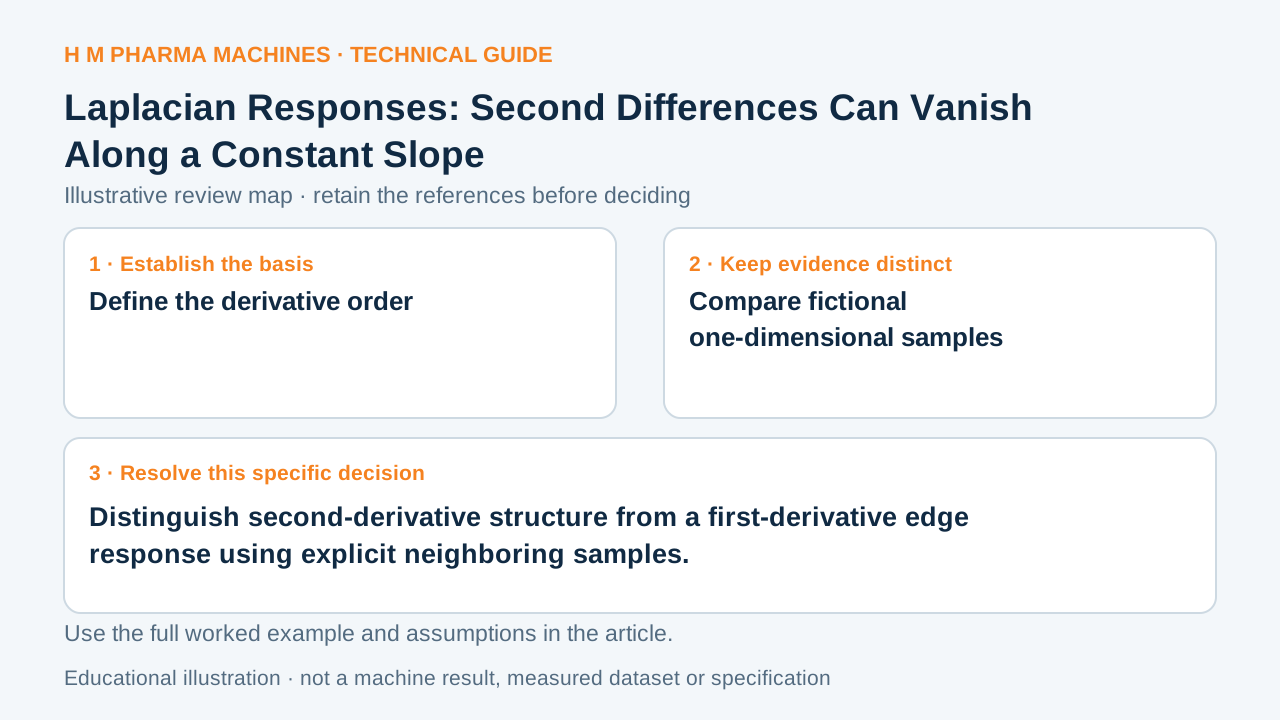
A constant intensity slope can have a nonzero first difference and a zero second difference. The two operators retain different structure.
Define the derivative order
The image Laplacian combines second derivatives along the coordinate directions. A discrete implementation uses a specified approximation and scale. Its response describes changes in slope rather than simply reproducing a first-derivative magnitude, so a zero result does not automatically mean uniform original intensity. Primary reference: OpenCV Laplacian second derivatives.
For an original processing record, retain derivative order, kernel and numerical convention beside the response. Keep first- and second-order quantities in different columns when comparing them. A display of response magnitude can hide the sign or zeros required to understand their different meanings.
Compare fictional one-dimensional samples
Use the defined second-difference expression left − 2 × center + right. For [10,20,30], the result is 10 − 40 + 30 = 0, although successive first differences are both 10. For [10,30,10], the second difference is 10 − 60 + 10 = −40.
The first array has a constant slope; the second has a central peak. This explicitly one-dimensional teaching stencil is not claimed as a software-default two-dimensional kernel output. Both examples use signed floating arithmetic before any display or integer storage conversion.
Review zeros and signs
Prepare an original comparison showing input samples, adjacent differences and their second difference. If a zero response is used as evidence, check whether it came from a flat input or a constant slope. Preserve sign before an absolute-value display if the interpretation needs the direction of curvature.
This guide claims no HM edge-detection performance or acceptance rule. Its reader decision is whether derivative order was retained when the output was interpreted. A second-order numerical response requires its own image context and evaluation before it supports a physical feature conclusion.
Customer Questions
What is the ramp's fictional second difference?
Zero.
Are its first differences also zero?
No. Both are ten.
What is the peak's signed second difference?
Minus forty under the stated stencil.
Primary References
These references support the technical principles discussed in this guide. The worked examples and review questions are educational.
Discuss Your Machine Requirement
Share your product, container, required output and the evidence needed for your technical review.
Request a Technical Review