
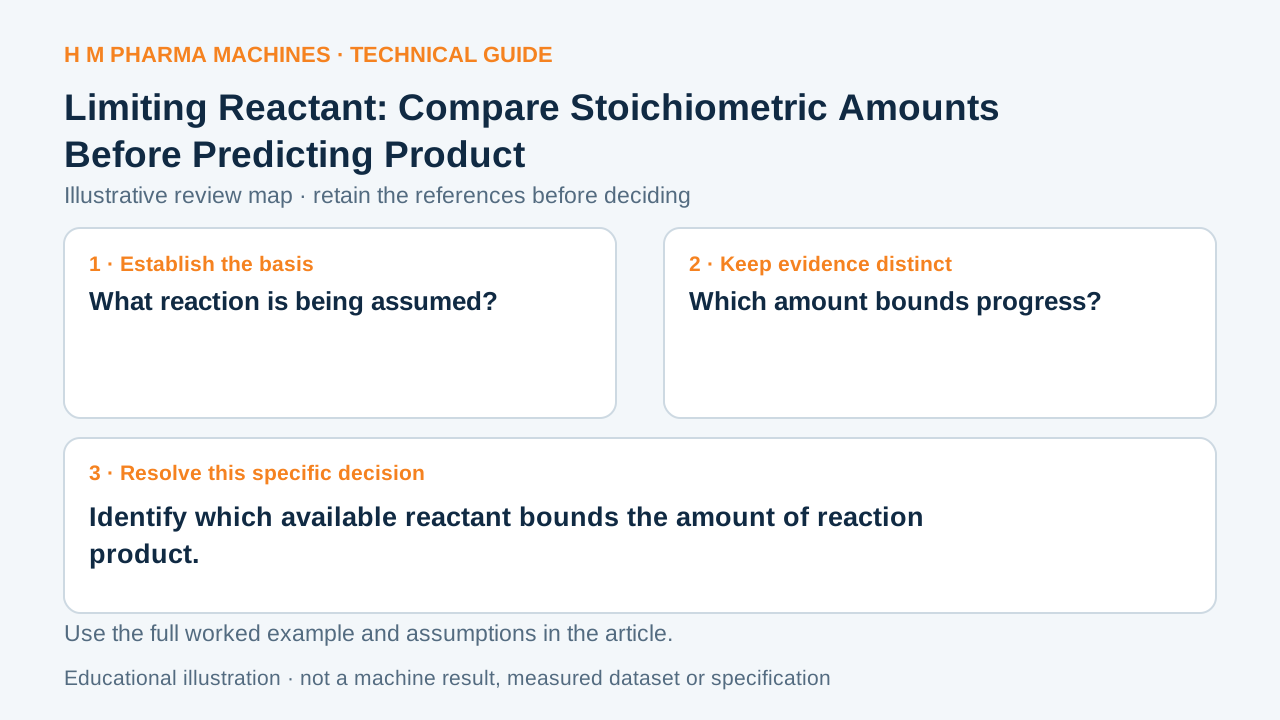
The smallest weighed reactant is not automatically the limiting one. A balanced equation fixes the amount ratio that must be compared before product is predicted.
Use the balanced reaction ratio
A limiting reactant bounds product formation when another reactant is available in excess under the stated reaction model. Comparing amounts requires the balanced stoichiometric coefficients. Equal molar amounts need not represent equal availability for the reaction. Primary reference.
Find the fictional limiting inventory
Use the hypothetical reaction 2A + B → 3P with starting amounts A = 0.80 mol and B = 0.50 mol. A supports 0.80/2 = 0.40 mol of reaction progress, while B supports 0.50/1 = 0.50 mol. A is limiting, and the constructed product bound is 3 × 0.40 = 1.20 mol P.
At that bound, 0.40 mol B would be consumed and 0.10 mol B would remain. Choosing B because its starting amount is numerically smaller would be wrong here. These numbers assume only the written reaction and complete consumption of the limiting inventory.
Keep the product bound separate from observed output
Prepare an original balance with each reactant’s starting amount, coefficient-normalized availability and predicted remainder. Record purity corrections and the actual chemical identities before using weighed masses as molar amounts. A balanced formula should not be substituted for observations of reaction completion.
This teaching calculation does not authorize a reagent charge or predict actual recovery, kinetics or side reactions. Its equipment-review use is to identify whether a trial’s product expectation came from a coherent chemical inventory, rather than from a tank charge mass or an assumed excess alone.
Solution review worksheet
This blank worksheet is for your own project. It contains no H M machine trial result.
| Question | Record to retain |
|---|---|
| What reaction is being assumed? | Balanced equation and identity of A, B and P |
| Which amount bounds progress? | Starting moles divided by consuming coefficient |
| What was actually recovered? | Independent output observation |
Customer Questions
Which fictional reactant is limiting?
A.
What is the ideal product bound?
1.20 mol P.
Does that bound prove actual product recovery?
No. Recovery requires separate evidence.
Primary References
These references support the technical principles discussed in this guide. The worked examples and review questions are educational.
Discuss Your Machine Requirement
Share your product, container, required output and the evidence needed for your technical review.
Request a Technical Review