
Heating a liquid changes its occupied volume. Use a liquid volume-expansion basis before treating an initial fill level as constant.
Define the Thermal Model
For a limited interval with nearly constant volumetric coefficient β, ΔV ≈ βV₀ΔT. OpenStax’s thermal-expansion treatment distinguishes liquid volume expansion from solid linear expansion. The approximation has a property and temperature-range basis; it is not a universal percentage to append to every formulation.
Compare a Hypothetical Case
An invented liquid occupies 80 L and has an assumed β of 0.0007/K over a 50 K rise. Its calculated increase is 2.8 L, producing 82.8 L under the stated free-expansion model. The container can expand too, so liquid growth and available geometric capacity should be recorded separately rather than combining unlike coefficients.
Complete the Engineering Review
Identify the actual liquid property source and interval. List the initial volume, expected temperature envelope and vessel geometry at the relevant condition. Ask how the design accounts for liquid occupancy and thermal effects. Do not use a linear coefficient from a metal table as though it were the liquid’s volume coefficient.
Use the storage-tank page to start the capacity discussion. This example calculates free volume change; it neither sets a permissible fill level nor predicts pressure in a closed system. Confinement requires compressibility and system-design information beyond this approximation.
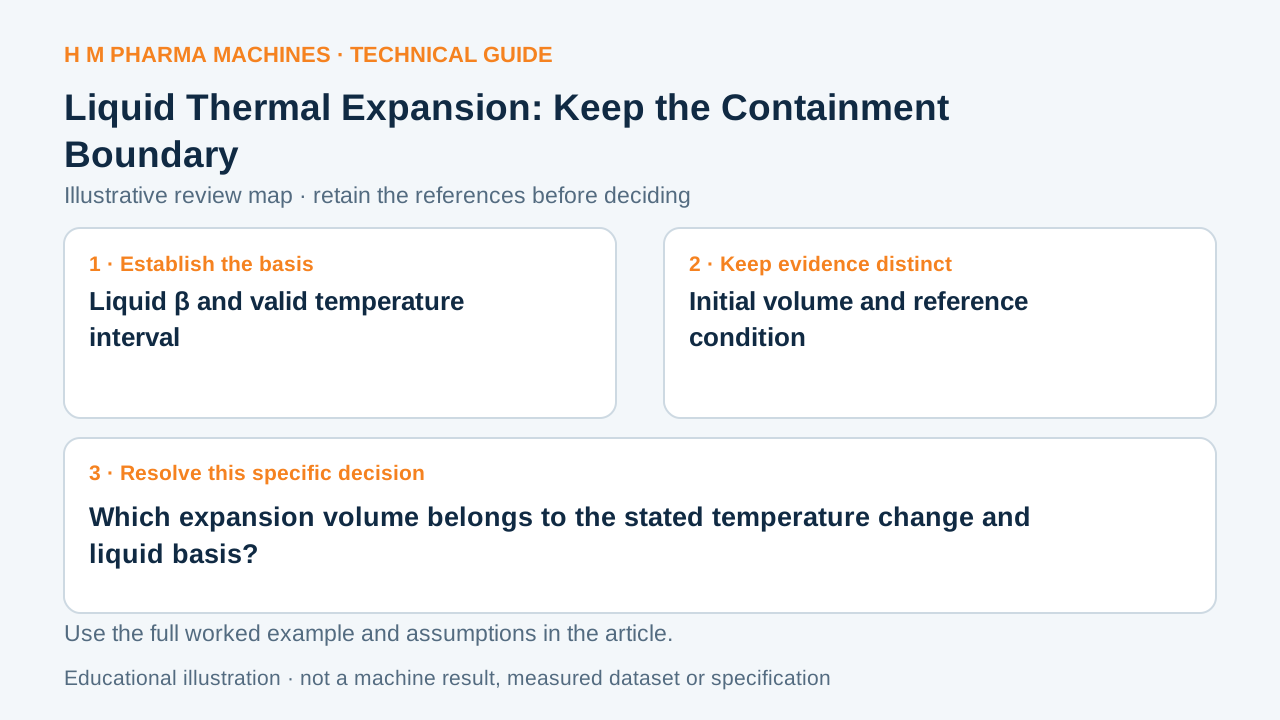
Which expansion volume belongs to the stated temperature change and liquid basis?
This blank worksheet is for your own project. It contains no H M machine trial result.
| Review field | Reference or result | Responsible person |
|---|---|---|
| Liquid β and valid temperature interval | To complete | To complete |
| Initial volume and reference condition | To complete | To complete |
| Predicted liquid occupancy | To complete | To complete |
| Separate vessel and confinement review | To complete | To complete |
Customer Questions
Can a solid linear coefficient replace β?
Not directly for a liquid.
Does this equation predict closed-system pressure?
No. Confinement needs additional information.
Is liquid expansion always linear?
Check the actual property range.
Related Equipment References
Review the actual offered equipment and application separately from this educational example.
Primary References
These references support the technical principles discussed in this guide. The worked examples and review questions are educational.
Discuss Your Machine Requirement
Share your product, container, required output and the evidence needed for your technical review.
Request a Technical Review