
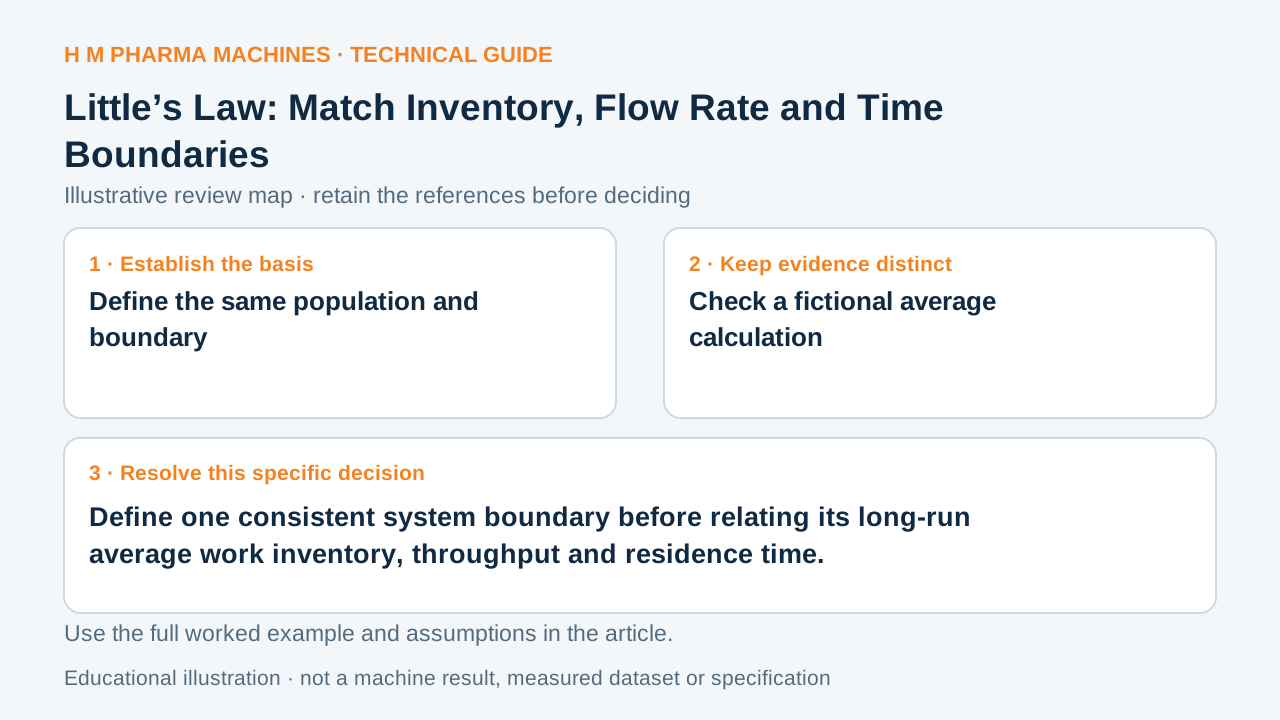
A work-in-progress count and a throughput figure can describe different parts of a line. Define the counted entry and exit before using an average residence-time relation.
Define the same population and boundary
Little’s law relates long-run average number in a system L, average arrival rate λ and average residence time W through L = λW. These quantities must concern the same population and boundary. Counting only a waiting rack while timing jobs through both rack and processing station mixes two different systems. Primary reference: MIT manufacturing systems lecture: Little’s law.
On a proposed worksheet, draw the included boundary and name each admission and removal event. State which waiting, processing and rework states count. A photograph alone does not define that population.
Check a fictional average calculation
Suppose a stable hypothetical flow has an average entry rate of 12 items per minute and an average time inside the chosen box of 2.5 minutes. The corresponding average inventory is 12 × 2.5 = 30 items. This does not say the inventory is exactly 30 at every instant.
If a second report times only processing, its shorter time cannot replace 2.5 minutes while retaining the same whole-system inventory. Keep the time unit visible: converting 2.5 minutes to 150 seconds also requires converting the rate to 0.2 items per second. Their product remains 30.
Review the observation route
Prepare separate fields for the observation window, average inventory method, admitted population and residence-time event pair. A startup run with an initially empty line and a short endpoint can make a finite-window comparison misleading; label such a trial rather than presenting it as a long-run balance.
Before using a mismatch to propose extra equipment, reconcile the boundary and population first. The relation does not identify which station causes waiting or establish a buffer size, processing speed or actual HM machine throughput. Those decisions need their own measured or modeled inputs.
Customer Questions
Is L an instantaneous work count?
No. The relation uses an average population within the declared boundary.
Can waiting-only time be used with total work inventory?
Only if the inventory boundary is also waiting-only; otherwise the quantities do not describe the same system.
Does the relation locate a bottleneck?
No. It relates averages and does not identify a causal station.
Primary References
These references support the technical principles discussed in this guide. The worked examples and review questions are educational.
Discuss Your Machine Requirement
Share your product, container, required output and the evidence needed for your technical review.
Request a Technical Review