
Supporting a shaft radially and fixing it axially are different tasks. The drawing should show where each task is performed.
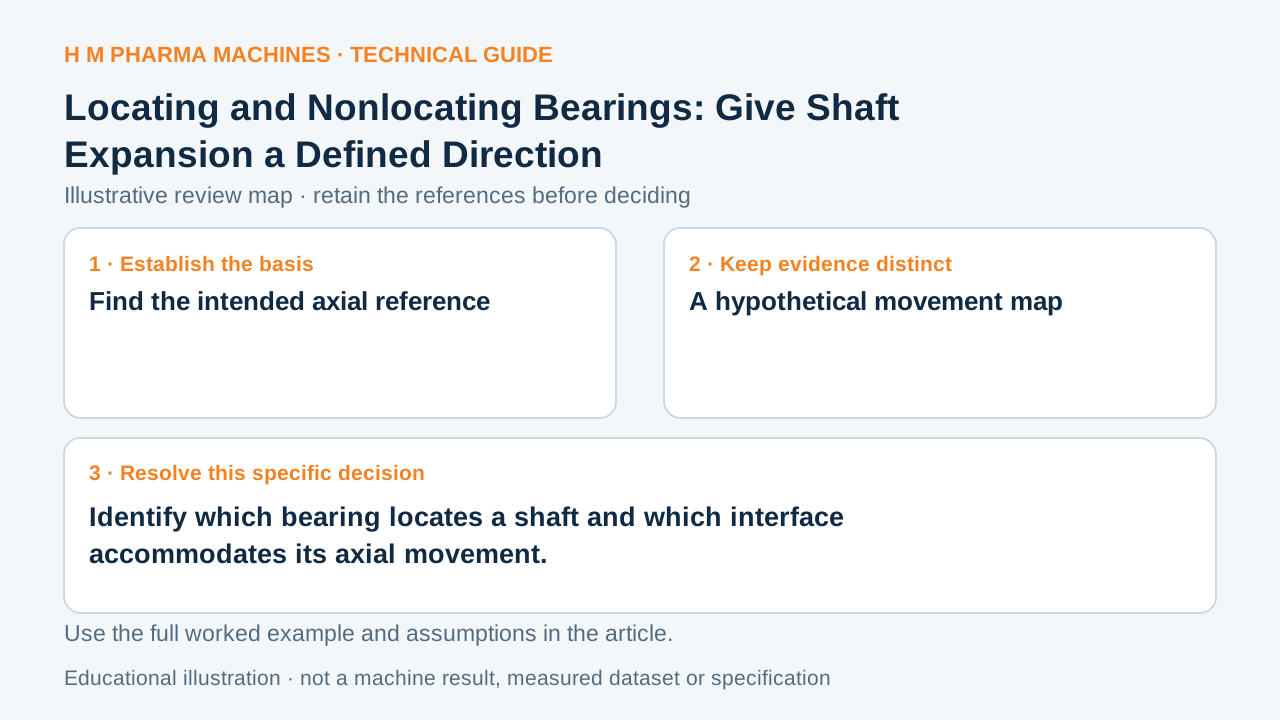
Find the intended axial reference
A locating bearing position establishes a shaft's axial location. A nonlocating position can support radial load while accommodating defined axial displacement. SKF's arrangement example illustrates these separate roles. Its product-specific allowances should not be transferred to another assembly. Primary reference: SKF bearing-unit arrangements.
Mark the locating position, the displacement interface and the available direction on the proposed drawing. A bearing name alone does not show where the shaft can move or which attached component follows that movement.
A hypothetical movement map
Imagine a fictional shaft expected to lengthen by a stated 1 mm relative to its supporting structure under one design case. Arrangement A fixes both end positions but supplies no accommodation explanation. Arrangement B identifies one axial reference and a reviewed displacement path at the other position. The worksheet does not approve B from the sketch alone; it asks for the actual arrangement allowance and the effect on attachments.
Add rows for shaft, housing, coupling, seal and any attached reference. Show which part moves relative to which other part. The 1 mm is an invented teaching input, not a material calculation, installed allowance or HM operating result.
Review the whole movement boundary
Ask whether nearby shoulders, covers or connected parts obstruct the intended path. Also identify where axial process loads are transferred; accommodating expansion does not mean axial loads disappear. Keep these load and movement questions in separate fields.
The accepted project record should name the locating function and the permissible displacement basis. A later replacement should preserve those roles rather than selecting two visually identical units by appearance. This approach produces a clear arrangement question for the designer and avoids assuming that more axial restraint always improves a machine. It also avoids using one manufacturer's unit-specific travel as a universal allowance.
Customer Questions
Does nonlocating mean the bearing provides no support?
No. It can provide radial support while allowing defined axial displacement.
Can I copy an allowance from a different unit catalog?
No. Use the identified arrangement's documented movement basis.
Why include seals and couplings in the sketch?
Their interfaces can be affected by shaft movement or constrain the intended displacement path.
Primary References
These references support the technical principles discussed in this guide. The worked examples and review questions are educational.
Discuss Your Machine Requirement
Share your product, container, required output and the evidence needed for your technical review.
Request a Technical Review