
A single-temperature cooling model first needs evidence that internal temperature gradients are small enough to ignore.
Define the Thermal Model
The lumped thermal model assigns one temperature to the body. COMSOL’s thermal-mass theory uses Bi = hL/k to assess that approximation, with Bi below 0.1 as a common criterion. Under its constant-parameter assumptions, the time constant is C/(hA), where C is the body’s thermal capacitance.
Compare a Hypothetical Case
For an invented solid component, assume h = 10 W/(m²K), relevant L = 0.001 m and k = 1 W/(m·K), giving Bi = 0.01. With C = 1,000 J/K and hA = 10 W/K, the time constant is 100 s. After 200 s, the modeled difference from ambient is e⁻², about 13.5% of its initial difference.
Complete the Engineering Review
Document the characteristic-length definition, material properties and external condition before fitting a single exponential. Ask whether the body has significant spatial gradients or changing boundary conditions. Keep a measured surface response distinct from a proven uniform body temperature. A convenient curve shape does not establish the approximation by itself.
The manufacturing-vessel context can involve components requiring thermal review, but this example is a solid-body model. It does not assume an unstirred product batch is uniform or specify a process holding time. A different physical system needs its own justified spatial model.
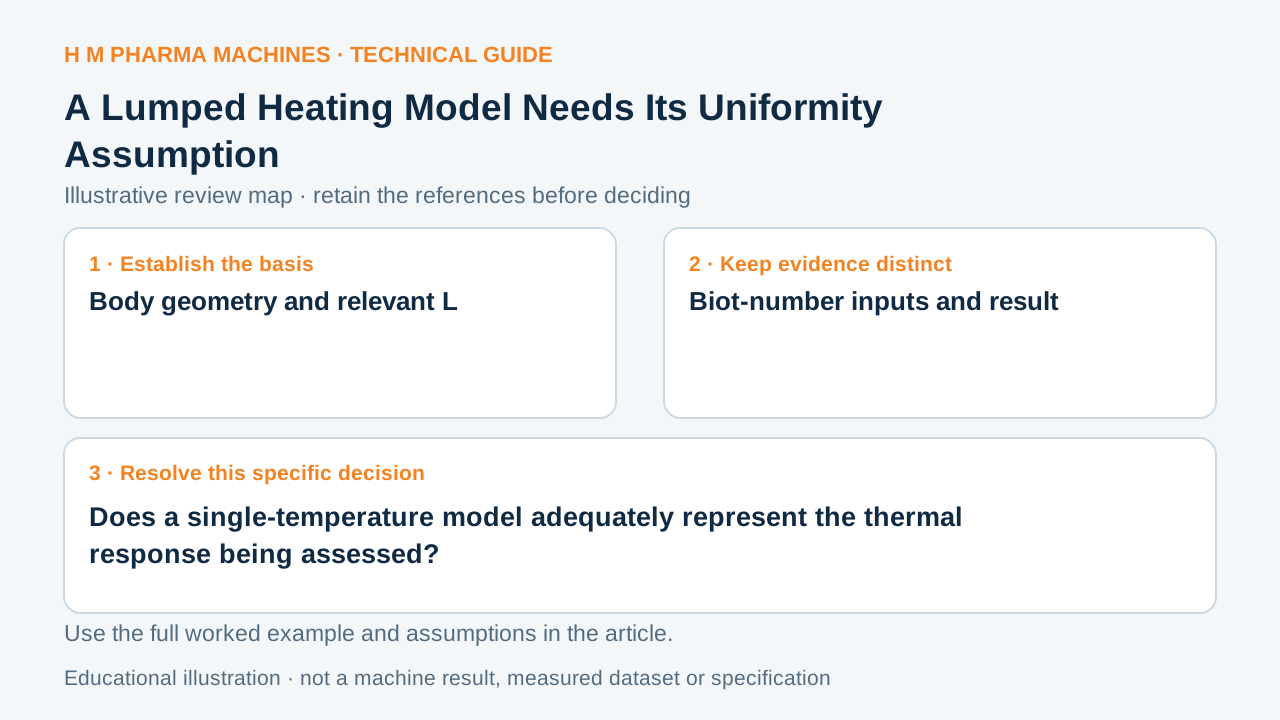
Does a single-temperature model adequately represent the thermal response being assessed?
This blank worksheet is for your own project. It contains no H M machine trial result.
| Review field | Reference or result | Responsible person |
|---|---|---|
| Body geometry and relevant L | To complete | To complete |
| Biot-number inputs and result | To complete | To complete |
| C and hA time-constant basis | To complete | To complete |
| Evidence supporting internal uniformity | To complete | To complete |
Customer Questions
Does one measured temperature prove uniformity?
It does not establish every internal location.
Is the time constant the time to reach ambient?
The ideal difference decays exponentially.
Can an unstirred tank use this automatically?
Its spatial behavior requires separate justification.
Related Equipment References
Review the actual offered equipment and application separately from this educational example.
Primary References
These references support the technical principles discussed in this guide. The worked examples and review questions are educational.
Discuss Your Machine Requirement
Share your product, container, required output and the evidence needed for your technical review.
Request a Technical Review