
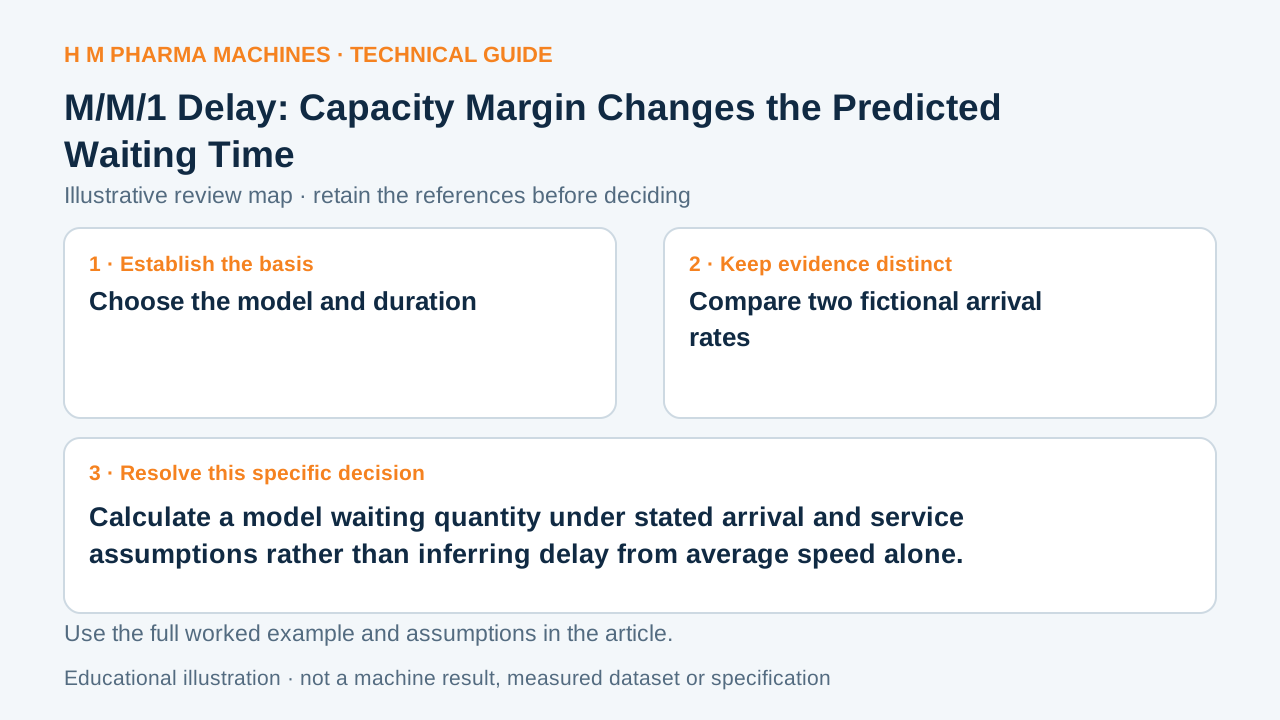
Changing a capacity margin changes a queue model’s delay nonlinearly. Keep queue waiting and total residence separate when comparing its calculations.
Choose the model and duration
For a stationary M/M/1 queue with Poisson arrivals, independent exponential service times, one server, first-come service and an infinite buffer, λ < μ. Average total residence is W = 1/(μ − λ). Subtracting mean service 1/μ gives average queue waiting Wq = λ/[μ(μ − λ)]. Primary reference: MIT time variability in manufacturing systems lecture.
These are model averages rather than deadlines for individual jobs. On a proposed comparison sheet, label the time quantity beside each formula and state the rates’ units. A minute-based rate returns minutes; a numerical result cannot be compared with seconds without conversion.
Compare two fictional arrival rates
Take a hypothetical service rate of 5 jobs per minute. With arrivals at 3 jobs per minute, W = 1/(5 − 3) = 0.5 minute. Mean service is 0.2 minute, leaving Wq = 0.3 minute. This separates the modeled delay from the processing interval.
At arrivals of 4 jobs per minute with the same service setting, W becomes 1 minute and Wq becomes 0.8 minute. Service remains 0.2 minute. The smaller capacity margin increases modeled waiting; it does not mean the machine’s per-job service has become slower in this constructed example.
Review applicability before interpreting a result
For an original model trial, tabulate λ, μ, the rate margin, W and Wq for each scenario. Keep the arrival and service assumptions identical if the comparison is intended to isolate the margin. Replacing random service with fixed service would change the model rather than merely its rate.
A real finite-buffer or scheduled production process may not satisfy these conditions. Document its arrival pattern, blocking behavior and service-duration basis before adopting this calculation. No number here promises an HM lead time, customer delivery time or approved operating utilization.
Customer Questions
Which formula includes processing time?
W = 1/(μ − λ) is total residence in the stated model.
What is waiting when λ = 3 and μ = 5 per minute?
The model gives 0.3 minute of average queue waiting.
Can this formula be applied to every production line?
No. Its arrival, service, server and storage assumptions must fit the intended model.
Primary References
These references support the technical principles discussed in this guide. The worked examples and review questions are educational.
Discuss Your Machine Requirement
Share your product, container, required output and the evidence needed for your technical review.
Request a Technical Review