
In This Guide
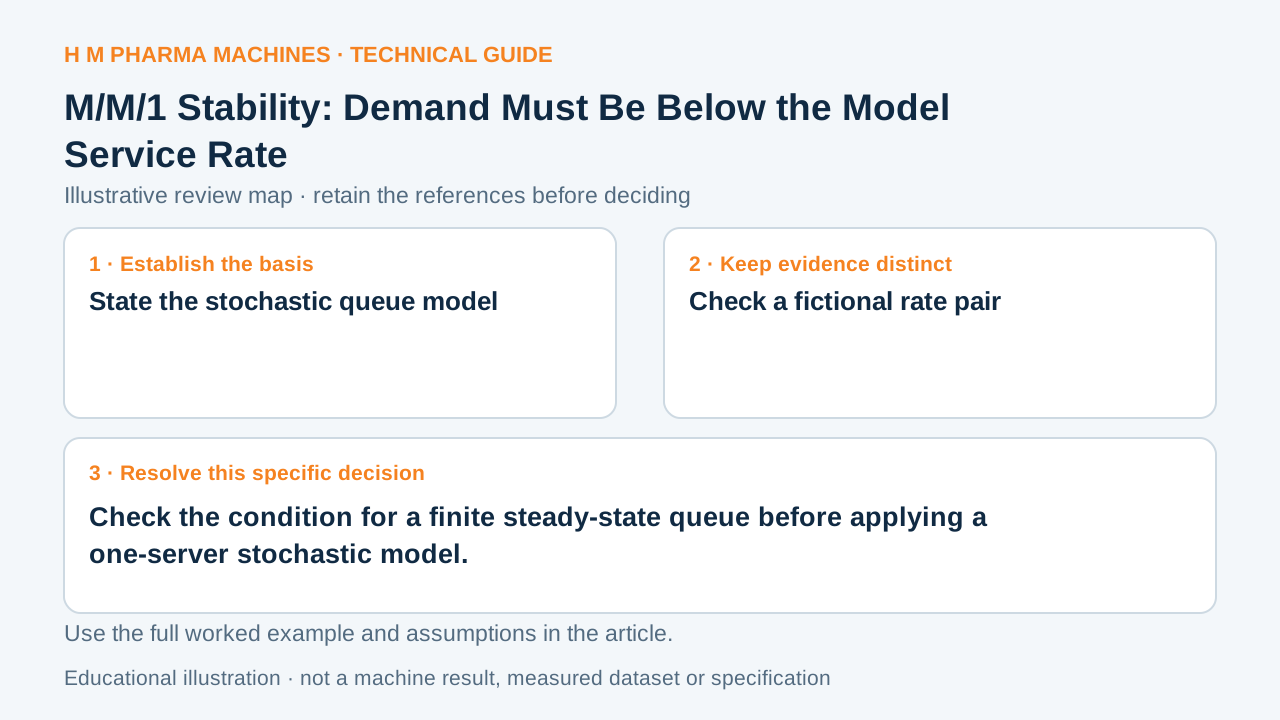
A queue formula needs a model that admits the reported long-run state. A service-rate number alone does not establish that the M/M/1 assumptions hold.
State the stochastic queue model
The standard M/M/1 model has Poisson arrivals, independent exponentially distributed service times, one server and an unbounded waiting area. Its finite stationary distribution requires arrival rate λ to be strictly below service rate μ. The ratio ρ = λ/μ is therefore below one for that result. Primary reference: MIT M/M/1 queue note.
List alternative mechanisms before selecting the formula: rejected jobs, finite-buffer blocking, fixed service or scheduled arrivals. Similar average rates do not make these alternatives the same stochastic queue model.
Check a fictional rate pair
For a hypothetical arrival rate of 4 jobs per minute and service rate of 5 jobs per minute, ρ = 4/5 = 0.8. The rate condition is satisfied, but the other stochastic assumptions still need justification. This arithmetic does not by itself establish measured waiting or real capacity.
If arrival rate becomes 5 with the same μ, ρ = 1 and the standard infinite-buffer stochastic model has no finite stationary queue distribution. This is not a universal statement about every deterministic line operating at equal average rates. A perfectly timed deterministic example has different assumptions.
Keep finite trials separate from stationarity
A short simulated run can finish with a small queue even when its selected rates do not meet the stationary condition. On the proposed review sheet, retain the initial queue, observation duration, rate units and model type. A finite endpoint is not a proof of an eligible long-run formula.
When the assumptions fail, revise the modeled arrival, service or storage mechanism before discussing a stationary estimate. The guide does not prescribe a production safety margin or an HM throughput target. It checks whether a specific mathematical result is being used within its stated conditions.
Customer Questions
Is λ = μ sufficient for the standard finite stationary result?
No. The infinite-buffer M/M/1 result requires λ < μ.
Does ρ = 0.8 prove the whole model is valid?
No. It checks the rate ratio, while arrival, service and storage assumptions remain separate.
Does a small queue at a short run endpoint prove stability?
No. A finite observation can conceal longer-run behavior.
Primary References
These references support the technical principles discussed in this guide. The worked examples and review questions are educational.
Discuss Your Machine Requirement
Share your product, container, required output and the evidence needed for your technical review.
Request a Technical Review