
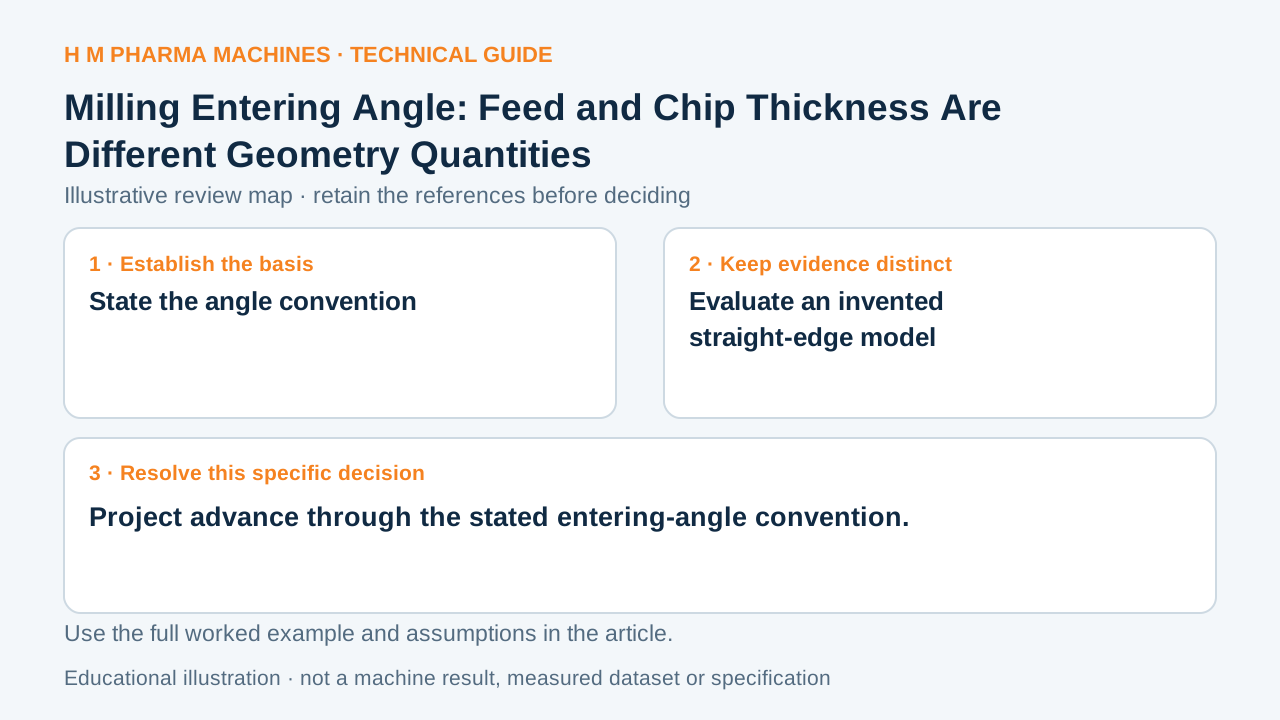
Entering geometry changes the ideal chip-thickness comparison.
State the angle convention
Sandvik relates chip thickness and nominal feed through the sine of the entering angle in its specified geometry. Preserve that angle definition. Primary reference: Sandvik technical reference.
Evaluate an invented straight-edge model
For a fictional fully engaged straight-edge model, take nominal advance f=0.12 mm and write h=f·sin κ. At κ=90°, h is 0.12 mm. At κ=30°, it is 0.060 mm. These results compare two explicitly assigned angles, not two recommended cutters.
Holding an illustrative h=0.12 mm at 30° would algebraically require f=0.24 mm. That is a geometric inversion, not authorization to double a real feed. Radial engagement, curved inserts and actual force limits can make this simplified model insufficient for the operation.
Keep geometry separate from process approval
Draw the angle relative to the feed direction and record whether it changes along the engaged edge. Preserve the tool geometry and the definition of the chip-thickness value being compared.
Ask whether the quoted relation applies to the actual engagement before using it to normalize two proposals. A thinner geometric chip does not establish a lower total load or a permissible feed increase. The worksheet identifies the conversion that the geometry implies and the evidence still required to evaluate the resulting machining condition.
Customer Questions
What is thickness at thirty degrees?
0.060 mm.
Does inversion approve feed?
It is only model arithmetic.
Why retain the angle convention?
A complementary angle gives a different trigonometric input.
Primary References
These references support the technical principles discussed in this guide. The worked examples and review questions are educational.
Discuss Your Machine Requirement
Share your product, container, required output and the evidence needed for your technical review.
Request a Technical Review