
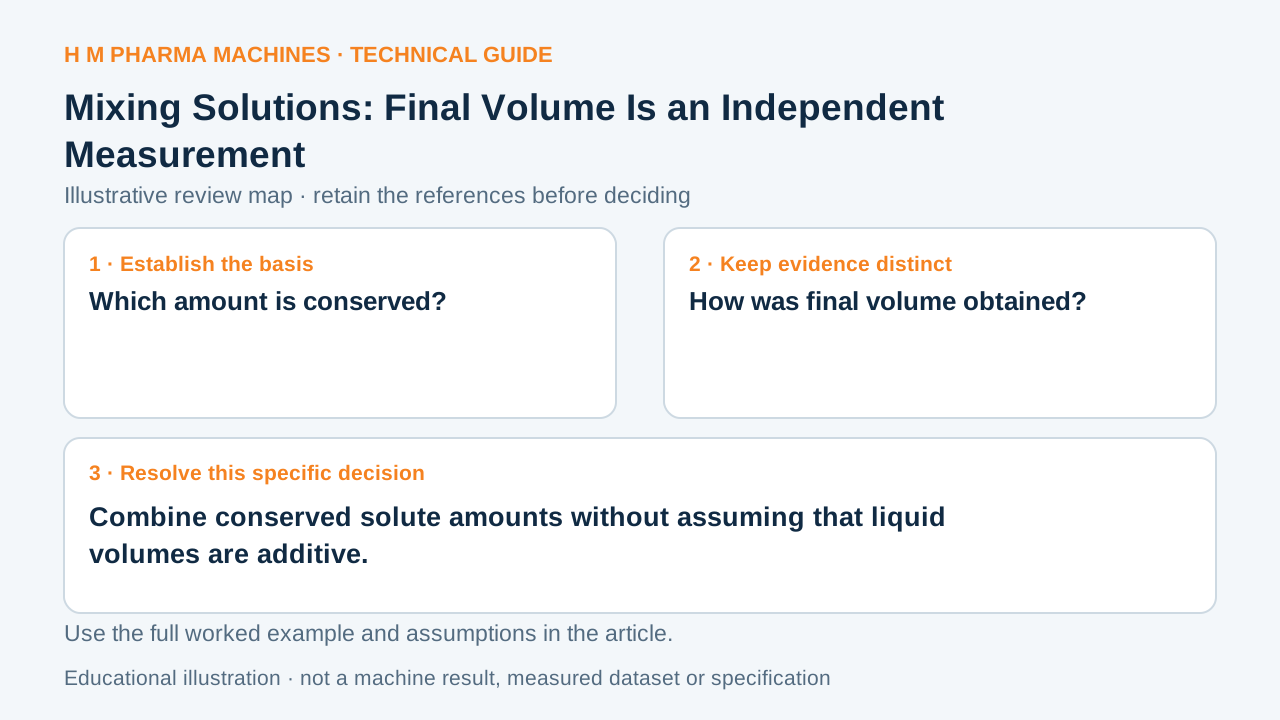
Combining two liquid charges conserves specified solute amounts under a nonreacting model. It does not establish the final mixture volume from the charge volumes alone.
Separate material balance from volume information
A partial molar quantity describes how an extensive property changes when a component amount is added under stated conditions. Volume contribution in a mixture is consequently a composition-dependent question. A concentration balance should retain the final mixture volume instead of silently imposing volume additivity. Primary reference.
Use a fictional measured final volume
Combine hypothetical nonreacting charges of 100 mL at 1.00 mol/L and 100 mL at 2.00 mol/L of the same solute. They carry 0.100 and 0.200 mol, totaling 0.300 mol. If the constructed final volume is expressly measured as 195 mL, its amount concentration is 0.300/0.195 ≈ 1.538 mol/L.
Assuming 200 mL would instead give 1.500 mol/L. Neither arithmetic result establishes a real liquid’s volume change; 195 mL is an invented measurement input. Reaction, phase separation or loss would require revisiting the conserved-solute premise as well.
Preserve the mixture state
Prepare an original charge-and-result sheet with the two incoming solute amounts and the final volume in separate columns. Retain the mixture temperature and measurement basis. If only charged volumes are known, label the additive-volume result as an explicit model rather than a measured final concentration.
For equipment trials, preserve actual composition and handling measurements together. This illustration is not a validated blending instruction or an HM vessel capacity claim. Its decision is whether the material-balance calculation has acquired a volume assumption that the available evidence does not support.
Solution review worksheet
This blank worksheet is for your own project. It contains no H M machine trial result.
| Question | Record to retain |
|---|---|
| Which amount is conserved? | Named unreacted solute and charge records |
| How was final volume obtained? | Measured value or explicit model |
| What state accompanies the volume? | Temperature, phase and observation record |
Customer Questions
What solute amount is combined in the example?
0.300 mol.
What result follows from the invented 195 mL volume?
Approximately 1.538 mol/L.
Does the example prove an actual mixing contraction?
No. Its final volume is expressly hypothetical.
Primary References
These references support the technical principles discussed in this guide. The worked examples and review questions are educational.
Discuss Your Machine Requirement
Share your product, container, required output and the evidence needed for your technical review.
Request a Technical Review