
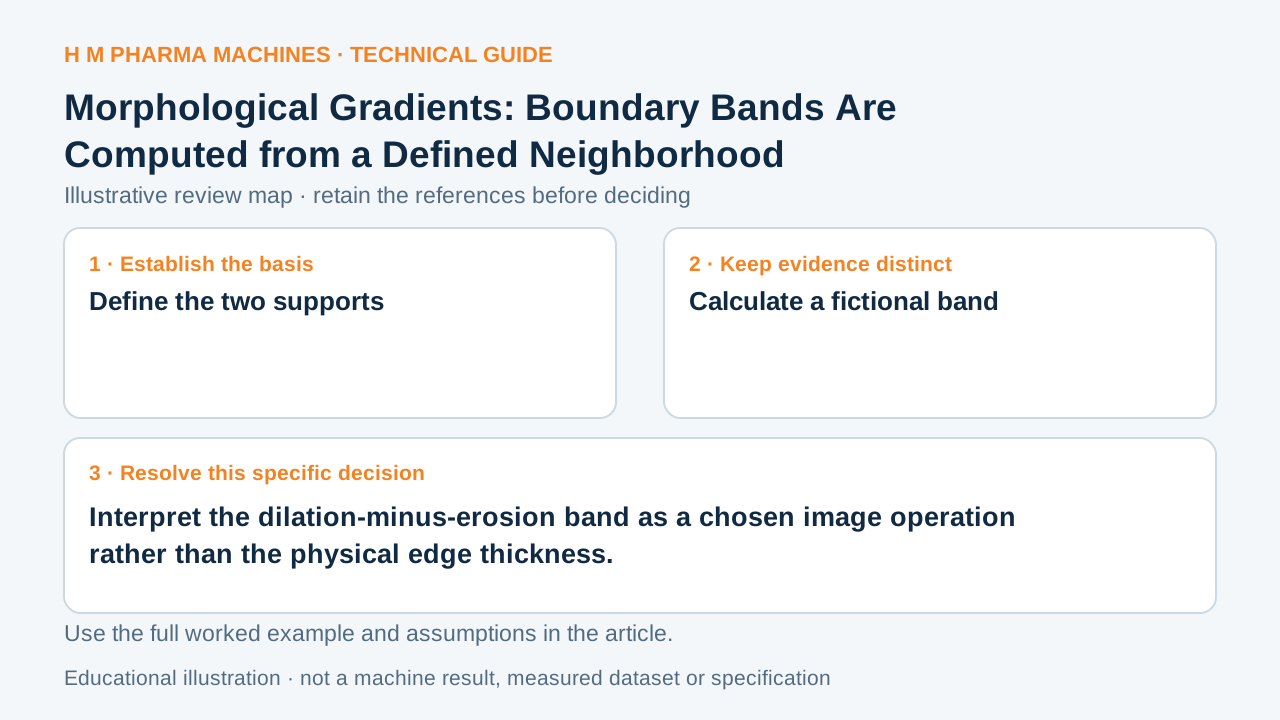
A morphological gradient is a neighborhood-derived band. Its support can change when the structuring element changes.
Define the two supports
A morphological gradient subtracts an eroded image from its dilated image. For a binary mask and a specified flat neighborhood, the result marks positions reached by the dilation but absent from the erosion. The neighborhood shape therefore helps determine the apparent band around foreground support. Primary reference: OpenCV morphological gradient definition.
For an original worksheet, retain the input mask, element and both intermediate results. State whether the displayed band uses binary support or grayscale value differences. A band visualization does not itself provide spatial calibration or identify a physical material layer.
Calculate a fictional band
Take [0,0,1,1,1,0,0] with centered horizontal offsets −1,0,+1. In the explicitly defined zero-background illustration, dilation gives [0,1,1,1,1,1,0], while erosion gives [0,0,0,1,0,0,0]. Their pointwise difference is [0,1,1,0,1,1,0].
Four positions belong to the computed band, split across the two ends of the run. That count is not a four-pixel physical coating thickness. It follows a selected discrete neighborhood and includes positions on both sides of the original support boundary.
Keep the interpretation bounded
Make an original side-by-side plot of dilation, erosion and difference, with the original foreground positions marked. If another element is evaluated, retain it as another operation rather than treating any changed band width as a measured change in the object. Track the actual coordinate unit separately.
This guide prescribes no HM edge-measurement setting or acceptable boundary width. Its purpose is to distinguish an image-operation band from a physical dimension. A later dimensional inference needs a defined edge convention, geometry and relevant calibration evidence beyond this mask calculation.
Customer Questions
What is subtracted for the gradient?
The erosion result from the dilation result.
How many fictional band positions are foreground?
Four under the stated horizontal neighborhood.
Is the band a physical thickness measurement?
No. It is a defined computational support.
Primary References
These references support the technical principles discussed in this guide. The worked examples and review questions are educational.
Discuss Your Machine Requirement
Share your product, container, required output and the evidence needed for your technical review.
Request a Technical Review