
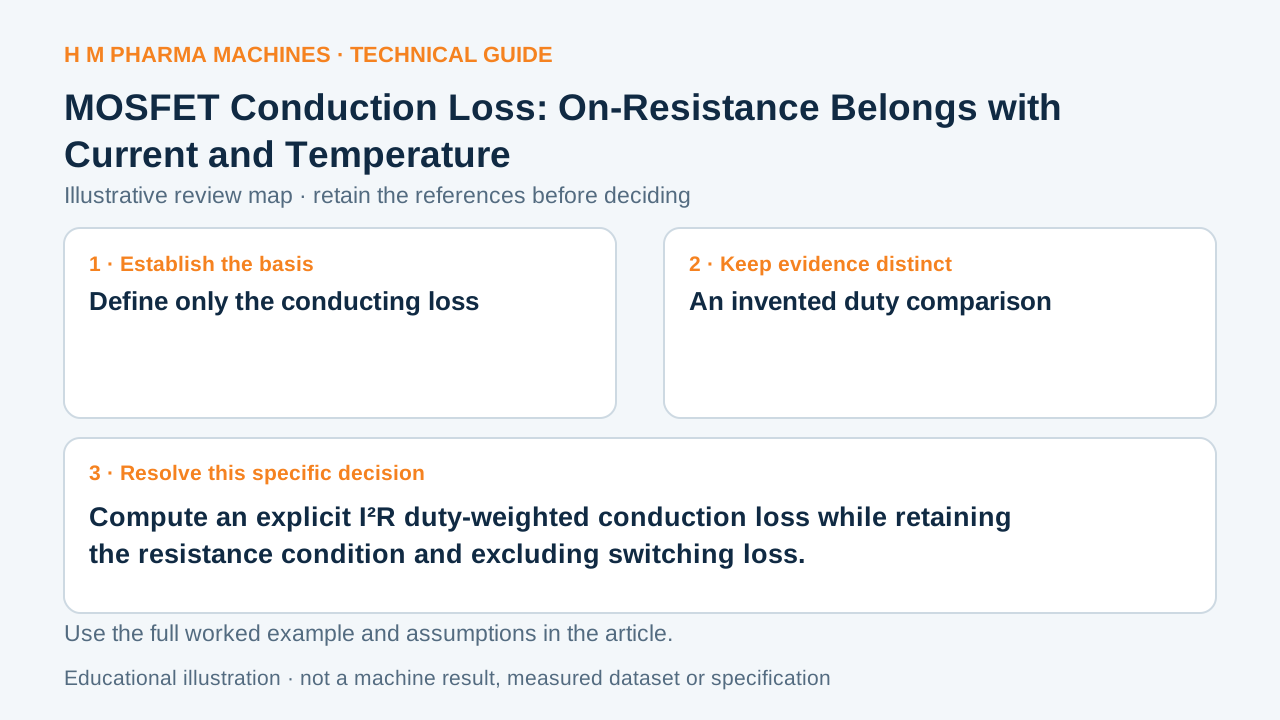
Retain resistance condition and current waveform when estimating MOSFET conduction loss.
Define only the conducting loss
TI expresses MOSFET conduction loss through RMS current squared times on-resistance and identifies gate-drive and temperature dependence of that resistance. Primary reference: conduction loss.
A resistance figure should retain the condition at which it applies. Do not pair a convenient resistance at one temperature and gate voltage with an unrelated operating current while hiding the mismatch. Switching transitions and driver losses belong to separate terms.
An invented duty comparison
Assume a hypothetical MOSFET carries 5 A during 40% of each modeled interval and zero otherwise. With fixed R =0.020 Ω, average conduction loss is 5²×0.020×0.40 =0.20 W. Its full-interval RMS current is 5√0.40, approximately 3.162 A, giving the same I²R result.
If the applicable resistance doubles to 0.040 Ω while that waveform is held unchanged, the loss becomes 0.40 W. These teaching conditions provide no actual part-temperature curve or allowed operating point. They identify why the resistance basis belongs beside the current calculation.
Build separate loss terms
Record conducting waveform, resistance condition, interval definition and calculated contribution. List switching and gate-driver energy separately instead of describing this term as complete device dissipation.
Request the actual component evidence used for the offered conditions and the relevant thermal assessment. A reviewer can then follow how a claimed loss was calculated without treating a nominal low-resistance label as a complete efficiency result.
Customer Questions
Does average current squared always give this loss?
Use RMS current or the equivalent waveform integral.
Is on-resistance condition-independent?
Retain its actual gate-drive and temperature basis.
Is this total inverter loss?
It covers the specified conducting contribution only.
Primary References
These references support the technical principles discussed in this guide. The worked examples and review questions are educational.
Discuss Your Machine Requirement
Share your product, container, required output and the evidence needed for your technical review.
Request a Technical Review