
In This Guide
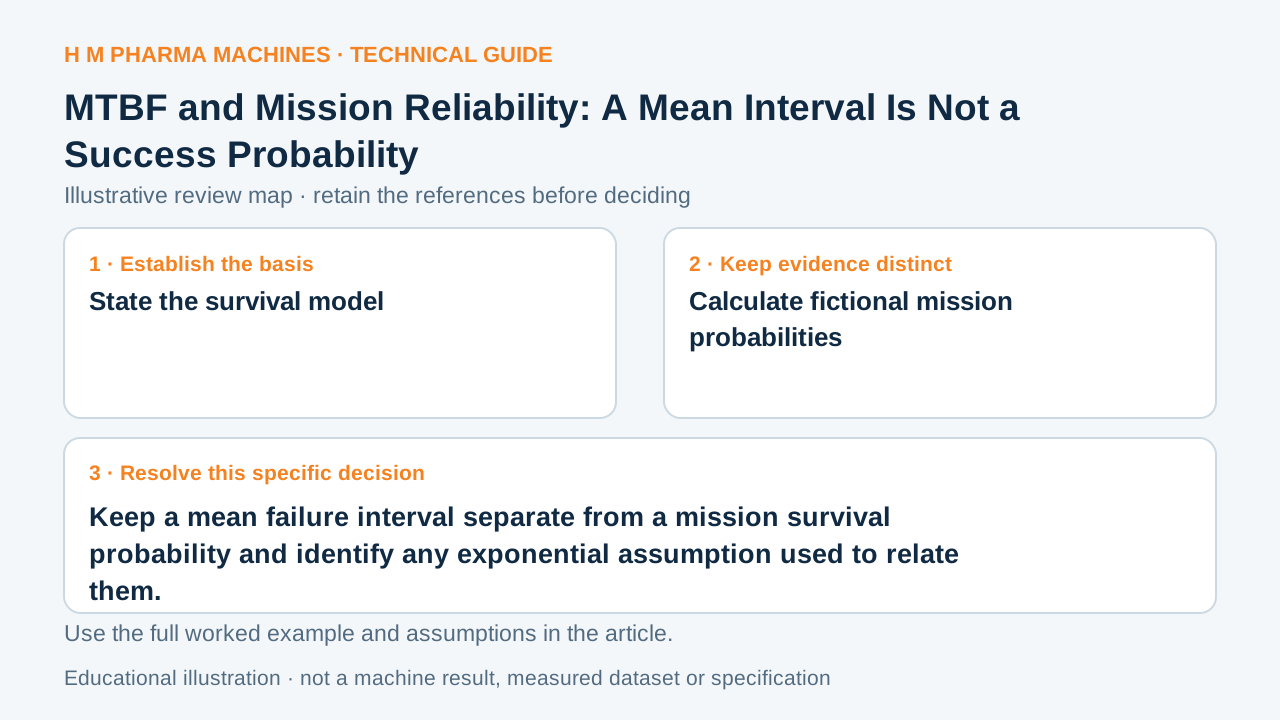
A mean interval is measured in time; mission reliability is a probability for a specified duration. Relating them requires a failure model, not a unit conversion alone.
State the survival model
For an exponential time-to-failure model with constant failure rate λ, survival for duration t is R(t) = exp(−λt) and the mean life is 1/λ. Using a mean interval m in that model gives R(t) = exp(−t/m). The exponential assumption is essential; a mean alone does not determine a survival curve. Primary reference: NIST exponential life model: mean and reliability function.
Define a failure-free mission and starting condition. A repairable-system mean needs a justified constant-rate model before use here. Steady-state availability answers a different question from no-failure survival.
Calculate fictional mission probabilities
Take a hypothetical modeled mean of 100 hours. A 10-hour failure-free mission gives exp(−10/100) ≈ 0.9048, or 90.48% survival under the stated model. A 100-hour mission gives exp(−1) ≈ 0.3679, or 36.79%, rather than a certainty of lasting to the mean.
These numbers are original calculations, not measured HM reliability. They describe the probability of no modeled failure across the specified duration. They do not include the possibility of failing, being repaired and operating again at the mission endpoint.
Review what supports the probability
Prepare fields for the mean’s origin, applicable population, failure definition, mission duration and evidence supporting constant hazard. Retain the time unit: a mean in hours must accompany a mission duration in hours or a documented conversion. Do not present a generic catalog mean as a product-specific probability.
If aging, changing conditions or another failure distribution is relevant, revisit the survival model rather than retaining this formula for convenience. The guide does not estimate an actual warranty, safe operating duration or failure-free guarantee. It checks the assumptions linking a time average to a mission probability.
Customer Questions
Is the mean interval a success probability?
No. It has time units; survival needs a duration and failure model.
Is survival at the exponential mean equal to one?
No. It is exp(−1), about 36.79%, in that model.
Does mission survival include repair after a failure?
No. The stated mission quantity is failure-free survival.
Primary References
These references support the technical principles discussed in this guide. The worked examples and review questions are educational.
Discuss Your Machine Requirement
Share your product, container, required output and the evidence needed for your technical review.
Request a Technical Review