
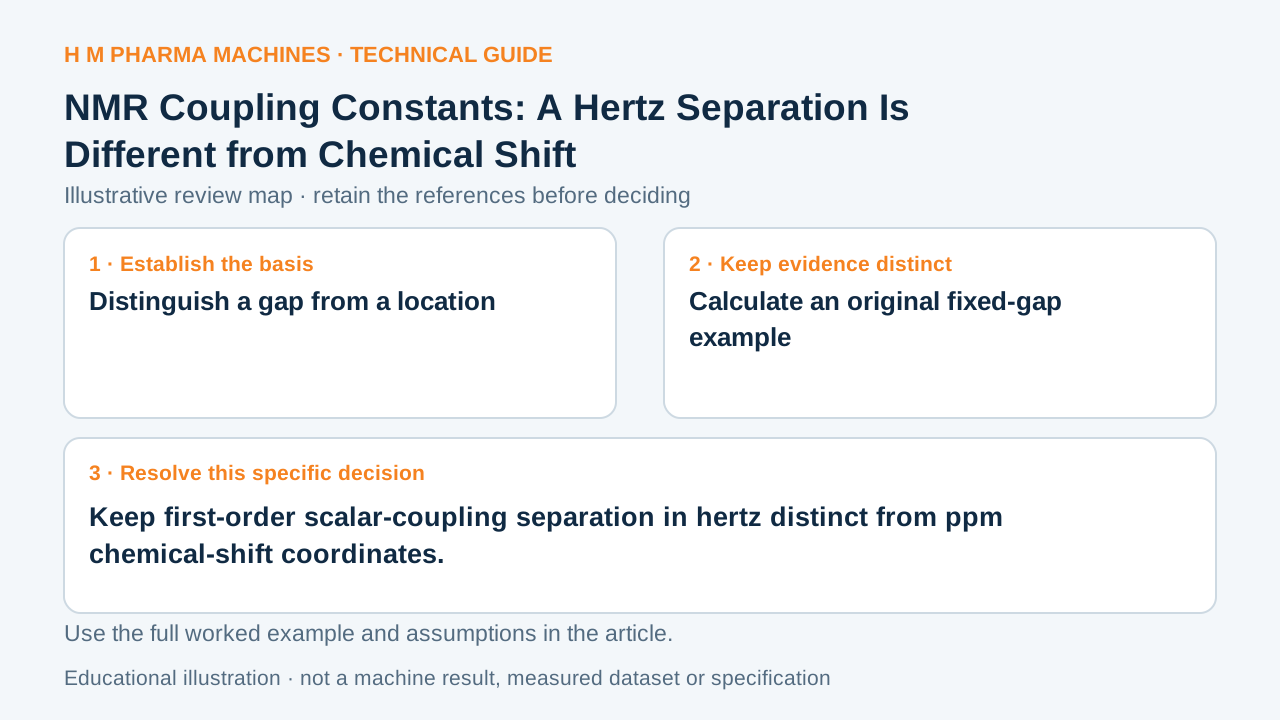
A first-order coupling-gap example concerns separation within a multiplet, not its position relative to a reference.
Distinguish a gap from a location
A coupling constant can be measured as a frequency separation between appropriate peaks in a proton spectrum and reported in hertz. The peak pairing and interpretation matter. A chemical-shift location relative to a reference answers a different question from the gap attributed to coupling. Primary reference: JEOL: measuring coupling constants.
This guide uses a stipulated first-order pair with a fixed 10 Hz gap for its unit exercise. It does not assume that every observed neighboring peak pair directly measures a coupling constant; overlap and more complicated spectral behavior can require other analysis.
Calculate an original fixed-gap example
At a 400 MHz frequency basis, the fictional 10 Hz separation corresponds to 10/400 = 0.025 ppm. At 600 MHz it corresponds to approximately 0.016667 ppm. The model explicitly retains the 10 Hz gap while changing the coordinate scale used to display it.
Moving both toy peaks together by 1 ppm relative to their reference leaves their mutual hertz separation unchanged at a fixed frequency basis. This operation isolates pair separation from multiplet location. It is a numerical illustration, not a prediction of how a real molecule responds to solvent, temperature or field conditions.
Identify the pair before measuring it
Give each selected peak an identity, position, frequency basis and the evidence that the proposed separation is the relevant coupling measurement. Calculate the pair difference rather than substituting the distance of either peak from the reference. Keep hertz and ppm fields labeled separately.
For a real assignment, inspect the spectrum and applicability of the first-order interpretation or another supported analysis. The worksheet offers no universal peak-picking rule. Its purpose is to avoid confusing a measured gap with chemical-shift position or changing the meaning of J when only the display coordinate is converted.
Customer Questions
What remains fixed in the toy pair?
Its stipulated 10 Hz gap.
Does shifting both peaks change their gap?
Their mutual separation stays unchanged in the model.
Can every neighboring gap be called J?
The peak assignment and interpretation matter.
Primary References
These references support the technical principles discussed in this guide. The worked examples and review questions are educational.
Discuss Your Machine Requirement
Share your product, container, required output and the evidence needed for your technical review.
Request a Technical Review