
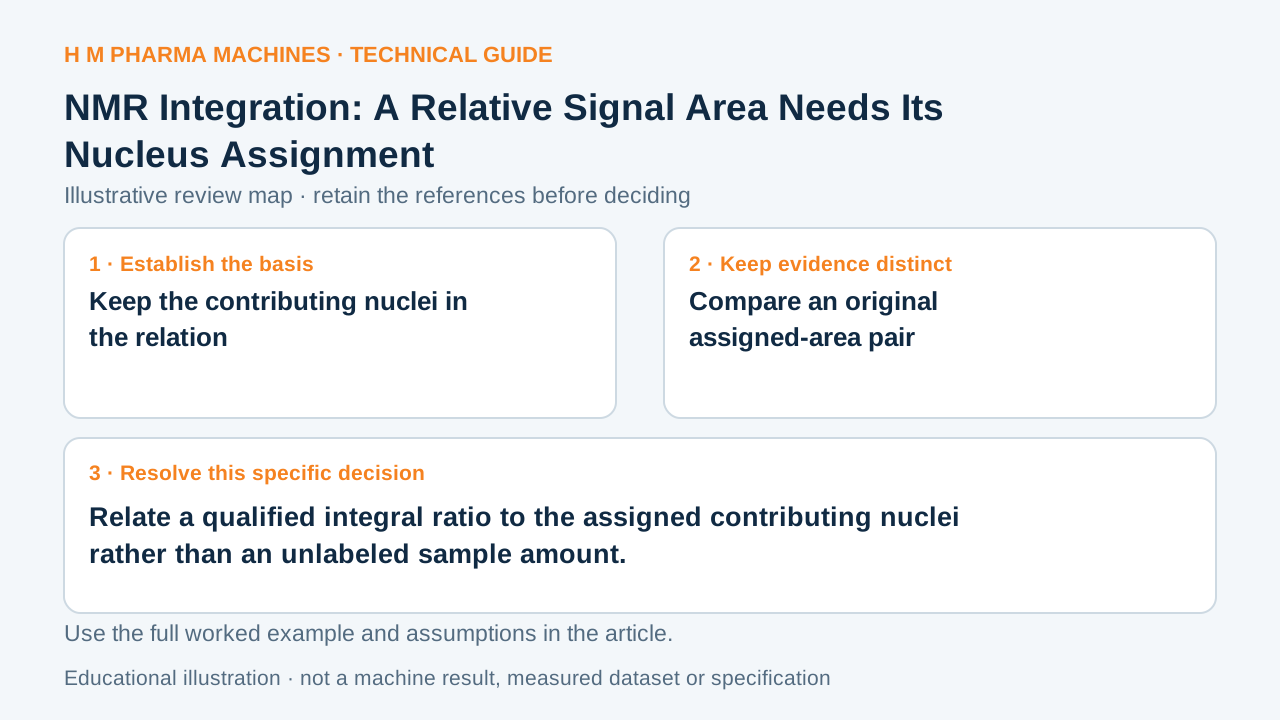
An integral includes the nuclei contributing to that signal, so an area ratio is not automatically a molecule ratio.
Keep the contributing nuclei in the relation
Under appropriate quantitative NMR conditions, a proton signal area can be related to molar concentration and the number of protons contributing to that signal. The assignment of those nuclei is therefore part of an area-based comparison. An unqualified area ratio can confuse proton counts with relative molecular amounts. Primary reference: JEOL: quantitative NMR signal-area principle.
A real calculation also needs evidence that acquisition, processing and signal selection support a quantitative relation. Integration is not automatically quantitative because a software tool draws an area. Overlap and unsuitable measurement conditions cannot be removed merely by dividing by a nucleus count.
Compare an original assigned-area pair
For a fictional fully quantitative exercise, signal X has area 40 and represents two protons per X molecule. Signal Y has area 30 and represents three protons per Y molecule. Normalized areas are 40/2 = 20 and 30/3 = 10, giving an X-to-Y molar amount ratio of 2 under the stipulated common response conditions.
The raw area ratio is 4/3, not 2. The difference comes from the assigned contributing nuclei. No chemical shifts, structures, standards or real sample concentrations are proposed, and the example does not demonstrate that any actual acquisition is fully quantitative.
Document the integration basis
Make fields for signal boundaries, assigned species, contributing proton count, integrated area, quantitative-condition evidence and normalized result. Preserve the spectrum and processing settings so another reviewer can inspect the chosen signal rather than trusting its name alone.
If a nucleus count or quantitative basis is unsupported, report the area observation separately from an inferred amount. An absolute concentration or purity calculation would require additional applicable evidence. This guide addresses the relative area-to-nuclei distinction and supplies no validated qNMR assay, sample acceptance level or HM instrument capability.
Customer Questions
What is the fictional raw area ratio?
It is 40/30, or 4/3.
What is its normalized amount ratio?
It is 2 under the stated assumptions.
Does a software integral prove quantitative conditions?
Those conditions require separate evidence.
Primary References
These references support the technical principles discussed in this guide. The worked examples and review questions are educational.
Discuss Your Machine Requirement
Share your product, container, required output and the evidence needed for your technical review.
Request a Technical Review