
A wall material’s conductivity and an exchanger’s overall coefficient describe different parts of the thermal problem.
Define the Thermal Model
Thermal conductivity k has units W/(m·K); overall U has units W/(m²·K). Spirax Sarco’s heat-transfer reference includes wall and fluid-side resistances in U. A highly conductive wall does not eliminate fluid films or deposits. Keep the material property and the assembled thermal performance in separate worksheet columns.
Compare a Hypothetical Case
Take a hypothetical 2 mm wall with k = 15 W/(m·K). Its area-based resistance is 0.002/15 = 0.000133 m²K/W. If two assumed fluid-film resistances total 0.005 m²K/W, U is about 195 W/(m²K). Doubling wall conductivity raises U only to about 197. The assumed film terms dominate this comparison.
Complete the Engineering Review
Ask what temperatures, fluids, geometry and circulation conditions support the quoted U. Check whether it represents a clean calculation, a design allowance or observed performance. When comparing two material options, calculate the wall’s share of total resistance before attributing a large throughput improvement to conductivity alone.
For a processing-tank project, request the selected construction and thermal calculation. The example provides no HM U value or wall thickness. Material choice also has compatibility and fabrication requirements that this resistance calculation does not settle.
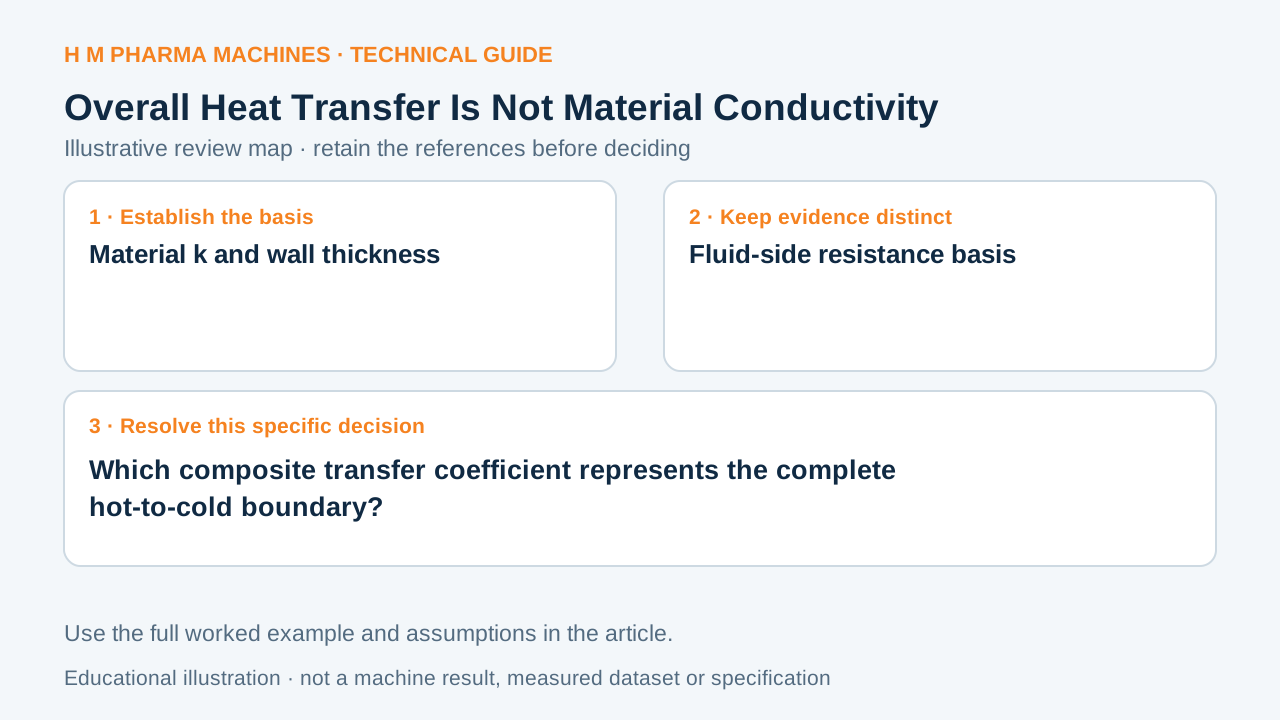
Which composite transfer coefficient represents the complete hot-to-cold boundary?
This blank worksheet is for your own project. It contains no H M machine trial result.
| Review field | Reference or result | Responsible person |
|---|---|---|
| Material k and wall thickness | To complete | To complete |
| Fluid-side resistance basis | To complete | To complete |
| Clean or design U definition | To complete | To complete |
| Wall share of total resistance | To complete | To complete |
Customer Questions
Are k and U interchangeable?
No. Their definitions and units differ.
Does doubling k double duty?
Other resistances may dominate.
Is U a permanent material property?
No. It belongs to specified transfer conditions.
Related Equipment References
Review the actual offered equipment and application separately from this educational example.
Primary References
These references support the technical principles discussed in this guide. The worked examples and review questions are educational.
Discuss Your Machine Requirement
Share your product, container, required output and the evidence needed for your technical review.
Request a Technical Review