
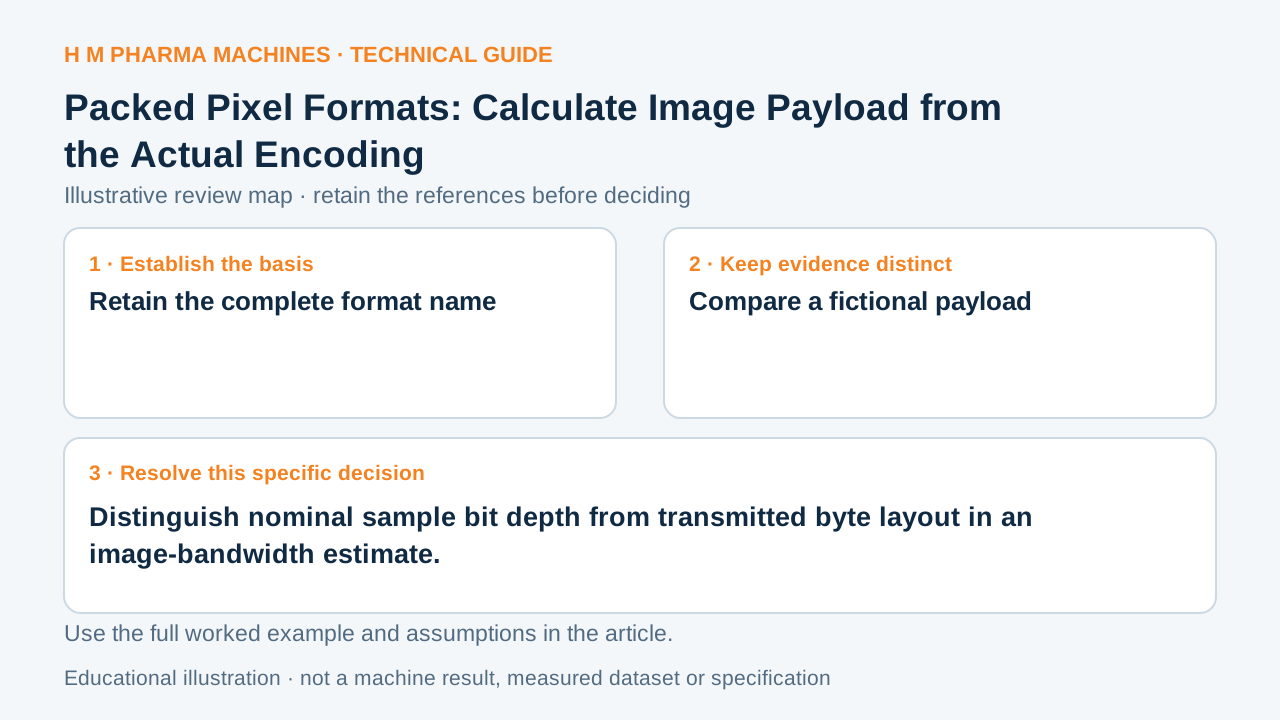
A 12-bit image does not always consume twelve transmitted bits for each sample. Its byte layout belongs in the bandwidth calculation.
Retain the complete format name
The Pixel Format Naming Convention distinguishes component depth from packing and alignment. A packed representation can place successive component bits together; an unpacked representation pads components to byte boundaries. Retain the exact format definition applicable to the image buffer. Primary reference: EMVA: Pixel Format Naming Convention 2.1, packing styles.
A purchasing comparison that lists only width, height and twelve bits leaves the stored or transmitted size unresolved. Record the number of components per pixel too. A monochrome sample and a multi-component colour pixel are different inputs to the calculation even when each component has the same depth.
Compare a fictional payload
Consider an invented monochrome frame with 1,000,000 samples. Tightly packed 12-bit values require 12,000,000 bits, or 1,500,000 bytes, before boundary padding and other overhead. Storing each sample in a 16-bit word instead requires 2,000,000 bytes. At 20 such frames per second, the respective ideal image payloads are 30 and 40 million bytes per second.
These are decimal byte counts. They exclude protocol overhead, metadata, buffering and applicable line alignment. They do not guarantee any interface throughput or camera frame rate. The useful conclusion is that the same nominal sample depth can produce different data volumes.
Check the real buffer boundaries
Ask the integrator which packing, row stride and boundary treatment the receiver uses. Compare its actual payload record with the arithmetic, including any extra components or chunk data. Preserve the format identifier with a sample file so another reviewer can decode it consistently.
If a format changes, revisit host decoding and the bandwidth estimate together. A receiver that assumes padded words may interpret a packed stream incorrectly even if the link can carry it. Keep the transport-capacity question distinct from whether the chosen data representation preserves the inspection information required by the task.
Customer Questions
Does twelve-bit depth always imply twelve stored bits?
No. Packing and padding determine the actual layout.
Do the example totals include protocol overhead?
No. They are ideal image-data payload calculations.
What identifies a row's actual stored size?
Retain the format definition and row-stride or boundary information.
Primary References
These references support the technical principles discussed in this guide. The worked examples and review questions are educational.
Discuss Your Machine Requirement
Share your product, container, required output and the evidence needed for your technical review.
Request a Technical Review