
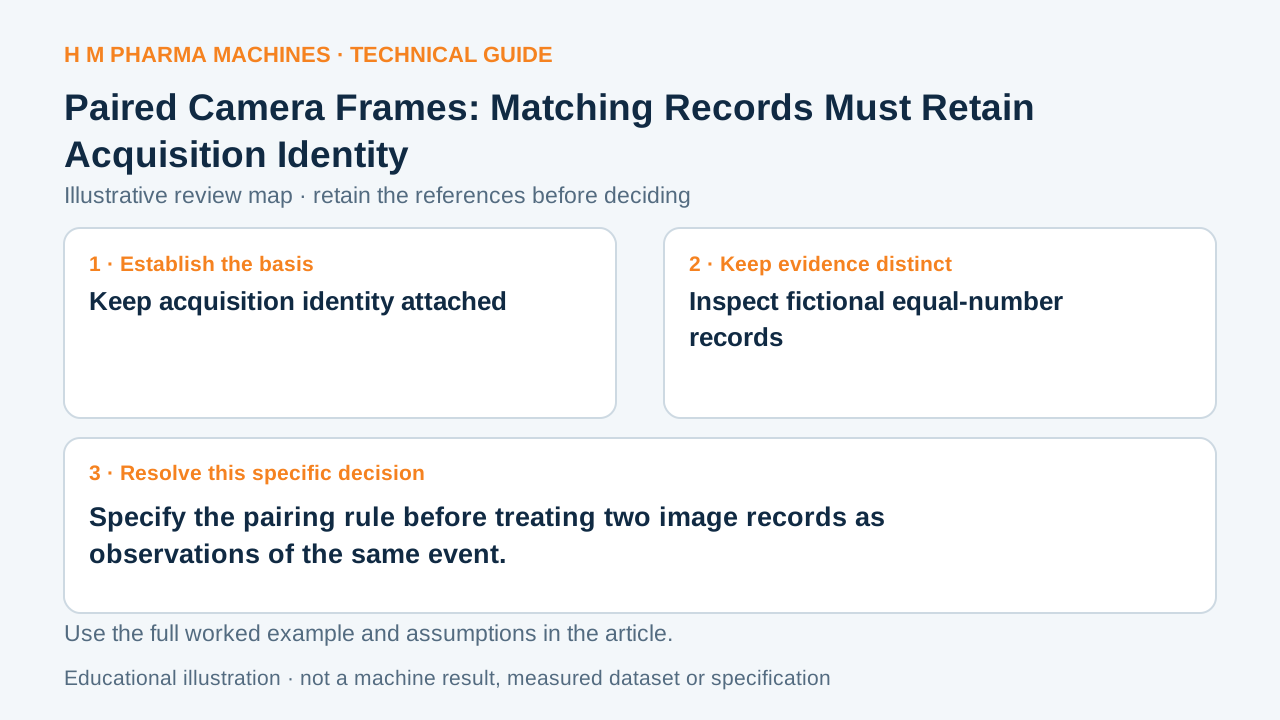
Equal local frame numbers do not automatically mean simultaneous or corresponding acquisition. A pairing rule needs its own evidence.
Keep acquisition identity attached
Camera image metadata can include acquisition counters, frame identifiers and timestamps whose available fields and event meanings depend on the device. Those fields describe the source record. Pairing images from different sources requires a documented relationship rather than assuming equal local numbers establish the same acquisition event. Primary reference: Basler image-specific frame and timestamp metadata.
For an original worksheet, retain source identity, local frame number and timestamp event definition. Record the timebase relationship separately. A raw tick number is not automatically comparable across cameras, and a host receipt time is another event from a defined camera acquisition timestamp.
Inspect fictional equal-number records
Assume invented camera A record 100 corresponds to time 10 ms, while camera B record 100 corresponds to 40 ms on an explicitly common teaching clock. Their equal local numbers conceal a thirty-millisecond separation. A record 101 from A at 30 ms is ten milliseconds from B's record 100.
Choosing the closer timestamps is a different pairing rule, but closeness alone still does not prove observations of the same physical event. This example assumes a common clock only to make the subtraction meaningful. It establishes no actual synchronization, permissible separation or camera setting.
Preserve the pairing criterion
Prepare an original paired-record table with both source IDs, both local IDs, event timestamps and the criterion used. Keep rejected or missing counterparts visible rather than shifting sequence positions silently. State what evidence connects the retained records to the intended shared event.
This guide claims no HM multi-camera synchronization or acquisition capability. Its reader decision is whether a pairing relation has been documented instead of inferred from numerical coincidence. Source metadata and the actual event relationship should survive any combined image or measurement record.
Customer Questions
What separates the fictional equal-number records?
Thirty milliseconds on the explicitly common clock.
Does equal local numbering prove a shared event?
No.
Does timestamp closeness alone prove physical correspondence?
No. The pairing rule needs further event evidence.
Primary References
These references support the technical principles discussed in this guide. The worked examples and review questions are educational.
Discuss Your Machine Requirement
Share your product, container, required output and the evidence needed for your technical review.
Request a Technical Review