
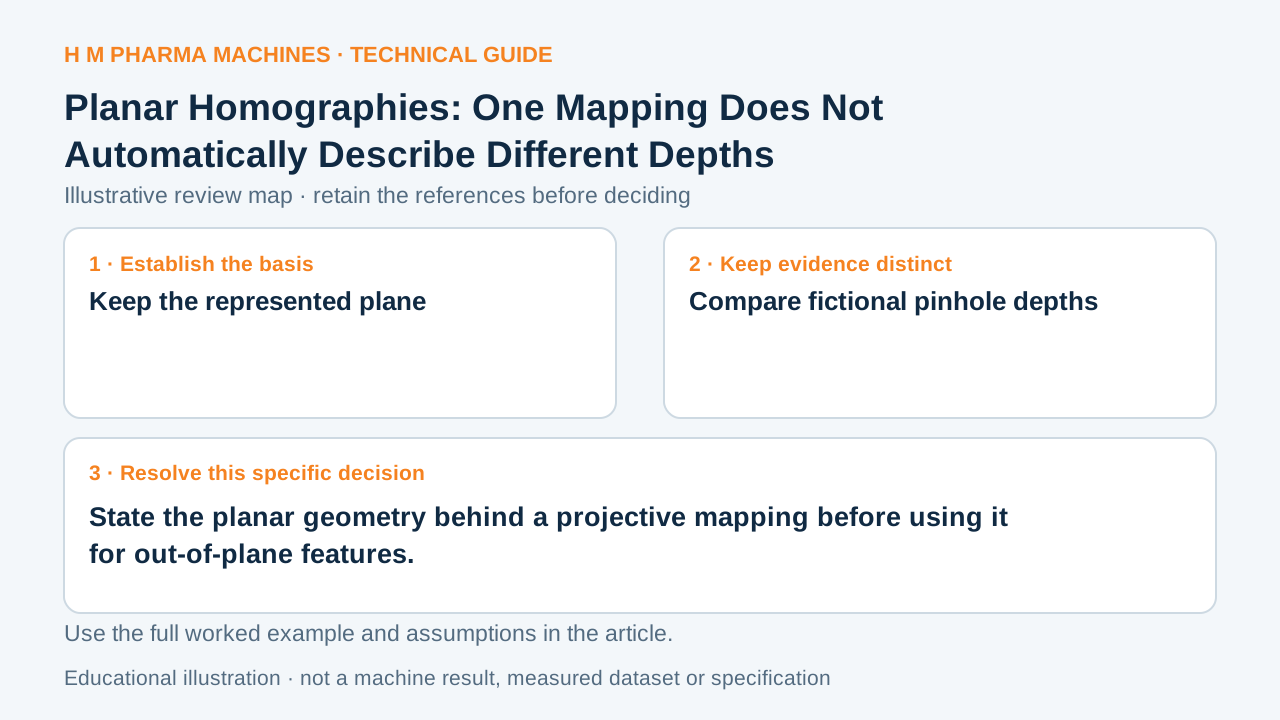
A planar homography has a geometric scope. An elevated feature need not follow the same mapping as the calibration plane.
Keep the represented plane
A planar homography relates coordinates through a projective mapping under its stated planar geometry. For a plane-to-image relationship, points on that plane share the intended model. A point away from the plane requires its own geometric justification before the same inverse mapping is used for a physical position. Primary reference: OpenCV planar homography geometry.
For an original review sheet, record the reference plane and coordinate frames, not merely the matrix values. Distinguish a planar correction from a complete three-dimensional reconstruction. A visually straightened image does not establish that features at every depth have the same recovered scale.
Compare fictional pinhole depths
Use a defined ideal pinhole camera with focal value 1,000 pixel units and x = fX/Z. A point with X = 100 mm at the reference depth Z = 1,000 mm projects to x = 100. The same X at Z = 800 mm projects to x = 125.
Applying the reference-plane conversion X = x × 1,000/1,000 to the second point would report 125 mm instead of its constructed 100 mm coordinate. This original illustration assumes aligned axes and no lens distortion. It identifies depth dependence, not a complete homography estimate or actual measurement error.
Match scope to the required feature
Prepare an original drawing marking the reference plane and any elevated surfaces used by the task. Preserve their expected depth range before accepting a common planar conversion. If the question needs three-dimensional positions, identify that separate model and evidence rather than extending a plane-only result by implication.
This guide provides no HM calibration plane, permissible height variation or dimensional accuracy. Its reader decision is whether the mapped feature belongs to the geometry used by the transform. Keep that scope with every converted coordinate used in a later physical comparison.
Customer Questions
What is the elevated fictional projection?
One hundred twenty-five pixel coordinate units.
Does the reference-plane conversion recover its true X here?
No. It returns 125 rather than the defined 100 mm.
Is planar correction a complete 3-D reconstruction?
No. Its geometric scope must be retained.
Primary References
These references support the technical principles discussed in this guide. The worked examples and review questions are educational.
Discuss Your Machine Requirement
Share your product, container, required output and the evidence needed for your technical review.
Request a Technical Review