
The rake sign describes a geometry; it does not alone select a tool or its allowable load.
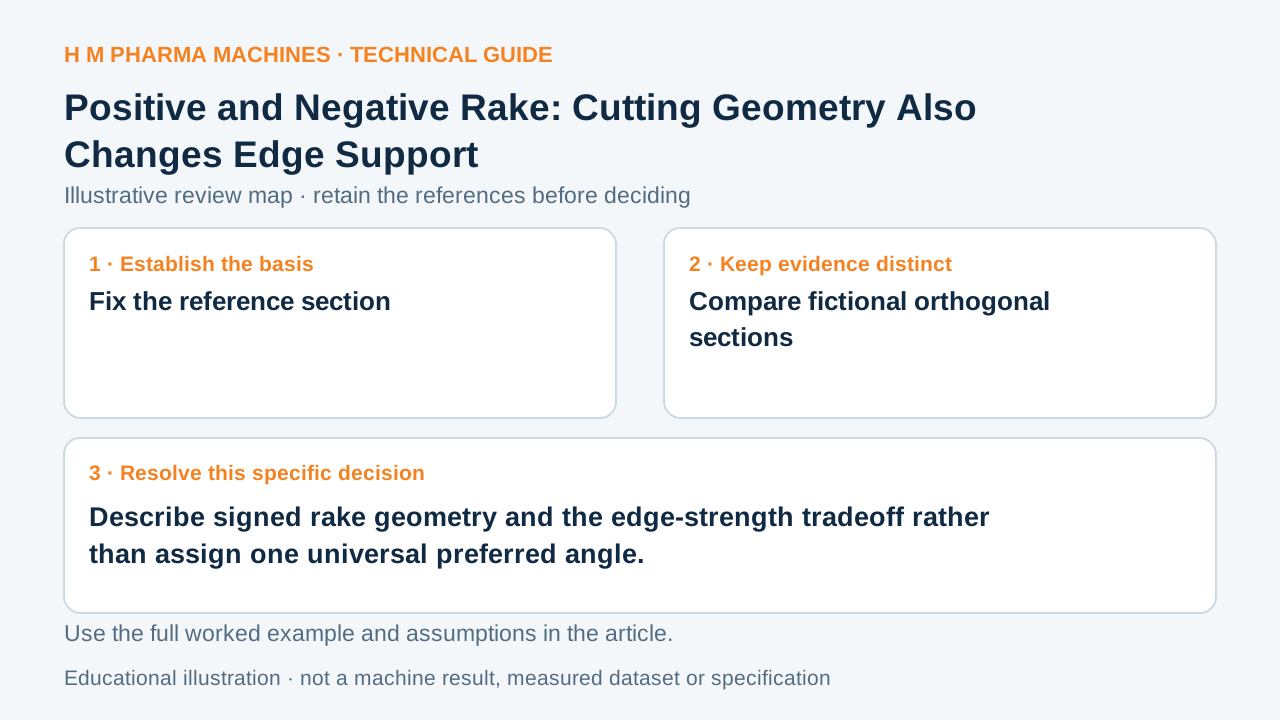
Fix the reference section
NPTEL shows rake and clearance in defined reference planes, including positive and negative rake configurations. Preserve the plane and orientation. Primary reference: NPTEL machining lesson.
Compare fictional orthogonal sections
Consider an ideal two-dimensional tool section with clearance α=8°. Under the stated convention α+β+γ=90°, where β is wedge angle and γ is rake. For γ=10°, β=72°. For γ=−5°, β=87°.
The second sketch has a larger wedge angle under that fixed clearance assumption. This is a geometric comparison, not a strength test. If holder orientation changes, the working angles can differ from the insert drawing, so the same nominal insert number cannot establish the active rake at contact.
Review geometry with its actual state
Keep separate rows for nominal insert shape, mounting orientation, defined reference plane and working rake. Preserve whether a catalog uses positive geometry, positive clearance or positive rake; those descriptions cannot automatically replace each other.
Request the actual cutting and material evidence before comparing edge loading or selecting the sign. This worksheet establishes which section the supplier described and what changes when it is mounted. It offers no universal best rake, tool-life prediction or approval for an edge load merely because the drawn wedge is larger.
Customer Questions
What is the fictional positive-rake wedge?
Seventy-two degrees.
Does negative rake alone prove higher allowable load?
Actual material and loading evidence are needed.
Can nominal and working rake differ?
Mounting orientation can change the working geometry.
Primary References
These references support the technical principles discussed in this guide. The worked examples and review questions are educational.
Discuss Your Machine Requirement
Share your product, container, required output and the evidence needed for your technical review.
Request a Technical Review