
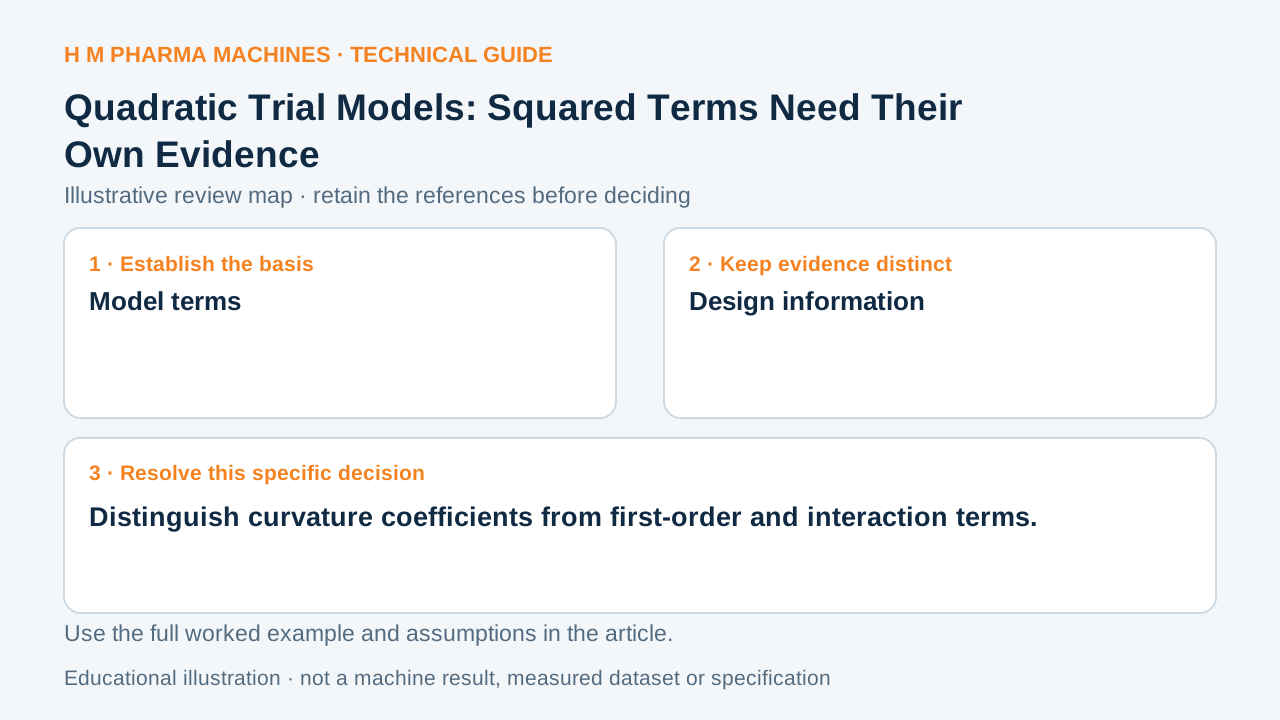
Quadratic models add squared-factor terms to represent curvature. Seeing an interaction or adding a center point does not establish that each curvature term can be fitted.
The statistical question
A quadratic response model includes squared-factor terms as well as first-order terms and possible pair interactions. The design must provide information that identifies the coefficients. In a two-level design with common center points, individual pure quadratic effects can remain confounded even though overall curvature is detectable. Model names alone do not establish what the collected setting combinations can estimate.
An illustrative review example
As an invented one-factor calculation, let a coded response model be y=10+2x+3x squared. Its responses at x=-1,0,+1 are 11,10 and 15. The endpoint average is 13, different from the center value 10. The squared term contributes to that difference. For two factors, giving both the same center coordinate does not by itself determine which separate squared term accounts for an observed aggregate difference.
Prepare the evidence for discussion
Ask the analyst for the model terms, coefficient-identifiability assessment and actual design matrix. Keep physical units and code mappings beside coefficients before discussing predicted settings. Preserve the difference between a detected lack of linearity and a supported fitted response surface. Any trial expansion must stay inside authorized operating limits, and a fitted optimum needs confirmation evidence appropriate to the application rather than a software label alone.
Curvature terms require identifiable evidence
This blank worksheet is for your own project. It contains no H M machine trial result.
| Question to resolve | Evidence to retain |
|---|---|
| Model terms | Linear, pair product and squared terms |
| Design information | Identifiable coefficient combinations |
| Physical map | Units and coded coordinates |
| Confirmation | Evidence beyond a fitted prediction |
Customer Questions
What does a squared term represent?
It permits curvature in the response to the associated numerical factor within the stated empirical model.
Are interaction and quadratic terms identical?
No. A pair product and a squared single-factor term represent different model contributions.
Can center points always identify all squared terms?
Common center points can detect aggregate curvature while leaving individual quadratic effects confounded.
Primary References
These references support the technical principles discussed in this guide. The worked examples and review questions are educational.
Discuss Your Machine Requirement
Share your product, container, required output and the evidence needed for your technical review.
Request a Technical Review