
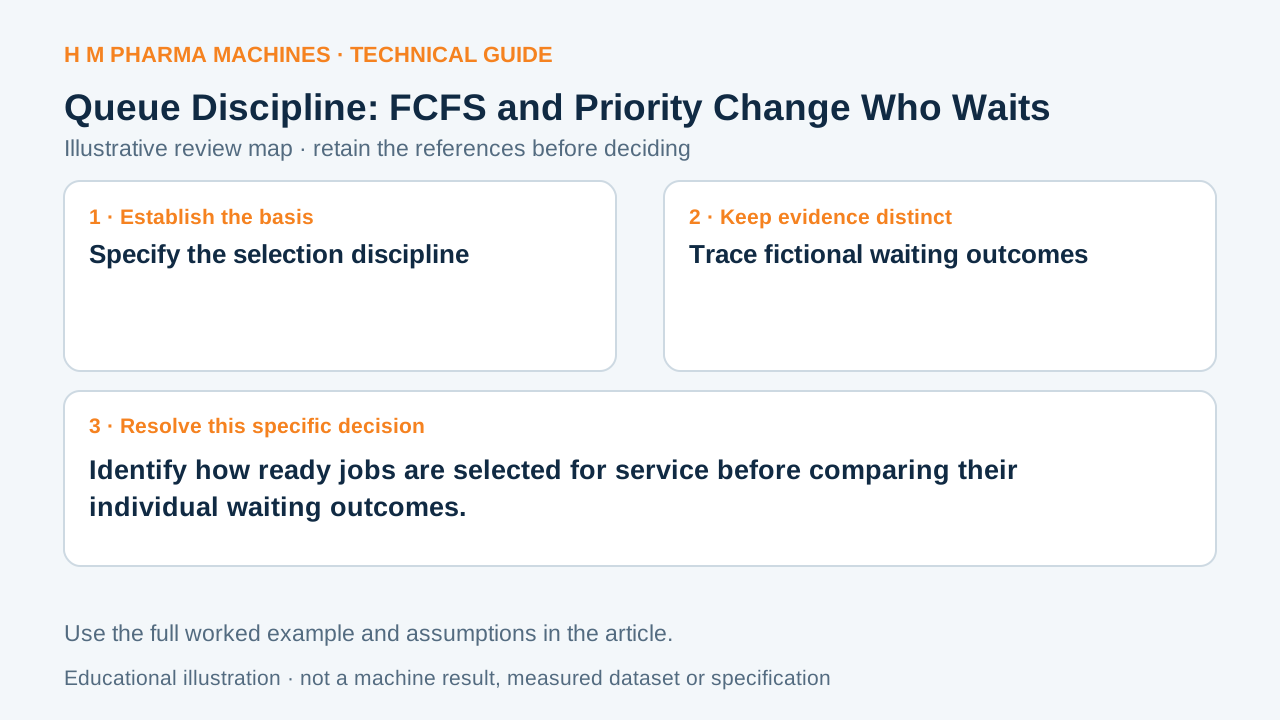
A queue contains ready work, but its selection rule determines who is served next. Keep that rule visible before comparing job waiting.
Specify the selection discipline
A queue can select stored agents in arrival order or according to priorities. First-come, first-served retains arrival order; a priority discipline can move a later ready job ahead of an earlier one. This ready-queue choice does not itself imply interruption of a job already receiving service. Primary reference: AnyLogic Queue: FIFO and priority-based disciplines.
For an original comparison, name the priority direction, the tie-breaker and whether service is nonpreemptive. Do not infer that a larger or smaller numeric value is universally higher priority: that convention depends on the implementation. Keep equal-priority arrival handling explicit.
Trace fictional waiting outcomes
Suppose an occupied server becomes free at minute 4. Job A arrived at minute 1 and needs 3 minutes of service; B arrived at minute 2 and needs 1 minute. Under nonpreemptive FCFS, A starts at 4 and B at 7, so their waits are 3 and 5 minutes.
If B has the higher modeled priority, it starts at 4 and A at 5. Their waits are then 2 and 4 minutes respectively. This original example changes individual allocation; it does not establish that a priority policy improves every objective or prevents some class from waiting excessively.
Review the chosen objective
Prepare a trial ledger with arrival, priority, selection, service start and finish for each job. State which outcome the scheduling comparison values: a particular class’s delay, total completion time or another defined criterion. A favorable result for one job need not describe every job’s result.
For an actual proposal, derive priorities from the authorized process objective and requirements. These fictional jobs are not a customer or production priority recommendation. The reader decision is whether a changed selection policy has been mistaken for a faster resource or a preemption rule.
Customer Questions
Does priority selection automatically interrupt active service?
No. The stated example is nonpreemptive and changes only the next ready-job selection.
Who starts first under FCFS in the example?
A, because it arrived before B.
Is a priority rule universally better?
No. Its consequences depend on the stated objective and workload.
Primary References
These references support the technical principles discussed in this guide. The worked examples and review questions are educational.
Discuss Your Machine Requirement
Share your product, container, required output and the evidence needed for your technical review.
Request a Technical Review