
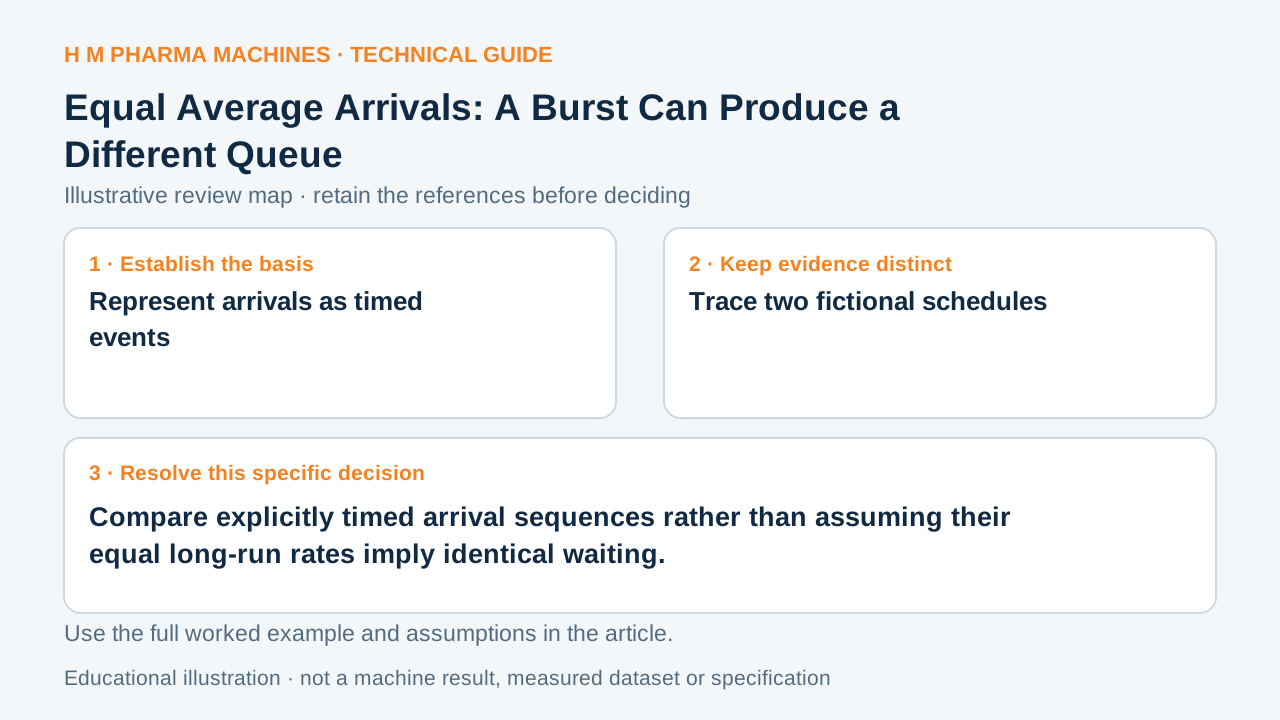
Equal arrival totals can conceal different timing. A small event ledger shows how an arrival burst changes waiting even when the average rate is unchanged.
Represent arrivals as timed events
A discrete-event process can specify when each arrival and service completion occurs. An average arrival rate summarizes a count over time; it does not retain the exact spacing of the events. Comparing queues therefore requires more than matching the average rate alone. Primary reference: SimPy basic concepts: processes, timeouts and events.
For a proposed demonstration, define one initially idle server, first-come service lasting exactly 1 minute, and arrivals counted over repeating 8-minute periods. At a tied timestamp, specify job order and allow an available server to begin service immediately. These rules make the original event ledger reproducible.
Trace two fictional schedules
Schedule A admits four jobs at minutes 0, 2, 4 and 6. Each can start on arrival and has zero wait. Schedule B admits three jobs at minute 0 and a fourth at minute 6. The three tied jobs start at 0, 1 and 2; the last starts at 6.
The waits in B are therefore 0, 1, 2 and 0 minutes, averaging 0.75 minute. Both repeating schedules admit 4/8 = 0.5 jobs per minute, below the server’s nominal one-per-minute service rate. Their different waiting follows the specified event timing, not a different average arrival count.
Retain the sequence behind the summary
Prepare separate columns for arrival, start, completion and waiting in each scenario. Calculate waits from the event ledger before collapsing the records into averages. If the next period overlaps unfinished work, carry that state forward instead of silently resetting the queue to empty.
This deterministic construction does not establish an observed burst distribution, a random-queue formula or an acceptable buffer size. Its reader decision is whether an average-rate comparison has discarded relevant timing. Any actual line proposal needs its own arrival record and service assumptions.
Customer Questions
Do equal average arrival rates guarantee equal waiting?
No. The timing of individual arrivals can differ.
What is Schedule B’s average wait?
The four waits 0, 1, 2 and 0 minutes average 0.75 minute.
Is this an M/M/1 prediction?
No. It is an explicitly scheduled deterministic example.
Primary References
These references support the technical principles discussed in this guide. The worked examples and review questions are educational.
Discuss Your Machine Requirement
Share your product, container, required output and the evidence needed for your technical review.
Request a Technical Review