
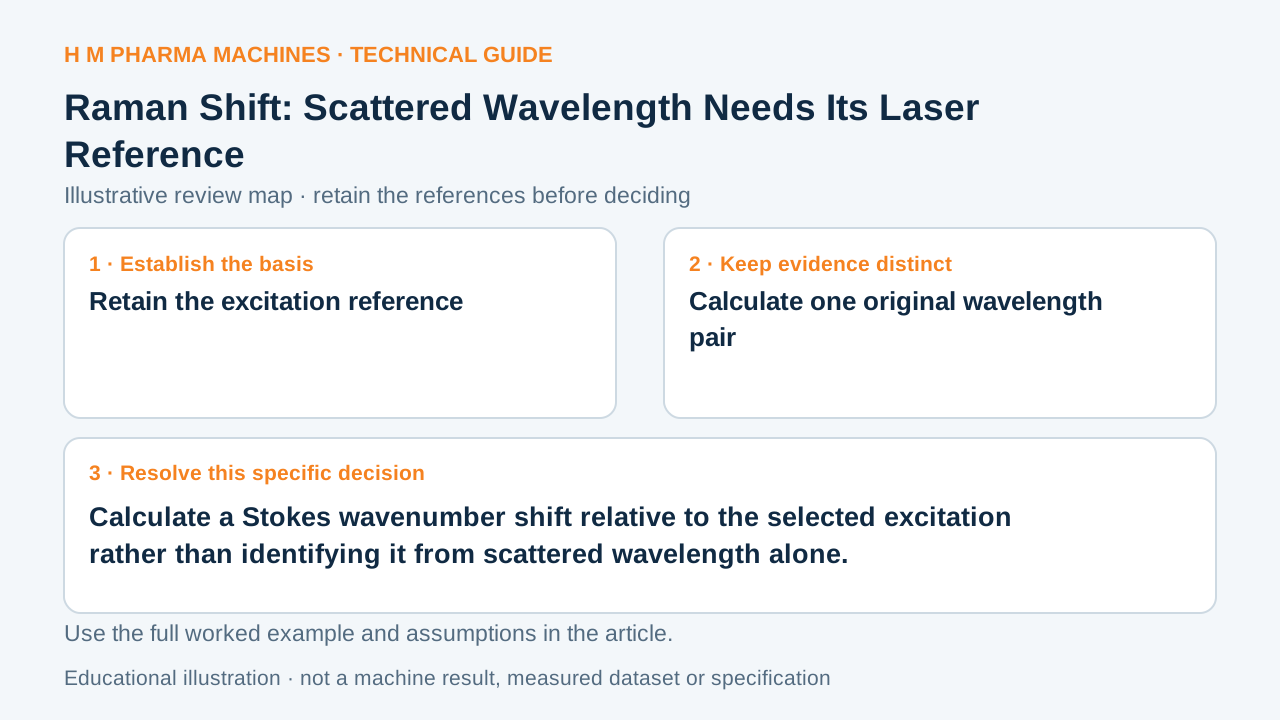
A scattered wavelength becomes a Raman-shift coordinate only after the excitation reference is identified.
Retain the excitation reference
Raman scattering involves an energy change relative to the excitation light. Raman shift expresses that difference in wavenumbers rather than reporting only the absolute scattered wavelength. For a Stokes observation, the scattered photon has lower energy and a longer wavelength than the exciting photon. Primary reference: HORIBA: Raman effect.
Using wavelengths in nanometres, this guide defines positive Stokes shift as 10^7 times (1/laser wavelength - 1/scattered wavelength), in cm^-1. Retain the sign convention. A scattered wavelength by itself does not determine the shift.
Calculate one original wavelength pair
Take fictional excitation at 600 nm and a scattered component at 660 nm. Their reciprocal wavenumbers are approximately 16666.667 and 15151.515 cm^-1. The positive difference is about 1515.152 cm^-1. Subtracting the wavelengths instead gives 60 nm, which is another quantity and cannot be labeled a Raman shift in inverse centimetres.
If the excitation reference were incorrectly entered as 620 nm for that same 660 nm component, the calculated shift would be about 977.517 cm^-1. The change demonstrates the missing-reference problem, not a predicted spectrum of a material under a second laser.
Review coordinate provenance before assignment
Create worksheet fields for laser wavelength, scattered wavelength, units, sign convention, both reciprocal values and their difference. Link each component to its actual excitation record. Preserve that relationship when data are exported as an already shifted axis.
Then separate the coordinate conversion from chemical interpretation. Assigning a band requires appropriate sample and spectral evidence beyond this calculation. The invented pair does not identify a compound, predict intensity, establish instrument performance or suggest that an analytical instrument is part of the HM machinery range.
Customer Questions
Can 660 nm alone specify the Raman shift?
The excitation wavelength is also needed.
Is 60 nm the shift in cm^-1?
It is a wavelength difference.
Does the calculation identify a material?
It only establishes the defined coordinate.
Primary References
These references support the technical principles discussed in this guide. The worked examples and review questions are educational.
Discuss Your Machine Requirement
Share your product, container, required output and the evidence needed for your technical review.
Request a Technical Review