
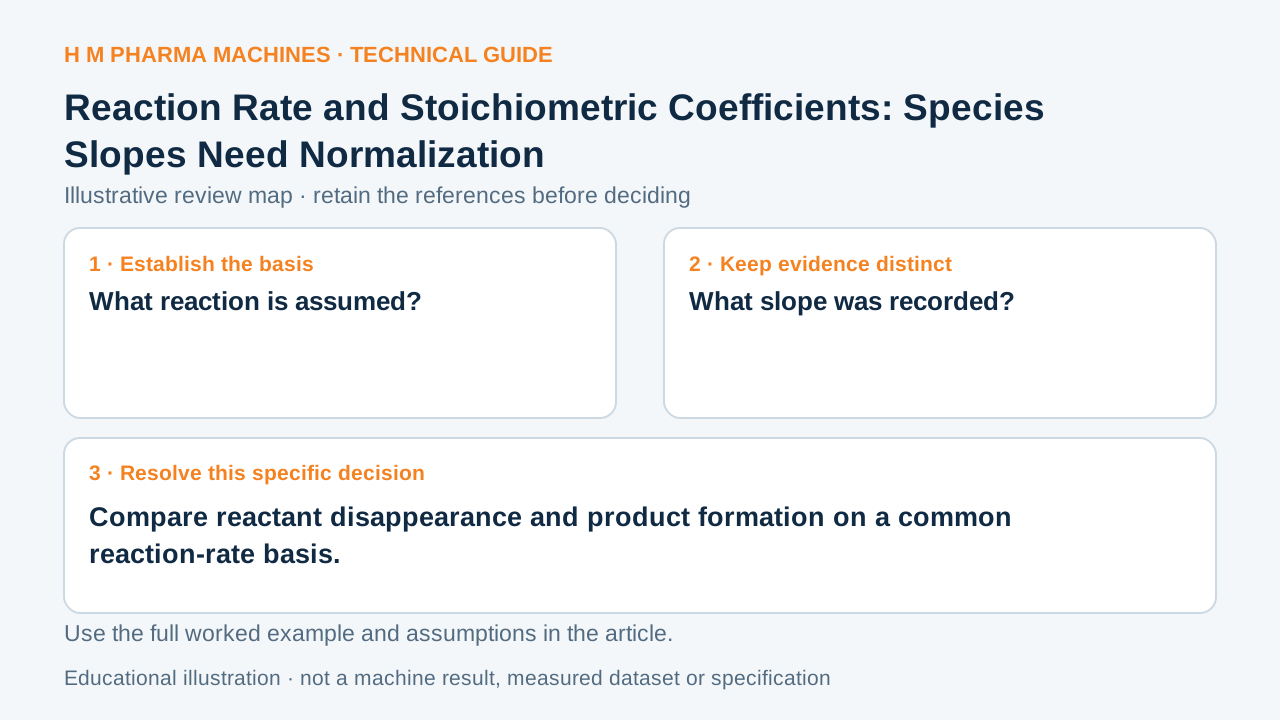
Species disappearance and product appearance can have different numerical rates in the same reaction. Stoichiometric normalization lets their changes describe one reaction rate.
Keep the coefficient-normalized rate
For a specified constant-volume reaction without unresolved intermediate accumulation or side products, a reaction rate can be related to species concentration changes divided by their signed stoichiometric coefficients. The reactant minus sign makes a disappearance slope correspond to a positive forward rate. Primary reference.
Compare fictional concentration slopes
Use the constructed reaction 2A → 3P at fixed volume. Assign observed teaching slopes d[A]/dt = −0.00600 mol/(L s) and d[P]/dt = +0.00900 mol/(L s). The normalized forward rate is −(1/2)d[A]/dt = (1/3)d[P]/dt = 0.00300 mol/(L s).
The raw slope magnitudes differ because the reaction consumes two A entities while producing three P entities. Their agreement after normalization does not prove that actual data are free of side reactions or measurement error; the example explicitly defines those slopes and its simple reaction boundary.
Check the observation boundary
Create an original slope table with species identity, sign, coefficient and normalized value. Preserve whether concentration changes reflect chemical conversion or a changing liquid volume. A variable-volume inventory requires its full amount-and-volume balance rather than the unchanged constant-volume expression.
This calculation sets no kinetic law, rate constant or process duration. Its decision is whether several species slopes have been compared on a coherent reaction basis. A reaction-extent balance concerns cumulative amount changes; this guide concerns their instantaneous concentration slopes under the stated volume condition.
Solution review worksheet
This blank worksheet is for your own project. It contains no H M machine trial result.
| Question | Record to retain |
|---|---|
| What reaction is assumed? | Balanced equation and species coefficients |
| What slope was recorded? | Signed concentration change per time |
| Is volume held constant? | Applicable observation and inventory boundary |
Customer Questions
What is the fictional normalized forward rate?
0.00300 mol/(L s).
Why do the raw slopes differ?
Their stoichiometric coefficients differ.
Does the slope normalization establish a rate law?
No.
Primary References
These references support the technical principles discussed in this guide. The worked examples and review questions are educational.
Discuss Your Machine Requirement
Share your product, container, required output and the evidence needed for your technical review.
Request a Technical Review