
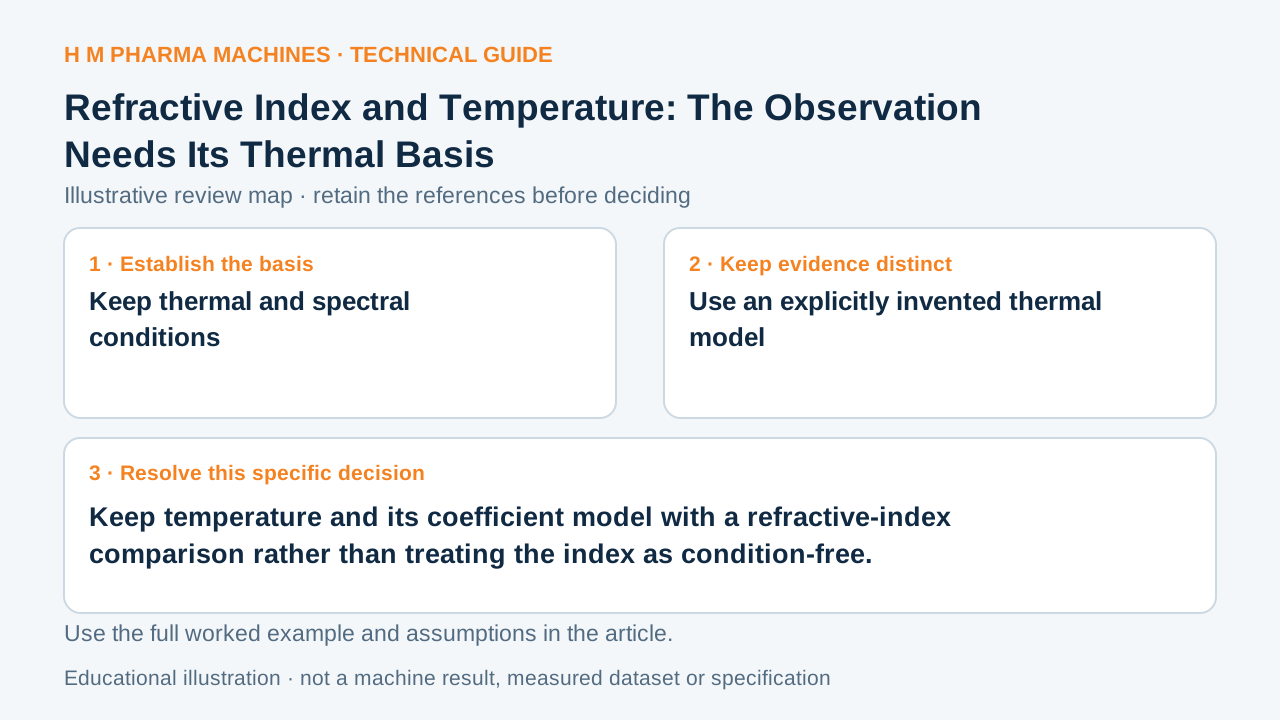
Refractive index can change with temperature; a thermal correction requires a material-specific model and stated range.
Keep thermal and spectral conditions
Primary measurements of optical materials demonstrate refractive-index dependence on both temperature and wavelength, with thermo-optic coefficients defined for the studied materials. A temperature coefficient is therefore not a universal correction for every solid or liquid. The material, wavelength and applicable model range belong to the reported observation. Primary reference: Leviton, Frey and Madison: temperature-dependent refractive index.
A reference-temperature number and an actual-temperature observation can differ without demonstrating a composition change. Conversely, assigning a generic coefficient to the difference does not prove that temperature explains a real result. Retain the measured conditions before evaluating an interpretation.
Use an explicitly invented thermal model
For an unnamed hypothetical transparent material at one fixed wavelength, define n20 = 1.5000 at 20 degrees Celsius and dn/dT = -0.0001 per kelvin over 20 to 30 degrees Celsius. Its toy linear model gives n30 = 1.4990. The temperature interval is 10 K; there is no change in stipulated material composition.
These coefficients are invented and are not the values from the cited optical-material research. If a report normalized n30 to 20 degrees Celsius using this same model, it would add 0.0010. That operation is conditional on the model, not an automatic property of a refractometer display.
Identify the correction provenance
Make worksheet fields for material, wavelength, observed temperature, observed n, requested reference temperature and the coefficient source. State whether the model is linear, its range and which variable it holds fixed. Distinguish observation from calculated reference-temperature value.
Before comparing samples, determine whether their thermal bases and composition models are compatible. Leave correction unavailable when the needed coefficient is unsupported. This example addresses optical thermal dependence, not Brix, concentration conversion, built-in temperature compensation or a claim about a particular instrument supplied by HM.
Customer Questions
Is -0.0001 per kelvin universal?
It is an invented model coefficient.
Does the toy temperature change composition?
The material is stipulated unchanged.
Is an instrument compensation feature claimed?
No particular instrument feature is described.
Primary References
These references support the technical principles discussed in this guide. The worked examples and review questions are educational.
Discuss Your Machine Requirement
Share your product, container, required output and the evidence needed for your technical review.
Request a Technical Review