
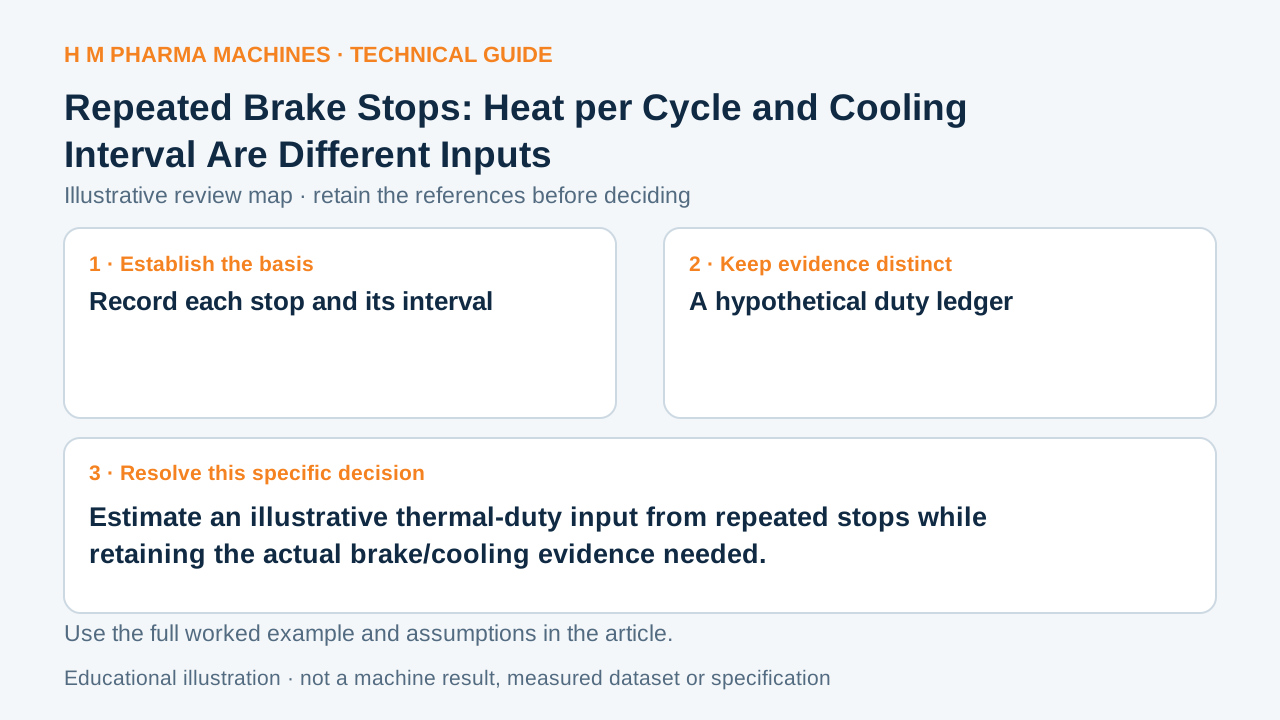
Keep energy per stop and repetition timing together when reviewing brake thermal duty.
Record each stop and its interval
KEB’s brake-sizing discussion treats kinetic energy per stop, stopping frequency, ambient conditions and cooling as thermal inputs. Torque alone cannot establish repeated-stop thermal suitability. Primary reference: brake thermal management.
The actual brake must be appropriate for the intended dynamic operation. A holding function does not automatically supply the same duty evidence. Preserve where the energy is dissipated rather than assuming every deceleration deposits all energy in one friction component.
A hypothetical duty ledger
Assume a fictional equivalent inertia of 0.02 kg·m² stops from 100 rad/s to zero, with its 100 J kinetic decrease assigned entirely to a hypothetical friction brake. Six evenly spaced stops per minute imply 10 J/s, or 10 W, of cycle-average energy input.
Sixty stops per minute imply 100 W under the same per-stop assumption. Equal per-stop energy therefore does not imply equal repeated duty. Neither average predicts peak temperature: cooling, transient heat flow and actual energy distribution still matter. These numbers select no brake and establish no permissible stop rate.
Prepare a thermal question
Record initial/final speed, inertia at the brake shaft, stop durations, repetition pattern and energy destination. Include ambient and cooling conditions in the supplier review. A cluster of stops can differ from evenly spaced stops even at the same hourly count.
Request the selected brake’s applicable dynamic and thermal evidence before assessing the real operating cycle. This guide provides no HM stop capability, emergency-stop design or adjustment instruction. Its outcome is a defined duty record that keeps heat input and cooling opportunity visible alongside torque requirements.
Customer Questions
Does equal energy per stop imply equal thermal duty?
Repetition and cooling conditions also matter.
Does average watts determine peak temperature?
Transient thermal behavior requires its own assessment.
Is a holding label sufficient for dynamic stops?
Obtain the applicable dynamic-duty evidence.
Primary References
These references support the technical principles discussed in this guide. The worked examples and review questions are educational.
Discuss Your Machine Requirement
Share your product, container, required output and the evidence needed for your technical review.
Request a Technical Review