
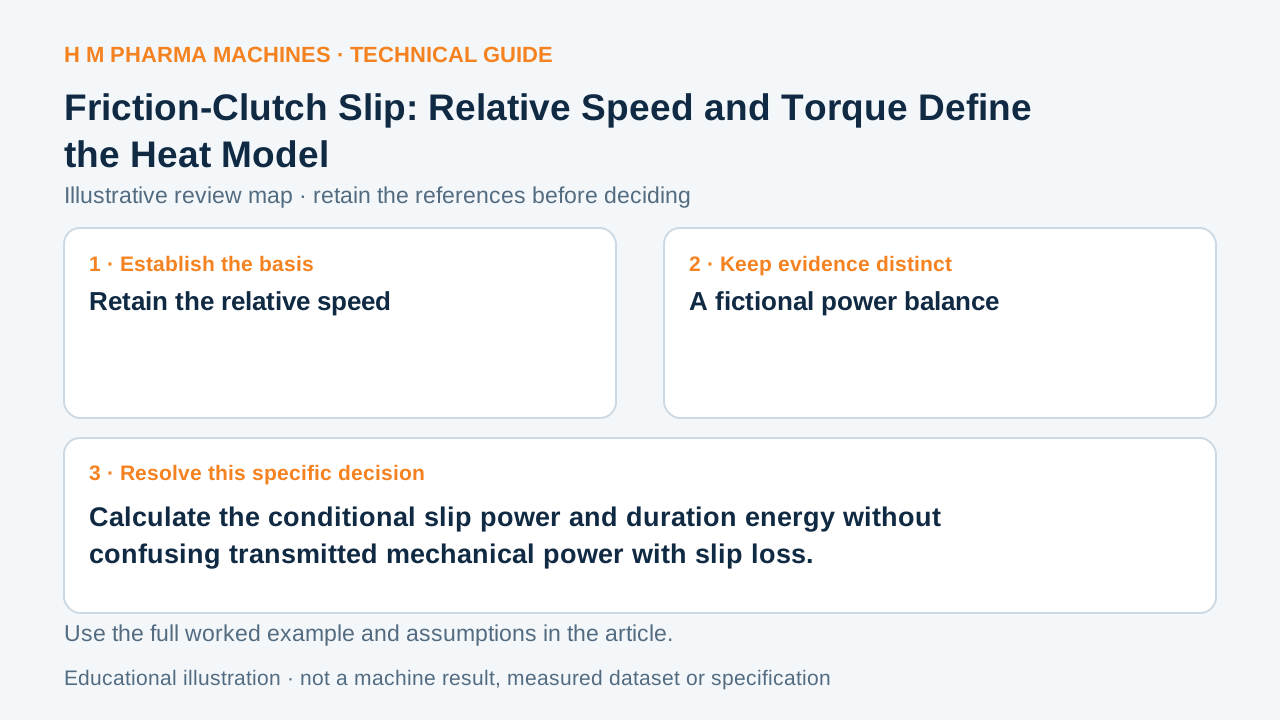
Use relative slip speed when estimating a friction clutch’s illustrative heat input.
Retain the relative speed
Mayr identifies slip speed, duration and torque as friction-power limits for a slipping clutch. In a simplified model, slip loss is T times the relative angular speed. Primary reference: slip-clutch performance limits.
Input-shaft speed alone is incomplete when the output also moves. Keep both speeds with their sign convention. The transmitted output power and the energy dissipated by slip describe different destinations in the same illustrative balance.
A fictional power balance
Assume the same-sense input and output rotate at 100 and 80 rad/s while a hypothetical 5 N·m torque is transmitted. Input mechanical power is 500 W, output mechanical power is 400 W and the simplified slip loss is 100 W. Over 2 s at unchanged values, that loss is 200 J.
Using 100 rad/s as slip speed would incorrectly assign 500 W to loss in this example. If speeds or torque vary, integrate the actual loss history rather than multiplying an average chosen from a different phase. These invented values establish no clutch capacity or allowed slip duration.
Prepare the slip-duty record
List input speed, output speed, transmitted torque and duration for each phase. Ask which portion of the cycle the selected component’s thermal evidence covers. Keep contact, cooling and repeated-cycle conditions visible to the supplier assessment.
This guide sets no torque limiter, changes no clutch and makes no HM component claim. The useful result is a consistent mechanical-power ledger that separates useful transmission from slip loss before a thermal-duty question is presented as a torque-only comparison.
Customer Questions
Is input speed always the slip speed?
Subtract the appropriately signed output speed.
Does transmitted output power equal slip heat?
They are different power terms.
Is 200 J a permitted clutch limit?
It is an invented duty calculation.
Primary References
These references support the technical principles discussed in this guide. The worked examples and review questions are educational.
Discuss Your Machine Requirement
Share your product, container, required output and the evidence needed for your technical review.
Request a Technical Review