
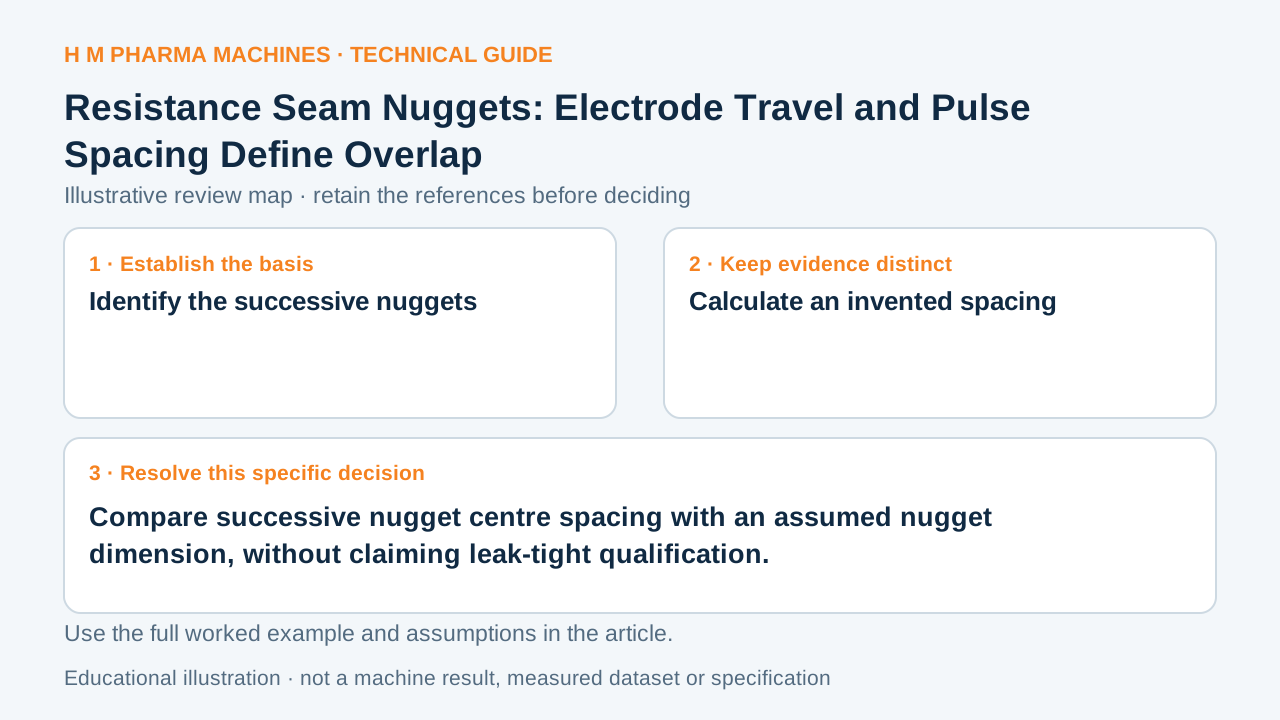
A seam description needs the relationship between travel and successive joining events.
Identify the successive nuggets
TWI explains resistance seam welding as a series of overlapping nuggets, commonly formed using wheel electrodes. Successive joint regions and their spacing are therefore relevant to the seam description. Primary reference: TWI technical explanation.
Retain electrode travel and the event sequence separately from a statement that the process uses wheels. Overlap is a geometric relationship; leak-tightness or joint acceptance also needs application-specific evidence.
Calculate an invented spacing
Assume a fictional travel speed of 20 mm/s and one joining event every 0.10 s. Centre spacing is 2 mm. For an expressly assumed along-travel nugget length of 3 mm, the simple one-dimensional overlap is 1 mm.
If only the event interval changes to 0.20 s, spacing becomes 4 mm and that assumed geometry leaves a 1 mm gap. Nugget length is held constant solely for this illustration; an actual process change could alter it.
Make continuity a checkable claim
Draw successive nugget centres and their observed longitudinal extents on one travel axis. Record timing, speed and how those extents were established. Keep gaps and overlap distinct in the resulting map.
Request the actual seam test appropriate to the requirement rather than treating the illustrative overlap as a leak-tight guarantee. This worksheet helps identify whether a proposal supports continuity with relevant geometry and evidence, instead of relying on the name of the joining process.
Customer Questions
What is the initial invented centre spacing?
Two millimeters.
What changes at the longer event interval?
Spacing becomes four millimeters under the same speed.
Does geometric overlap prove leak-tightness?
The required seam performance needs its own evidence.
Primary References
These references support the technical principles discussed in this guide. The worked examples and review questions are educational.
Discuss Your Machine Requirement
Share your product, container, required output and the evidence needed for your technical review.
Request a Technical Review