
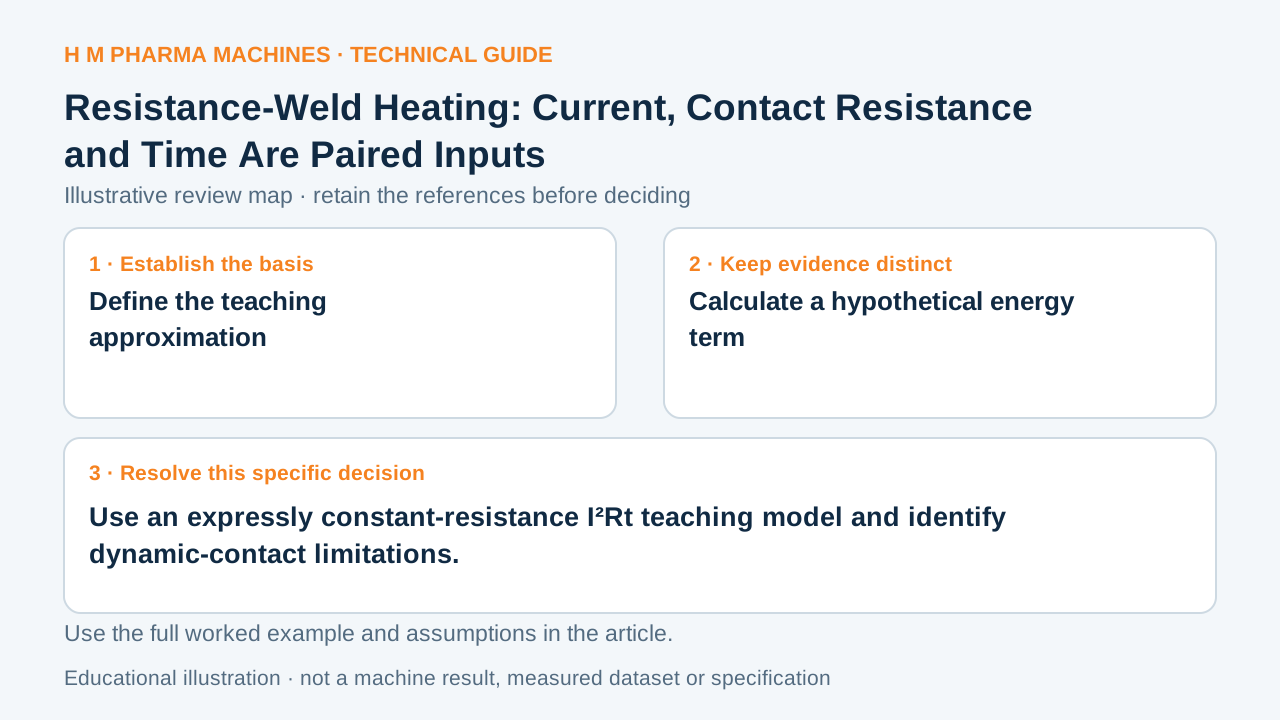
Contact resistance and current history belong to the same heating question.
Define the teaching approximation
TWI describes resistance joining through current-generated heating at contacting materials. With explicitly constant resistance and current, electrical energy is I²Rt. Primary reference: TWI technical explanation.
Real contacts can change as surfaces heat and deform. An average resistance label does not automatically justify a constant-resistance calculation across the entire event. Retain the assumed electrical boundary before interpreting its energy.
Calculate a hypothetical energy term
Assume fictional current 1,000 A, resistance 0.00010 Ω and interval 0.020 s. The stated model gives 1,000²×0.00010×0.020 = 2 J. Doubling only current gives 8 J because current is squared.
These are original teaching assumptions, not resistance-welding settings. The computed electrical term does not establish nugget size, complete fusion or how much energy reaches a specific interface. Heat loss and changing contact behavior are outside this simplified model.
Keep contact and timing evidence
Create an event record with current waveform, relevant voltage/contact boundary, force condition and time interval. Preserve which quantity was measured and which was assumed. A waveform integral may be needed when the stated constants do not describe the event.
Ask for joint evidence separately from the heating calculation. This avoids replacing the process assessment with a current number or interpreting unchanged current as proof that contact heating was unchanged across surface or assembly revisions.
Customer Questions
What is the invented constant-input energy?
Two joules at the stated boundary.
What happens when only current doubles?
The constant-resistance model gives four times the energy.
Does that energy determine nugget acceptance?
Actual contact and joint evidence are still needed.
Primary References
These references support the technical principles discussed in this guide. The worked examples and review questions are educational.
Discuss Your Machine Requirement
Share your product, container, required output and the evidence needed for your technical review.
Request a Technical Review