
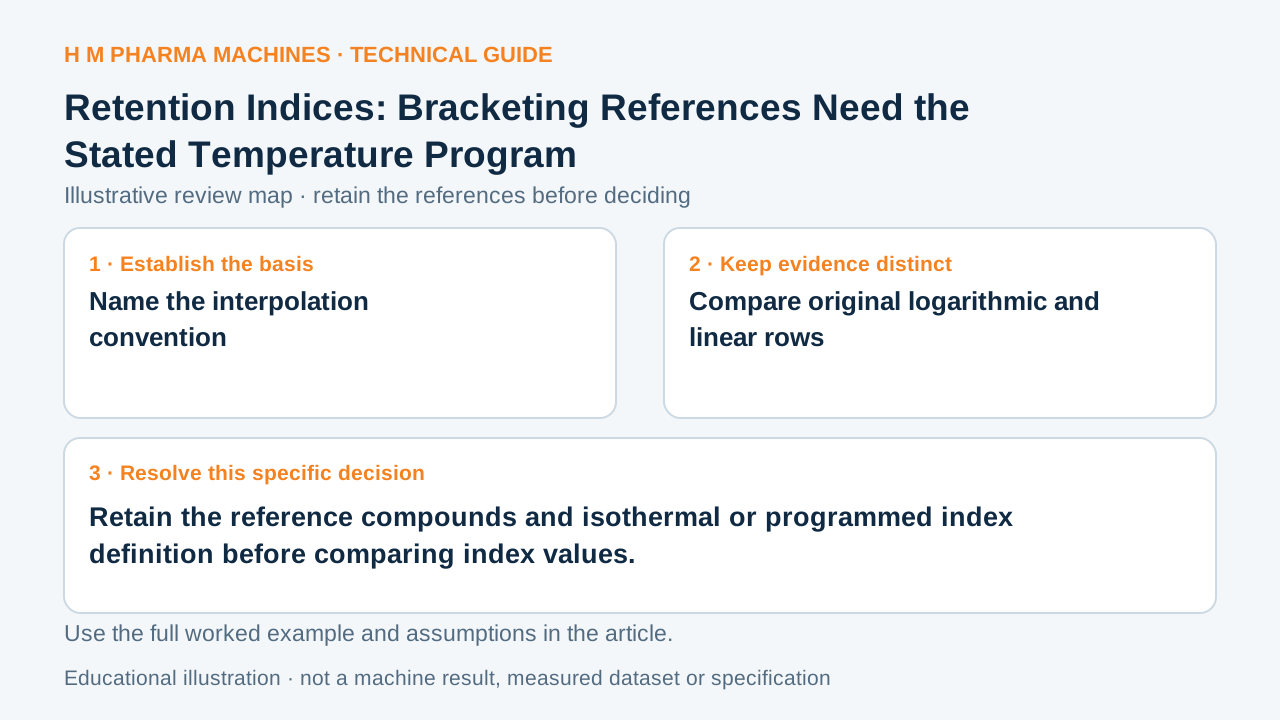
A retention-index value carries its bracketing-reference and temperature-program convention.
Name the interpolation convention
A retention index relates a component to bracketing standards measured under corresponding conditions. The isothermal Kovats convention uses logarithmic interpolation of adjusted retention quantities between n-alkanes. Temperature-programmed linear retention indices use a different interpolation based on direct retention-time differences. Primary reference: IUPAC: retention index.
A reported index therefore needs its method convention as well as its standards. Values obtained under different temperature programs cannot automatically be treated as the same number. The naming distinction preserves how the reference comparison was calculated.
Compare original logarithmic and linear rows
For a fictional isothermal case, use adjacent n-alkanes numbered 8 and 9, with adjusted times 2 and 8 units. Let the component adjusted time be 4. Its logarithmic position is (log4 - log2)/(log8 - log2) = 0.5, giving I = 100(8 + 0.5) = 850.
For a separate invented programmed convention, total times are 3, 5 and 9 units for lower reference, component and upper reference. Linear position is (5 - 3)/(9 - 3) = 1/3, giving about 833.333. These deliberately constructed rows compare formulas; they do not claim one sample would have these times under both conditions.
Retain reference and temperature identity
List the index convention, reference carbon numbers, raw and adjusted time basis, hold-up treatment and temperature program. Link the component to the same-run references where required by the method. Make the logarithmic or linear operation visible on the worksheet.
Then compare reported indices only with appropriately documented method evidence. A matching number alone does not establish chemical identity. The original calculations are not retention-index reference data, recommended programs or operating conditions for an actual GC system; they show why an index without its convention is incomplete.
Customer Questions
Which fictional row gives 850?
The stated isothermal logarithmic row.
Does the programmed row use the same interpolation?
It uses direct time differences.
Are these times chemical reference data?
They are invented worksheet inputs.
Primary References
These references support the technical principles discussed in this guide. The worked examples and review questions are educational.
Discuss Your Machine Requirement
Share your product, container, required output and the evidence needed for your technical review.
Request a Technical Review