
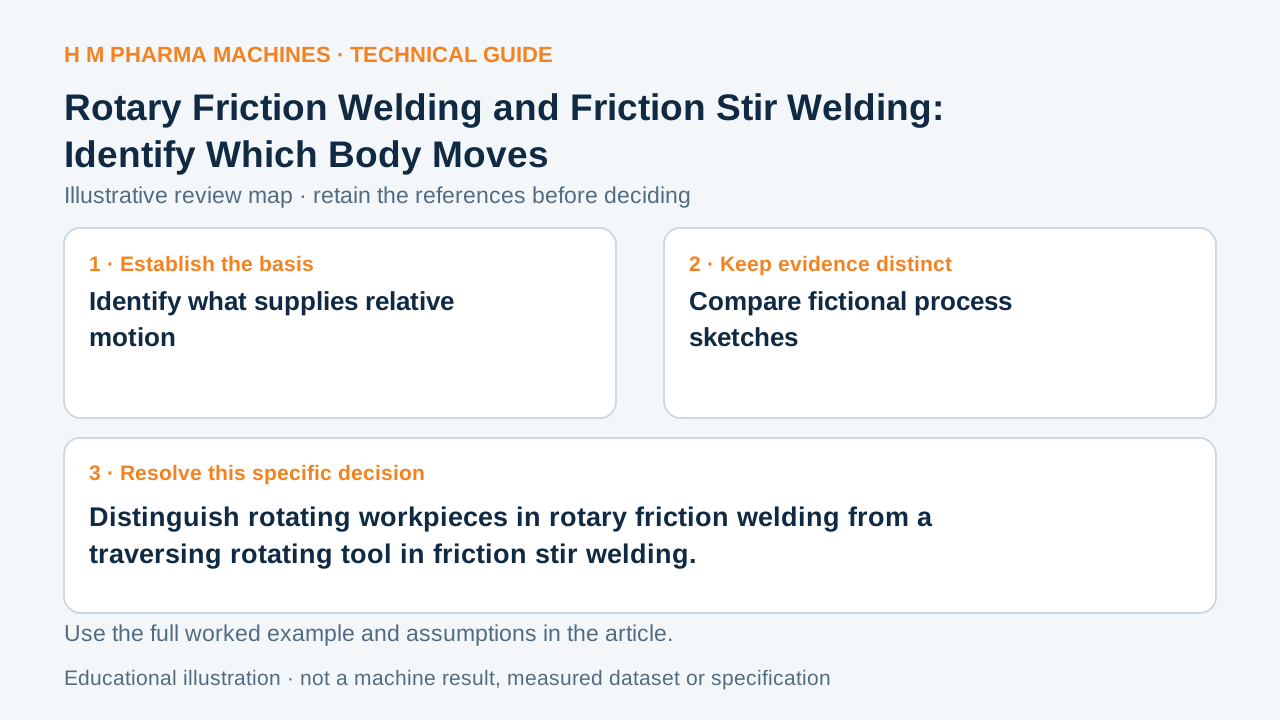
The moving body is a useful distinction between two solid-state joining routes.
Identify what supplies relative motion
TWI lists rotary friction welding and friction stir welding within the wider friction-welding family. Rotary friction welding joins meeting surfaces through workpiece rotation; friction stir welding uses a rotating tool traversing the interface. Primary reference: TWI technical explanation. Primary reference: TWI technical explanation.
The shared friction-welding family does not make these layouts equivalent. Record which bodies move, which joint surfaces meet and how the tool or workpiece path reaches the intended interface.
Compare fictional process sketches
Imagine layout A with one workpiece rotating against another at their meeting faces. Layout B shows two stationary workpieces while a rotating tool travels along their common seam. The sketches intentionally omit settings and dimensions.
A review sheet treating both as rotating the part would misdescribe B. A sheet treating both as moving a tool down the seam would misdescribe A. This thought experiment distinguishes process architecture, not a demonstrated joint or permitted material combination.
Review access and retained identity
Make separate rows for moving workpiece, traversing tool, joint path and required physical access. Preserve the actual process designation in the supplier proposal rather than compressing it into friction joining.
Ask how the named route reaches and supports the intended interface. The answer should be connected to actual joint and process evidence. These sketches do not select a joining route or claim HM uses one; they give a concrete way to detect an incomplete or contradictory motion description before a fabrication proposal is compared.
Customer Questions
Which invented layout rotates a workpiece?
Layout A.
Which layout traverses a rotating tool?
Layout B.
Does shared friction heating make the layouts identical?
Their moving bodies and access requirements differ.
Primary References
These references support the technical principles discussed in this guide. The worked examples and review questions are educational.
Discuss Your Machine Requirement
Share your product, container, required output and the evidence needed for your technical review.
Request a Technical Review