
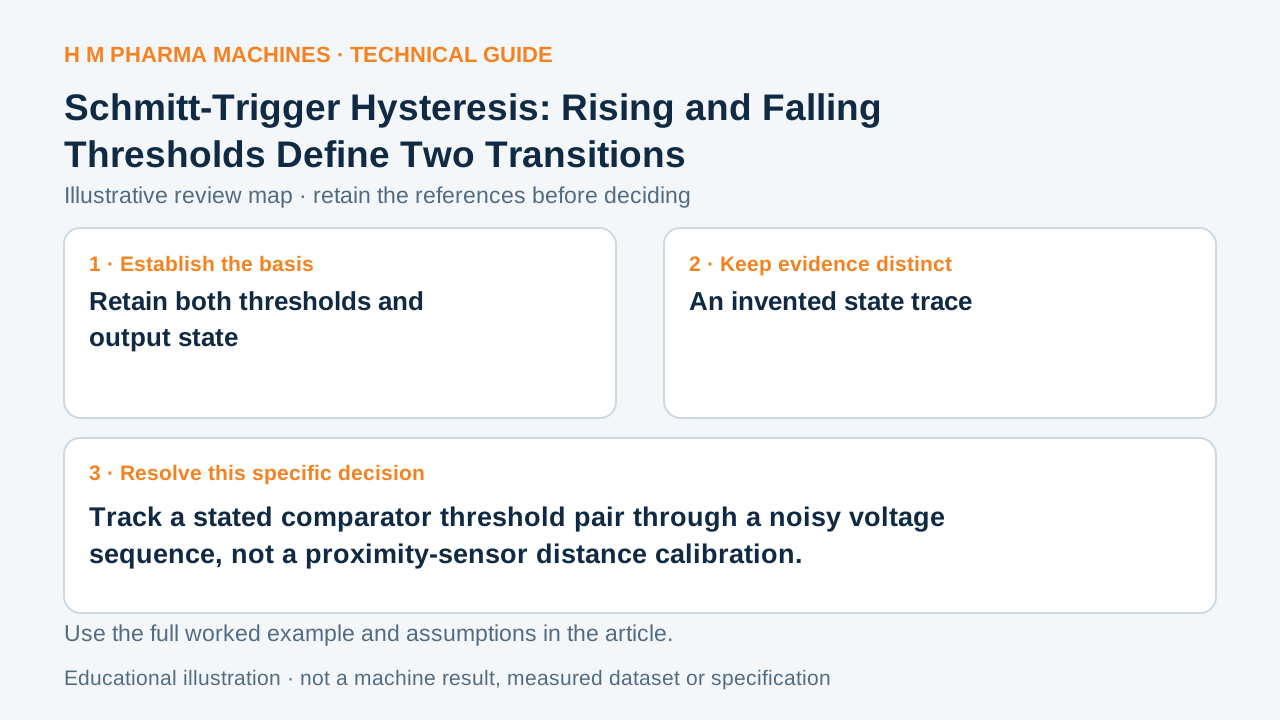
Trace distinct rising and falling voltage thresholds before interpreting comparator output transitions.
Retain both thresholds and output state
Analog Devices explains hysteresis as separating the up-going and down-going switching points so a reversal requires crossing the other boundary. Primary reference: comparator hysteresis.
The output state between those thresholds depends on the previous transition. A single nominal threshold cannot describe this behavior. Keep the circuit’s polarity as well: an inverting and non-inverting arrangement can associate a voltage transition with different output states.
An invented state trace
Assume a fictional non-inverting model switches high when rising voltage passes 3.0 V and low when falling voltage passes 2.0 V. Start with the output low at 1.5 V. The input sequence 2.5,3.2,2.7,2.1,1.8 V gives output states low,high,high,high,low.
The middle 2.7 V does not undo the preceding transition because it has not crossed the lower threshold. The example specifies assumed thresholds for teaching and no actual comparator precision or allowable noise level. Equality at a threshold would also need the model’s explicit convention.
Make the sequence reviewable
Write starting state, polarity, both thresholds and each input value in order. Record the expected state after every step rather than treating a point between thresholds as ambiguous without history.
For an actual interface, preserve threshold variation and timing evidence. The worksheet clarifies the state rule that a proposed hysteresis feature represents while avoiding the claim that one gap removes every possible disturbance.
Customer Questions
Is there only one switching voltage?
The stated model uses different rising and falling boundaries.
Does a value between them identify output alone?
Previous state and transition history matter.
Are 3.0 V and 2.0 V approved thresholds?
They are explicitly fictional model inputs.
Primary References
These references support the technical principles discussed in this guide. The worked examples and review questions are educational.
Discuss Your Machine Requirement
Share your product, container, required output and the evidence needed for your technical review.
Request a Technical Review