
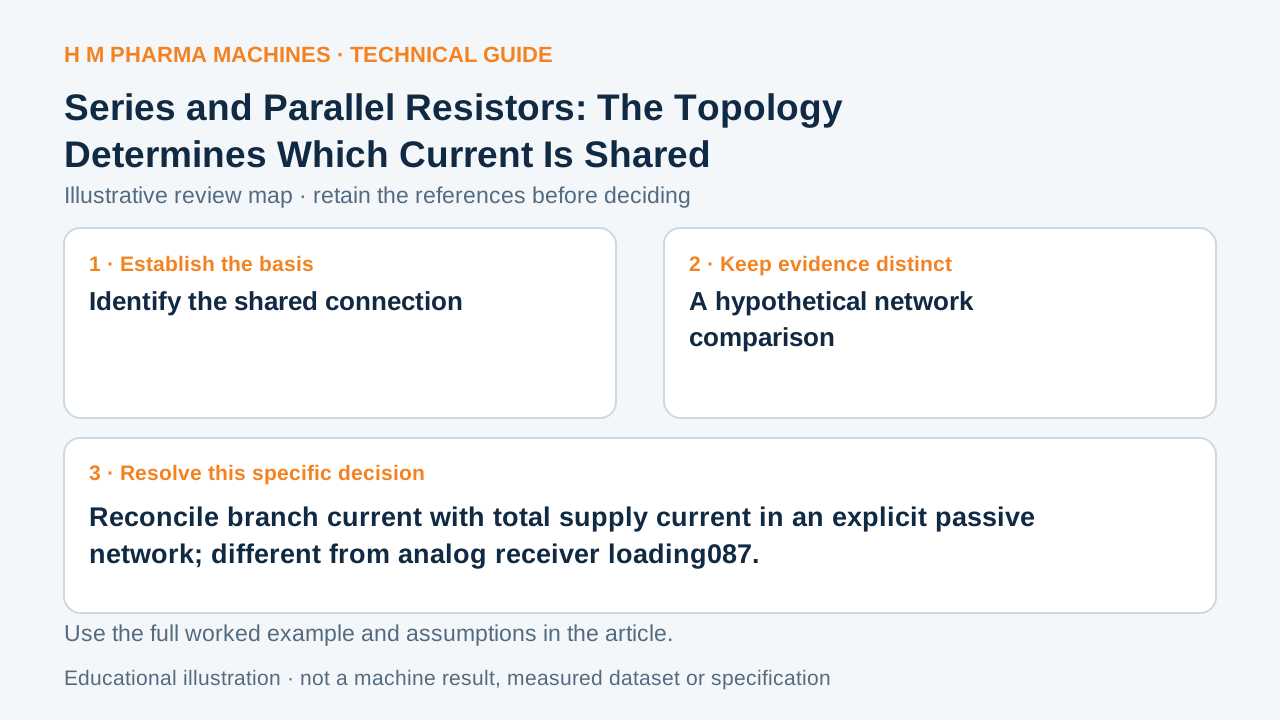
Use the actual circuit topology to distinguish branch current from the current supplied to the whole network.
Identify the shared connection
Series resistors share one current path; parallel resistors share the voltage between the same two nodes. Their branch currents add at the junction. Primary reference: resistor networks.
A sketch needs node identities, not only a list of resistance values. Two components drawn beside each other are not necessarily parallel. Trace both ends of each branch before choosing the equivalent-resistance relation.
A hypothetical network comparison
Imagine ideal 100 Ω and 200 Ω resistors supplied from a fictional 12 V source. In series, their equivalent resistance is 300 Ω and each carries 0.040 A. The voltage drops are 4 V and 8 V. Neither resistor receives the complete supply voltage.
In parallel, each receives 12 V. Their branch currents are 0.120 A and 0.060 A, so supply current is 0.180 A. Calling the larger branch current the total would omit the other current path. These cases describe passive teaching networks, not an installed control circuit.
Make the drawing checkable
Write a node-to-node connection table, equivalent resistance, branch voltage, branch current and total current. Check that the current sum and voltage relationships match the selected drawing.
If the intended review involves active devices, changing loads or a nonideal source, add those models explicitly. Request the approved schematic before interpreting a current reading as evidence about one component. The worksheet clarifies which current the reviewer is actually comparing.
Customer Questions
Do series resistors share equal voltage?
They share current; their voltage drops depend on resistance.
Is a parallel branch current the supply current?
Supply current includes every connected branch.
Does the sketch authorize rewiring?
Use the approved circuit and responsible electrical review.
Primary References
These references support the technical principles discussed in this guide. The worked examples and review questions are educational.
Discuss Your Machine Requirement
Share your product, container, required output and the evidence needed for your technical review.
Request a Technical Review