
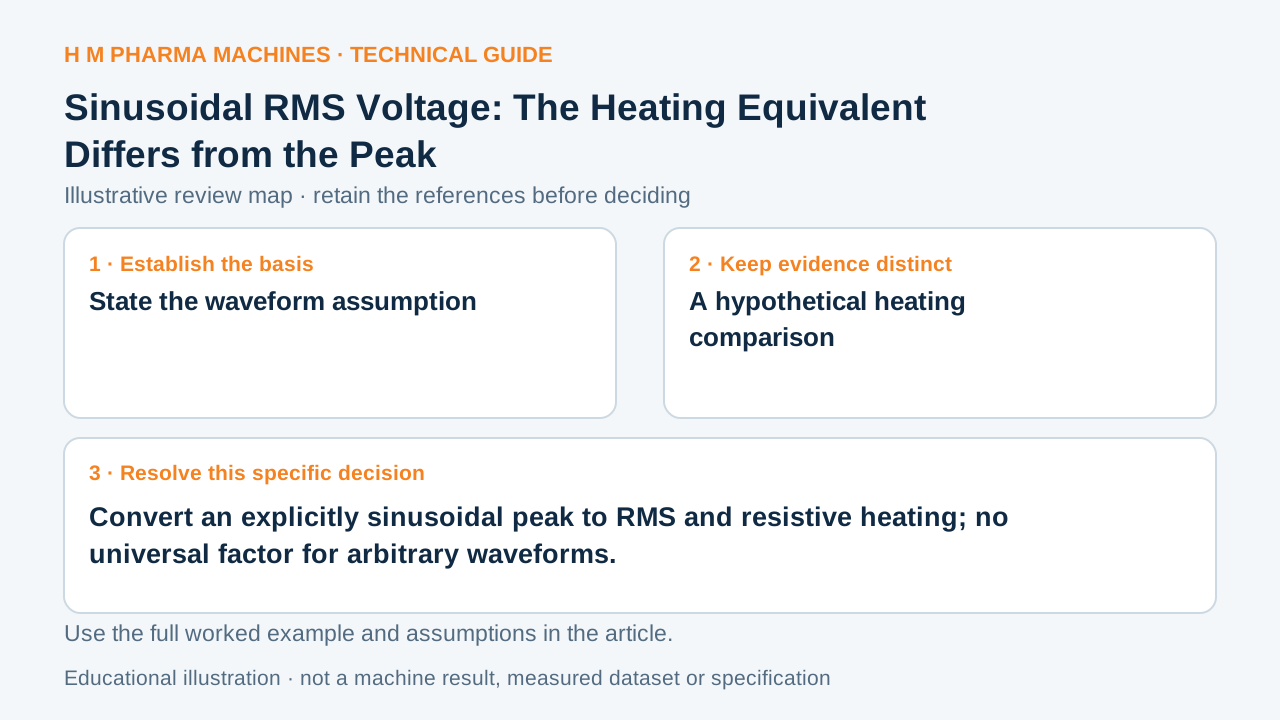
Convert a stated sinusoidal peak into RMS before comparing ideal resistive heating.
State the waveform assumption
RMS means the square root of the mean square. For a sinusoidal voltage, RMS equals peak divided by √2. Primary reference: AC RMS convention.
A voltage label must retain whether it is peak, peak-to-peak or RMS. The sinusoidal conversion cannot be silently applied to a pulsed or distorted signal. Ordinary arithmetic averaging of a symmetric alternating voltage also does not describe its resistive heating.
A hypothetical heating comparison
Consider an invented sinusoid with 20 V peak across an ideal 100 Ω resistor. Its RMS voltage is approximately 14.142 V, so average resistive power is 14.142²/100 =2 W. Using the 20 V peak as a DC-equivalent heating value would instead give 4 W.
A symmetric square wave alternating between +20 V and −20 V has 20 V RMS under the ideal model, despite having the same peak magnitude. It gives 4 W in the same resistor. This original comparison illustrates waveform dependence; it selects no actual resistor or voltage range.
Make a voltage specification usable
Record waveform, frequency, voltage convention, any DC component and the load assumption. Preserve the acquisition bandwidth and calculation window when reviewing an actual RMS result.
An electrical assessment must use the real component conditions and complete waveform evidence. The worksheet prevents a drawing or test record from changing its meaning merely because the word peak was omitted beside a voltage number.
Customer Questions
Is peak divided by √2 universal?
That factor requires the stated sinusoidal waveform.
Does zero average voltage imply zero heating?
RMS can remain nonzero for an alternating waveform.
Do equal peaks guarantee equal RMS?
Different waveforms can have different RMS values.
Primary References
These references support the technical principles discussed in this guide. The worked examples and review questions are educational.
Discuss Your Machine Requirement
Share your product, container, required output and the evidence needed for your technical review.
Request a Technical Review