
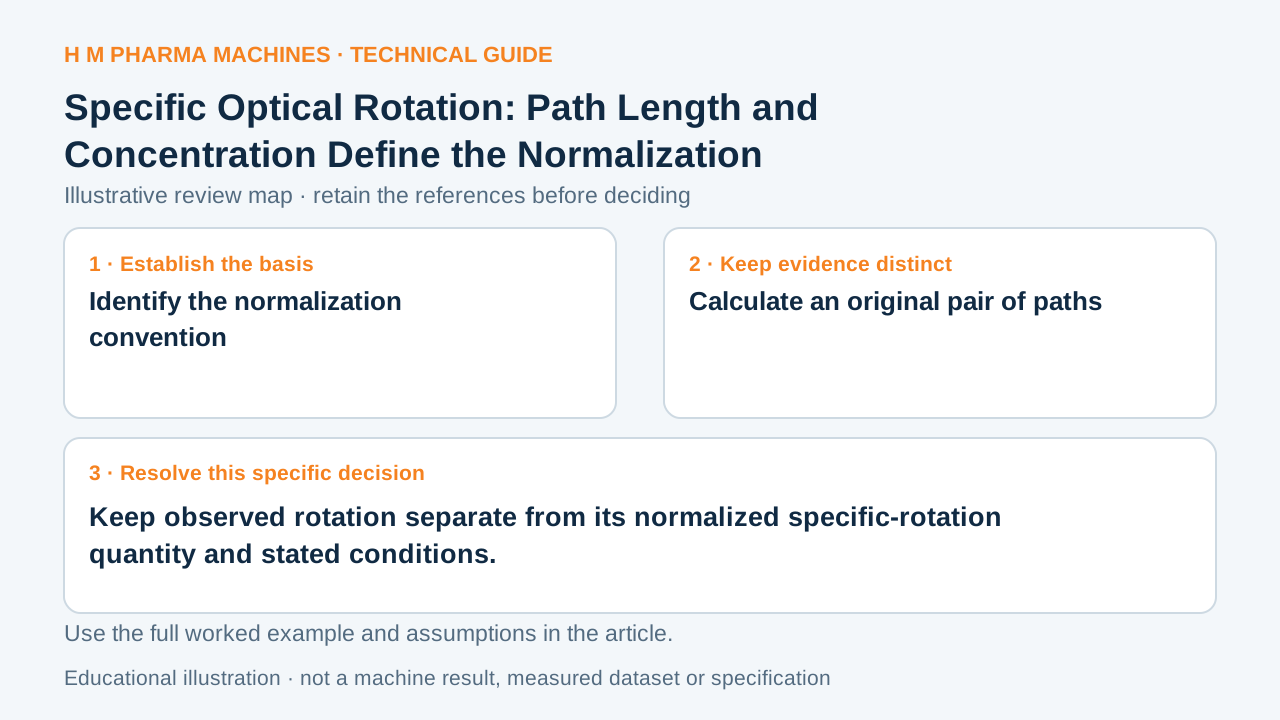
A specific-rotation value needs its path, concentration units, wavelength and temperature basis.
Identify the normalization convention
Specific optical rotatory power normalizes observed rotation by optical path and mass concentration; a normalization using amount concentration is a different molar basis. Temperature and wavelength conditions belong to the value. A rotation angle cannot be exchanged for a normalized material quantity without those inputs. Primary reference: IUPAC: optical rotatory power.
This worksheet defines [alpha] = alpha/(l c), with alpha in degrees, l in decimetres and c in grams per millilitre. The resulting unit is degree mL/(g dm). Other concentration conventions require their explicit conversion factors rather than silently reusing this number.
Calculate an original pair of paths
In a fictional observation, alpha is +2 degrees, l is 1 dm and c is 0.05 g/mL. The defined specific rotation is +40 degree mL/(g dm). Under the same stipulated linear normalization, a 2 dm path gives +4 degrees while preserving that specific-rotation value.
If concentration were instead entered as 5 because a record said 5 g per 100 mL, the calculation would give 0.4 without the required factor of 100. That wrong input represents a unit-basis mistake, not a hundredfold change in the sample. No real compound or standard value is used here.
Keep the conditions with the result
Record signed angle, path value and unit, concentration value and denominator, solvent, temperature and wavelength. Write the chosen normalization formula on the worksheet. Retain whether the concentration represents mass or amount of substance so two differently defined quantities are not mixed.
Before a comparison, convert both records to the same declared basis and inspect whether the conditions support comparison. A matching normalized number alone does not establish identity, purity or an enantiomeric composition. The original example concerns reporting and arithmetic, not a pharmacopeial procedure or an HM instrument specification.
Customer Questions
Which concentration basis is used here?
Grams per millilitre is explicit.
What does doubling the fictional path do?
The stipulated angle doubles to +4 degrees.
Does +40 identify a compound?
The example provides no identity evidence.
Primary References
These references support the technical principles discussed in this guide. The worked examples and review questions are educational.
Discuss Your Machine Requirement
Share your product, container, required output and the evidence needed for your technical review.
Request a Technical Review