
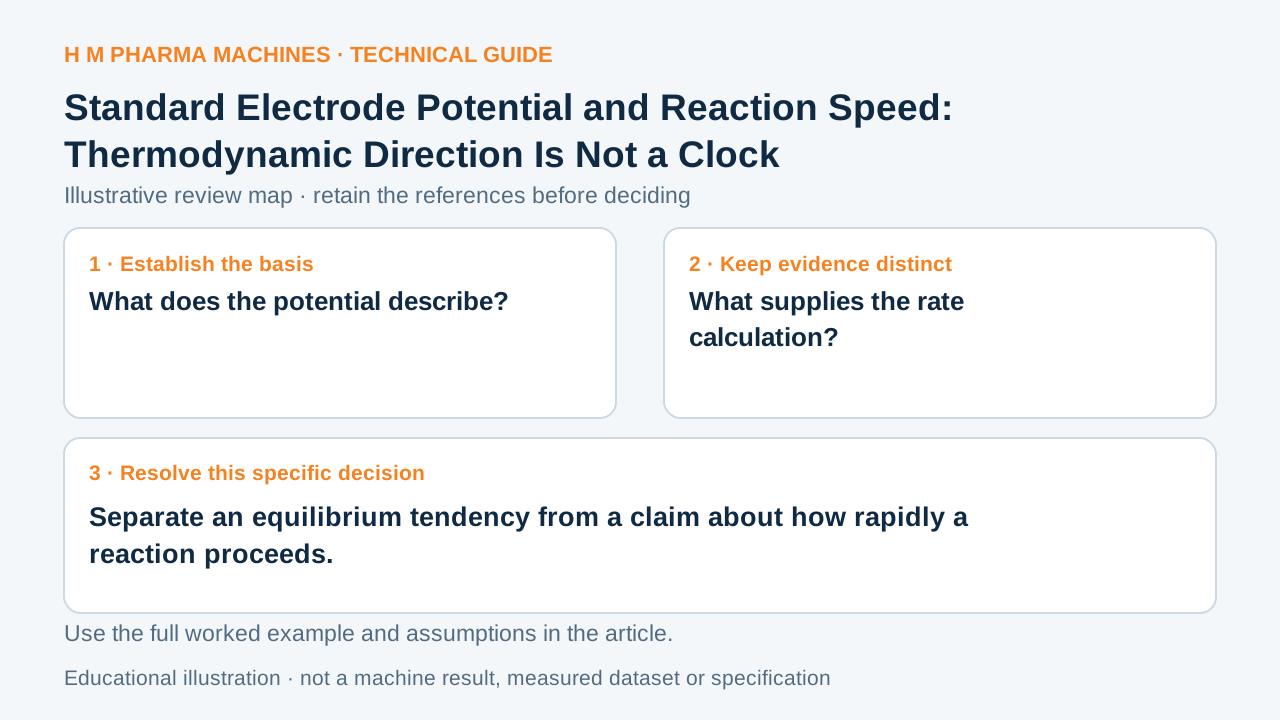
A thermodynamic direction does not supply a reaction timescale. A positive standard cell potential can support an equilibrium comparison while leaving kinetics unresolved.
Separate potential from a rate model
A standard electrode potential uses a defined reference and standard-state conditions. Reaction speed concerns kinetic behavior, including the pathway and activation barrier. A potential difference is not itself a rate constant and does not establish how quickly a chemical inventory changes. Primary reference 1. Primary reference 2.
Compare constructed kinetic information
Construct two abstract reactions, each assigned standard cell potential +0.200 V. Supply separate fictional first-order kinetic constants of 0.100 s⁻¹ and 0.0100 s⁻¹, and a common starting concentration of 0.200 mol/L. Their initial modeled disappearance rates are 0.0200 and 0.00200 mol/(L s).
The ten-fold rate difference follows the supplied kinetic models, even though the assigned potential values are equal. These invented inputs do not assert that any named real reactions have those properties. Removing the kinetic constants would remove the basis for the rate comparison.
Retain the evidence needed for time claims
Prepare an original interpretation record distinguishing standard potential data, actual composition and observed rate evidence. If a completion time is claimed, retain the fitted kinetic relationship and its applicable conditions rather than substituting an equilibrium sign. Surface state, transport or other processes may also affect an actual observation.
This guide is not an oxidant recommendation or a prediction of cleaning speed. Its decision is whether a time or rate claim has evidence beyond thermodynamic favorability. The separate half-life guide addresses the consequences of already specified rate-law orders; this article asks whether kinetic information exists at all.
Solution review worksheet
This blank worksheet is for your own project. It contains no H M machine trial result.
| Question | Record to retain |
|---|---|
| What does the potential describe? | Specified thermodynamic reference |
| What supplies the rate calculation? | Applicable kinetic law and constant |
| What was actually observed? | Time-resolved evidence and its conditions |
Customer Questions
What are the fictional initial rates?
0.0200 and 0.00200 mol/(L s).
What establishes their ten-fold difference?
The separately supplied kinetic constants.
Does a positive potential alone supply completion time?
No.
Primary References
These references support the technical principles discussed in this guide. The worked examples and review questions are educational.
Discuss Your Machine Requirement
Share your product, container, required output and the evidence needed for your technical review.
Request a Technical Review