
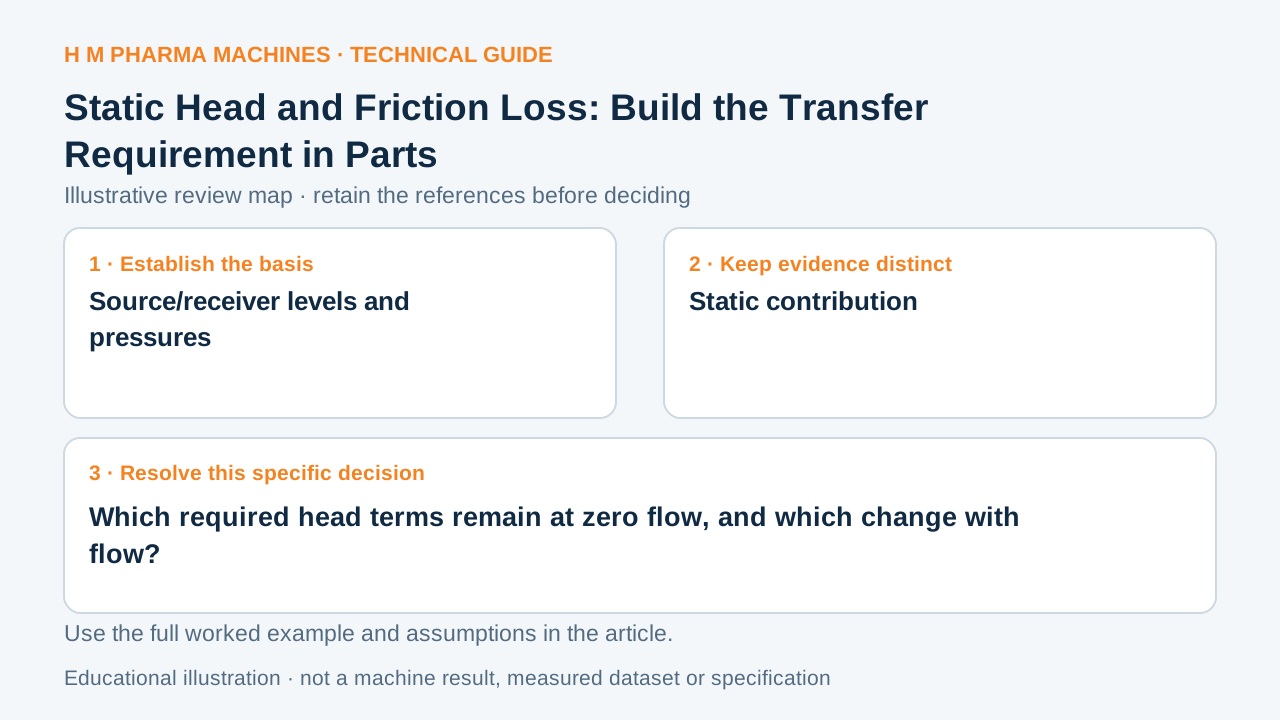
Separate the flow-independent transfer requirement from losses that change as liquid moves through the selected route.
Two Contributions Answer Different Questions
A system characteristic curve relates required system head to flow. KSB separates its flow-independent contribution from head losses. The static contribution can reflect level and boundary-pressure differences; the loss contribution describes resistance along the route.
Keep these terms separate when asking for a transfer pump. One elevation number cannot describe a long route with fittings. Equally, a friction-only estimate can omit a difference between the source and receiving conditions that still exists when flow approaches zero. KSB primary engineering reference.
A Clearly Bounded Illustration
Suppose a hypothetical route is represented by Hsys = 4 + 0.02Q², with H in metres and Q in m³/h. At Q = 10 the model gives 6 m; at Q = 20 it gives 12 m. The 4 m term stays constant while the modelled loss term increases.
These coefficients are invented, not measured pipe data. A quadratic loss relationship assumes an appropriate regime and sufficiently consistent loss coefficients. It should not be applied automatically to every viscous or non-Newtonian product. Ask the engineer which model represents the actual route.
Preserve the Operating Cases
List the source and receiving levels or pressures that can change during a batch. Those changes can shift the system curve even if the piping stays identical. Describe the route alternatives independently, including whether a bypass or shared transfer path is part of the calculation.
Use the worksheet to retain static terms, loss-model inputs and the intended flow range. Comparing these parts helps explain why two apparently similar transfer duties may need different assessments. It does not prescribe a valve position or establish a pump operating range. Relevant HM context: Pharmaceutical Storage Tank.
Static Head and Friction Loss: Build the Transfer Requirement in Parts — blank review record
This blank worksheet is for your own project. It contains no H M machine trial result.
| Question | Reference or result | Owner/status |
|---|---|---|
| Source/receiver levels and pressures | To complete | To complete |
| Static contribution | To complete | To complete |
| Loss model and route revision | To complete | To complete |
| Required flow cases | To complete | To complete |
Customer Questions
Does the system curve always pass through zero?
No. A flow-independent requirement can give it a nonzero head at zero flow.
Are losses always proportional to Q²?
Use that approximation only when its model assumptions suit the fluid and route.
Can one maximum tank level cover every case?
The engineer should assess the relevant combinations of source and receiver conditions.
Related Equipment References
Review the actual offered equipment and application separately from this educational example.
Primary References
These references support the technical principles discussed in this guide. The worked examples and review questions are educational.
Discuss Your Machine Requirement
Share your product, container, required output and the evidence needed for your technical review.
Request a Technical Review