
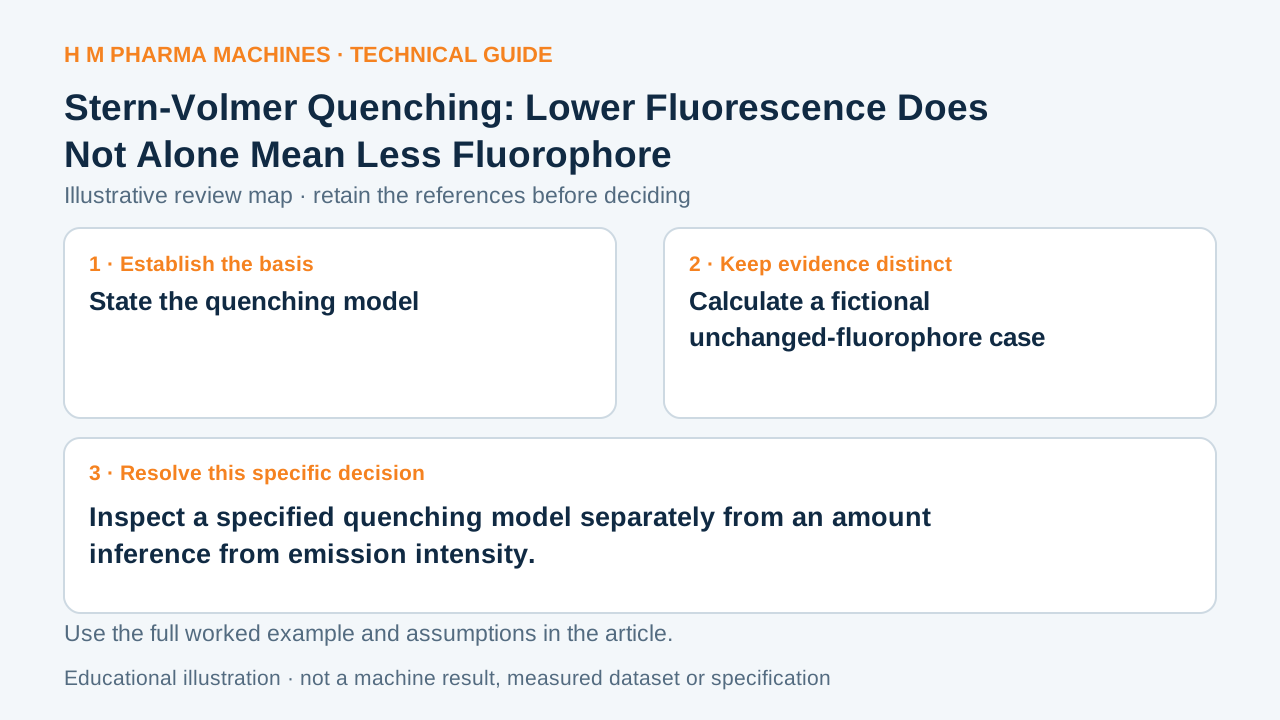
A lower fluorescence signal can arise from quenching even when the stipulated amount of fluorophore is unchanged.
State the quenching model
The simplest Stern-Volmer relationship can express the unquenched-to-quenched emission ratio as F0/F = 1 + KSV[Q]. The constant and quencher concentration must have compatible units. Its applicability depends on the stated quenching mechanism and assumptions rather than on the existence of any fluorescence decrease. Primary reference: IUPAC: Stern-Volmer kinetic relationships.
Do not identify all reduced emission as less fluorophore. Changes in the sample or observation conditions can affect the signal. A model of quenching provides one explicit mechanism to examine; it does not alone establish what happened in a real preparation.
Calculate a fictional unchanged-fluorophore case
Set KSV to 100 L/mol and quencher concentration to 0.005 mol/L in an invented model. The ratio F0/F is 1.5. If the unquenched signal is 90 arbitrary units, the calculated quenched signal is 60 units. The stipulated fluorophore amount remains fixed throughout this calculation.
Treating 60/90 as a direct fraction of the fluorophore would therefore misinterpret the defined example. Conversely, observing that ratio in an experiment would not prove the fictional KSV or mechanism. Many different physical changes could yield the same numerical decrease.
Review model inputs before inference
Create fields for F0, F, the measured ratio, quencher identity, [Q], its unit, the proposed KSV and relevant observation conditions. Mark whether the constant is supported for that system or merely an assumed number. Keep the arithmetic separate from a claim of mechanism.
A useful review asks what evidence distinguishes quenching from other signal changes and whether the selected relationship fits the data over its intended range. Do not apply this invented coefficient to an assay. The worksheet explains interpretation of one model and establishes no analytical detection capability for HM machinery.
Customer Questions
Does the toy model reduce fluorophore amount?
It holds that amount fixed.
What ratio follows the invented inputs?
F0/F equals 1.5.
Does a 60-unit observation prove quenching?
A numerical decrease alone does not.
Primary References
These references support the technical principles discussed in this guide. The worked examples and review questions are educational.
Discuss Your Machine Requirement
Share your product, container, required output and the evidence needed for your technical review.
Request a Technical Review