
Use a Stokes settling estimate only after checking the particle and flow assumptions that make it meaningful.
Define the Process Model
For an isolated sphere in a Newtonian liquid under creeping-flow conditions, balancing buoyancy-corrected weight with Stokes drag gives v = (ρp − ρf)gd²/(18μ). OpenStax’s viscous-fluid discussion provides the drag basis. The estimate depends on diameter squared, density difference and viscosity; it is not a general rule for concentrated or irregular-particle suspensions.
Compare a Hypothetical Case
Assume an invented sphere has d = 20 µm, density difference 500 kg/m³ and μ = 0.010 Pa·s. With g = 9.81 m/s², the modeled terminal speed is about 1.09×10⁻⁵ m/s. Taking ρf = 1,000 kg/m³ gives particle Reynolds number ρfvd/μ ≈ 2.18×10⁻⁵. Doubling diameter would quadruple the modeled speed, with the validity check repeated.
Complete the Engineering Review
Record particle geometry, concentration and the density and viscosity conditions. Calculate the resulting particle Reynolds number rather than assuming small diameter automatically establishes creeping flow. Identify walls, aggregation and particle interactions that can invalidate the isolated-sphere approximation. If those effects matter, select evidence or a model suited to them instead of reporting excessive decimal precision.
For a storage-tank discussion, provide actual product characterization and holding conditions. This arithmetic does not predict a real batch separation time or prescribe agitation. It explains the assumptions behind a simplified material-settling estimate.
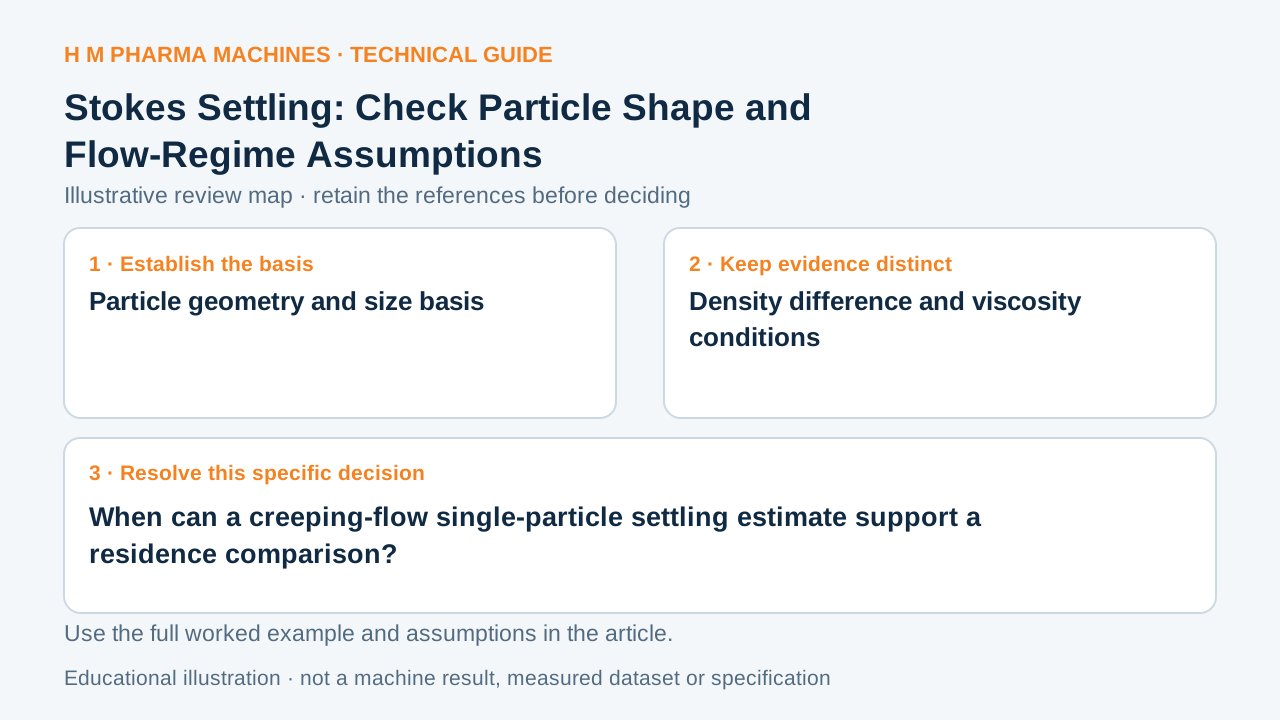
When can a creeping-flow single-particle settling estimate support a residence comparison?
This blank worksheet is for your own project. It contains no H M machine trial result.
| Review field | Reference or result | Responsible person |
|---|---|---|
| Particle geometry and size basis | To complete | To complete |
| Density difference and viscosity conditions | To complete | To complete |
| Predicted speed and particle Reynolds number | To complete | To complete |
| Concentration, walls and aggregation effects | To complete | To complete |
Customer Questions
Is this valid for every powder shape?
The stated relation assumes an isolated sphere.
Does diameter alone establish validity?
Check the resulting particle Reynolds number.
Can concentration change the result?
Interacting particles need a different treatment.
Related Equipment References
Review the actual offered equipment and application separately from this educational example.
Primary References
These references support the technical principles discussed in this guide. The worked examples and review questions are educational.
Discuss Your Machine Requirement
Share your product, container, required output and the evidence needed for your technical review.
Request a Technical Review