
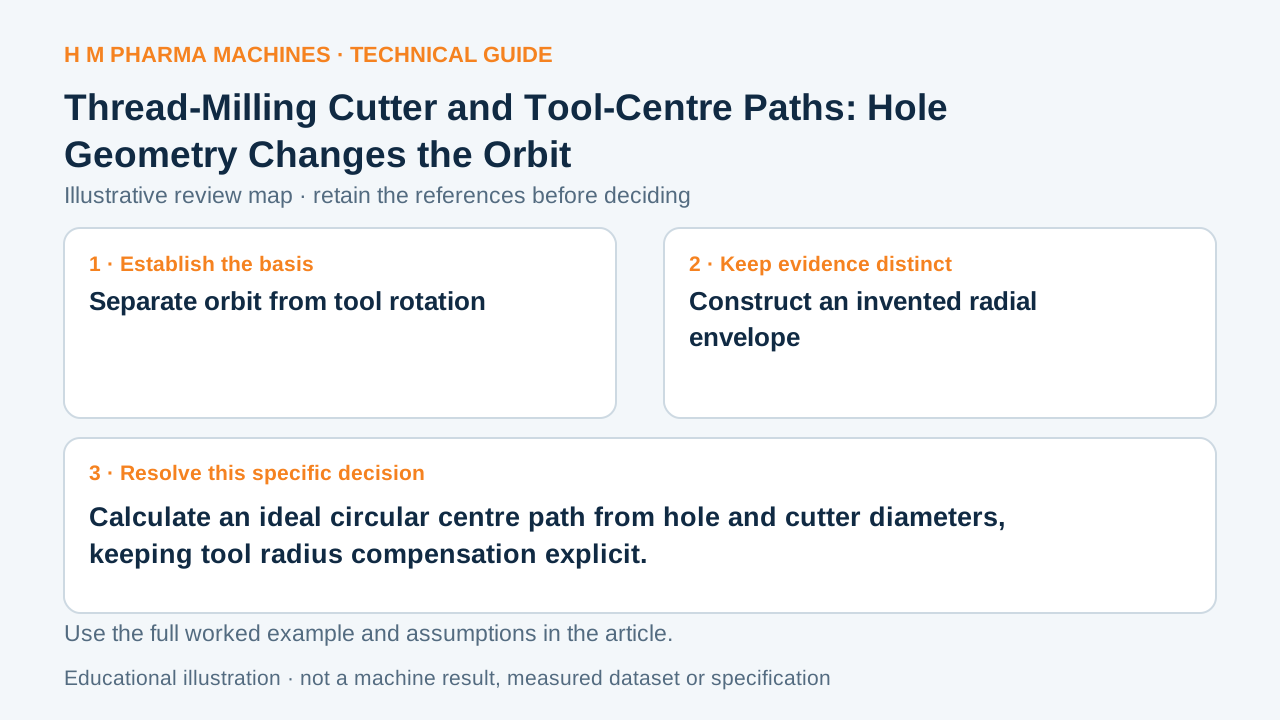
The cutter center travels inside the intended wall, rather than along that wall radius.
Separate orbit from tool rotation
Harvey describes thread milling through interpolation of the cutter around or inside a workpiece. Cutter orbit and spindle rotation are separate motions. Primary reference: Harvey technical explanation.
Construct an invented radial envelope
Consider a fictional cylindrical contact envelope of diameter 20 mm and an effective cutter diameter of 6 mm. In the ideal circular tangency model, the center-orbit radius is 10−3=7 mm.
If the center were instead sent around a 10 mm radius, the same outward cutting envelope would reach radius 13 mm, or diameter 26 mm. This is a geometric construction, not a complete thread-form tool path. Actual flank profile, cutter definition, compensation and interpolation direction require their own treatment.
Preserve the contact and path conventions
Record which diameter belongs to the intended envelope and which belongs to the active cutter geometry. Draw the center path and outer contact path separately. Keep orbital advance per revolution distinct from spindle RPM; a helical path adds another axial relationship.
Ask how the actual CAM or controller handles cutter compensation rather than applying this toy subtraction directly to a program. The worksheet detects a center-versus-envelope confusion and identifies the remaining geometry evidence. It does not establish thread tolerance, recommend a cutter size or claim that one simplified circle defines every internal thread profile.
Customer Questions
What is the fictional center-orbit radius?
Seven millimeters.
Is orbit speed the cutter spindle speed?
They describe separate motions.
Is the circle a complete thread path?
Actual profile and compensation are omitted.
Primary References
These references support the technical principles discussed in this guide. The worked examples and review questions are educational.
Discuss Your Machine Requirement
Share your product, container, required output and the evidence needed for your technical review.
Request a Technical Review