
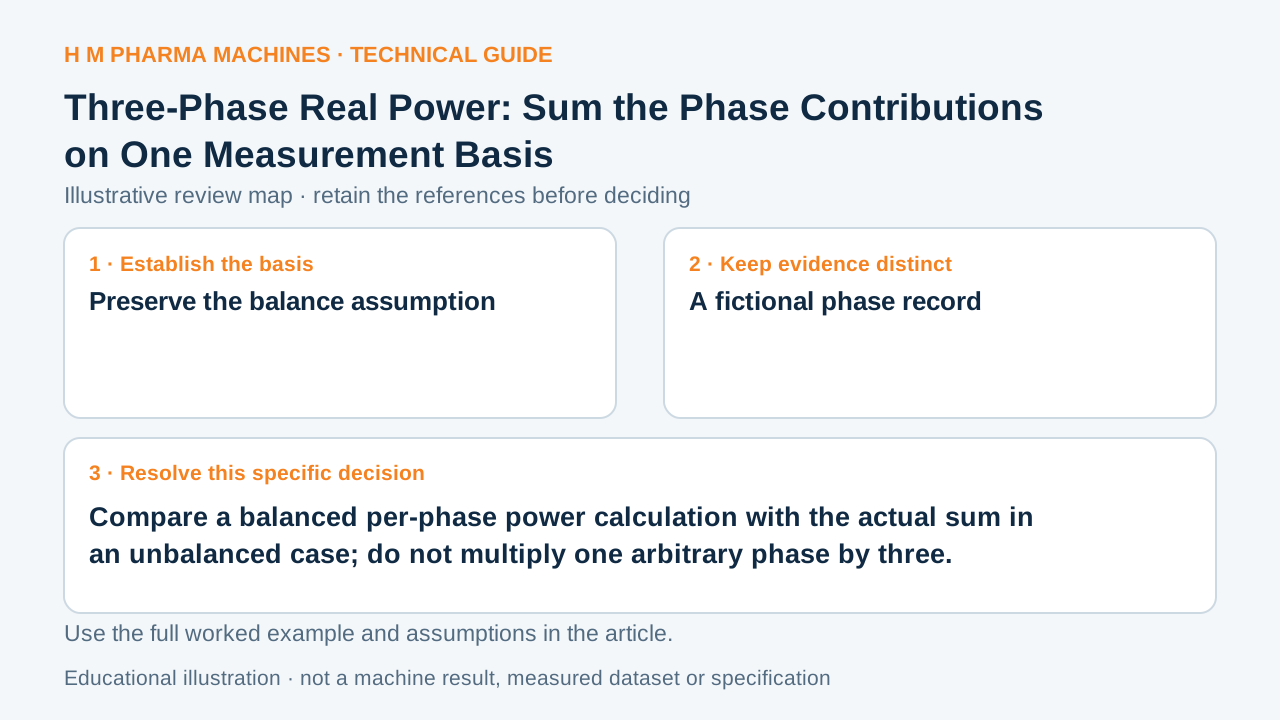
Add the actual phase real-power contributions instead of multiplying one arbitrary phase by three.
Preserve the balance assumption
Fluke explains total power as the sum of the respective phase contributions in its balanced-system discussion. Balance permits equal contributions to be multiplied by three. Primary reference: balanced phase power.
An actual unbalanced comparison needs its phase-specific information. Retain whether the numbers are active power, apparent power or reactive power. Adding unlike categories would create a result whose unit label conceals a changed physical meaning.
A fictional phase record
Imagine equal sinusoidal phase-to-neutral RMS voltage 230 V, phase RMS current 5 A and displacement factor 0.80 for each of three balanced phases. The modeled real power per phase is 230×5×0.80 =920 W, giving 2,760 W total under those assumptions.
In a separate invented unbalanced record, the actual phase real powers are 300 W,500 W and 700 W. Their sum is 1,500 W. Multiplying the first phase by three would give 900 W and omit the differences. Neither scenario is an HM machine power measurement.
Make the total traceable
Create three phase rows and one total row. Identify the measurement boundary, time interval, power category and connection model beside the results.
When reviewing a quoted total, request its source phase values or the evidence supporting a balanced assumption. The useful outcome is a number whose calculation can be followed without silently substituting one convenient phase for the complete system.
Customer Questions
Can any one phase be multiplied by three?
Equal contributions need a justified balanced basis.
Can watts and volt-amperes be added here?
Retain the same power category across the sum.
Are the teaching values installed consumption?
They are fictional calculations only.
Primary References
These references support the technical principles discussed in this guide. The worked examples and review questions are educational.
Discuss Your Machine Requirement
Share your product, container, required output and the evidence needed for your technical review.
Request a Technical Review