
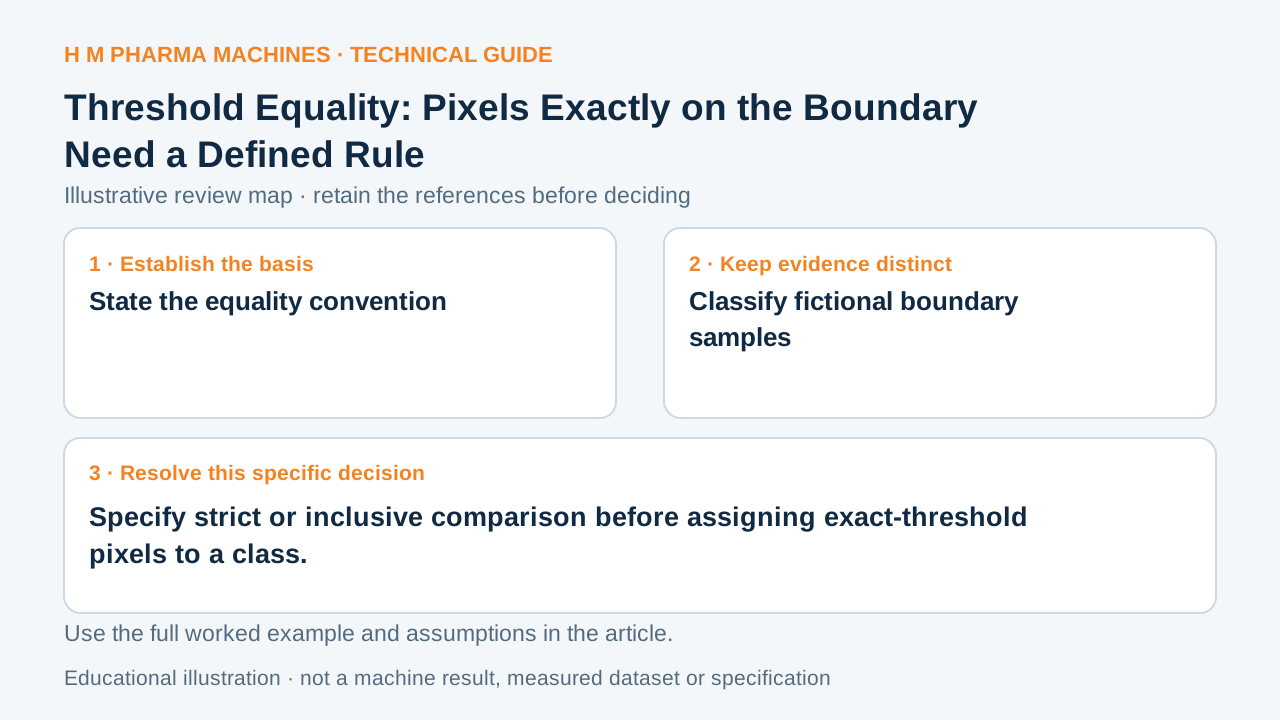
A sample equal to a cutoff needs an explicit comparison rule. Greater-than and greater-than-or-equal do not classify it identically.
State the equality convention
A binary threshold definition specifies which side of a cutoff receives the foreground value. A strict greater-than comparison leaves equality on the other side; an inclusive greater-than-or-equal rule includes it. The threshold value alone therefore does not completely define the class assignment. Primary reference: OpenCV binary threshold strict-comparison definition.
For an original worksheet, retain the comparison symbol, output encoding and input units. Keep equality handling with the rule instead of inferring it from a rounded verbal description. Storage conversion or earlier rounding can place several samples exactly at the stated cutoff.
Classify fictional boundary samples
Use invented values [127,128,129] with cutoff 128 and foreground code 1. The strict condition value greater than 128 gives [0,0,1]. The separate inclusive condition value at least 128 gives [0,1,1]. Only the equal-boundary sample changes class.
The two comparisons are explicitly different teaching rules, not interchangeable settings or an approved physical tolerance. The example uses exact integer values and no preceding rounding. It does not establish which rule is appropriate for the actual feature or an HM inspection system.
Test the boundary deliberately
Prepare an original three-point boundary test with a sample below, equal to and above the cutoff. Record expected outputs before comparing a proposed implementation. If the input scale or rounding changes, revisit which observed values can meet the exact equality case.
This guide recommends no inspection cutoff and certifies no HM classification performance. Its reader decision is whether the comparison itself was defined. A successful boundary test proves the stated numerical rule on those samples; it does not by itself validate the physical acceptance interpretation.
Customer Questions
What happens to fictional value 128 under the strict rule?
It receives background code zero.
What happens under the inclusive rule?
It receives foreground code one.
Does the cutoff number alone specify equality handling?
No. The comparison rule is also needed.
Primary References
These references support the technical principles discussed in this guide. The worked examples and review questions are educational.
Discuss Your Machine Requirement
Share your product, container, required output and the evidence needed for your technical review.
Request a Technical Review