
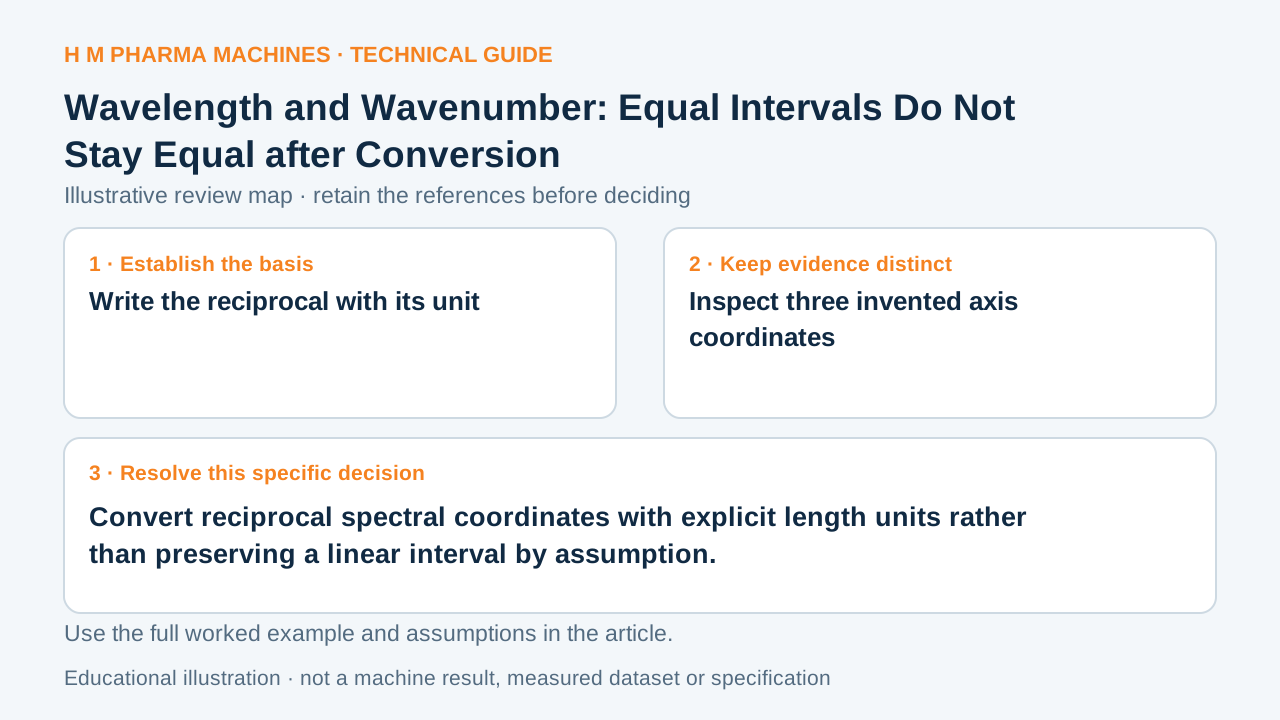
Equal wavelength increments map to unequal wavenumber increments because the coordinate conversion is reciprocal.
Write the reciprocal with its unit
Wavenumber is the reciprocal of wavelength, with an SI unit of inverse metres; spectroscopy often uses inverse centimetres. The wavelength basis must be stated, including whether it describes vacuum or a medium. A number without its wavelength unit cannot safely be inverted into a spectroscopy coordinate. Primary reference: IUPAC: wavenumber.
For wavelength expressed in micrometres, the conversion to inverse centimetres is 10000 divided by the wavelength value. The conversion changes coordinate spacing as well as coordinate labels. It should not be replaced by a fixed linear multiplier over a wide wavelength interval.
Inspect three invented axis coordinates
An original worksheet lists 5, 6 and 7 micrometres. Their wavenumbers are 2000, about 1666.667 and about 1428.571 cm^-1. The successive wavelength increments both equal 1 micrometre, but the wavenumber decreases are approximately 333.333 and 238.095 cm^-1.
The point order reverses under the reciprocal mapping: increasing wavelength means decreasing positive wavenumber. These results concern coordinates only. Relabeling three points does not imply that a uniformly sampled wavelength spectrum has become uniformly sampled in wavenumber or gained additional measured information.
Check conversion and plotting assumptions
Put wavelength, wavelength unit, converted length in centimetres, reciprocal value and neighboring interval in separate worksheet columns. Reconstruct the starting wavelength from the reciprocal as a check on unit scale. Keep the full precision until the displayed values are rounded.
If a later calculation requires a uniform wavenumber grid, identify the interpolation and its purpose explicitly. Do not silently call the original transformed points uniform. The coordinate example establishes neither spectral resolution nor peak identity, and it supplies no acceptance criterion for a pharmaceutical measurement.
Customer Questions
Do the two 1 micrometre steps become equal steps?
Their reciprocal differences are unequal.
Does changing the axis add measurements?
It only transforms the existing coordinates.
What factor converts micrometres to cm^-1?
Use 10000 divided by wavelength in micrometres.
Primary References
These references support the technical principles discussed in this guide. The worked examples and review questions are educational.
Discuss Your Machine Requirement
Share your product, container, required output and the evidence needed for your technical review.
Request a Technical Review