
In This Guide
- Record what the stop actually interrupted
- Check the product condition before comparing recipes
- Use the restart procedure for the actual product path
- Keep initial bottles identifiable
- Compare the beginning with the continuing run
- Turn a recurring restart issue into an approved action
- Customer Questions
- Product References
- Discuss Your Requirement
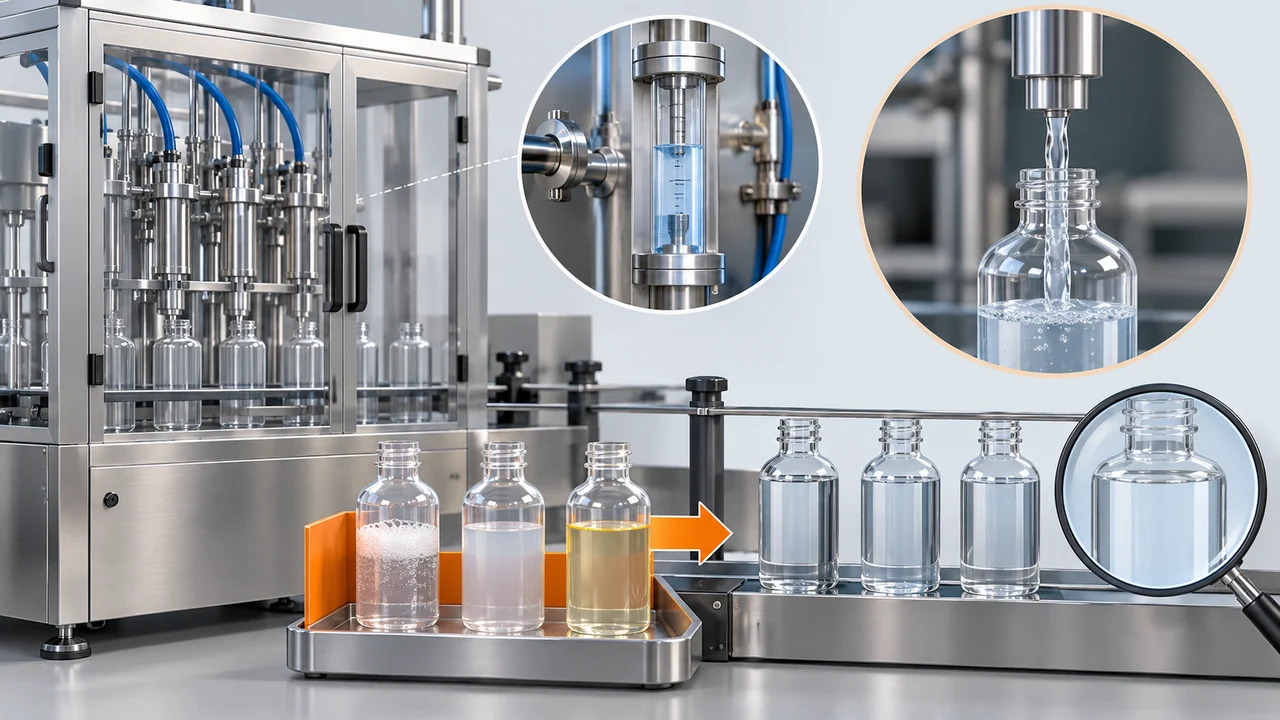
The first bottles after a long stop deserve their own observation record. Product may have changed condition while stationary, and the supply path may not be in the same state as it was during the preceding run. A bottle liquid filling machine or flowmeter liquid filling machine should be restarted through its approved procedure, with the initial output identified until acceptance is confirmed.
Retain the approved recipe, record the stop and product conditions, complete the manufacturer-defined restart procedure and identify first-off bottles. Confirm the agreed quantity and appearance checks before releasing restart output into ordinary production.
Record what the stop actually interrupted
Note why the line stopped and where containers remained. Distinguish a planned production pause from loss of product feed, a utility interruption or a cleaning-related shutdown. Record whether the product path was left filled, drained or otherwise handled under the operating procedure.
These differences matter when interpreting the first results. A restart after a supply container exchange is not equivalent to a restart after equipment inspection. Without a short description of the stop, the supplier receives an unexplained first-bottle problem rather than an identifiable operating condition.
Check the product condition before comparing recipes
Review the product identity, observed temperature and any visible separation, settling or aeration with the responsible process team. Do not assume that stationary material remains representative merely because the recipe has not changed. The approved product-handling procedure determines whether the material can be used and what preparation is required.
Do not introduce an improvised mixing, heating or flushing step to make the filler restart. If product or equipment condition is outside the agreed operating scope, resolve that condition before using filling adjustments to compensate for it.
Use the restart procedure for the actual product path
Follow the machine-specific instructions for returning the product feed and dosing system to operation. A flowmeter-based filler depends on its selected meter and feed arrangement, while the general bottle filler may use another dosing method. An instruction appropriate to one configuration should not be transferred to the other by analogy.
Any priming, purge, drain or valve operation must be defined for the supplied equipment and product. Record which approved step was completed. Never disconnect a pressurized line or bypass a guard or interlock to accelerate the restart.
Keep initial bottles identifiable
| Restart record | Decision it supports |
|---|---|
| Stop cause and duration record | Which restart procedure applies |
| Product and feed-path condition | Whether the material is suitable to resume |
| Recipe and configuration identity | Whether the approved baseline is retained |
| First-off bottle sequence and head | Where an initial deviation appears |
| Quantity and visible condition | Whether the agreed checks are satisfied |
| Disposition and authorized release | Which bottles may join normal output |
The sampling quantity and acceptance limits belong to the approved production or trial plan. Do not invent a universal number of bottles that is guaranteed to make every restart acceptable.
Compare the beginning with the continuing run
A problem that disappears as the run continues can have a different explanation from a persistent channel-specific deviation. Keep the initial observations alongside later checks under comparable conditions. Record the point at which the agreed acceptance checks were met, rather than discarding the first results from the report.
If the same pattern repeats after similar stops, use that evidence to discuss the restart method with engineering. Repetition helps define a technical question; it does not prove that a particular valve, meter or recipe setting is the cause.
Turn a recurring restart issue into an approved action
Provide H M Pharma Machines with the stop timeline, completed restart steps, product conditions, head identities and individual results. Include the difference between the approved baseline and any authorized trial changes. Ask for a configuration-specific review of the product path and restart sequence.
Once a revised procedure or setting is approved, retain its revision identity with the operating record. The purpose is a repeatable, documented restart, with clear responsibility for product status and bottle release, rather than an operator-dependent workaround.
Customer Questions
How many restart bottles should be held?
Use the sampling and disposition rules approved for the actual product and line. There is no universal count that demonstrates an acceptable restart for every configuration.
Can the same priming method be used on every liquid filler?
No. Priming and restart steps depend on the supplied dosing system, product path and operating procedure.
Should a repeated first-off problem be corrected by changing the recipe?
First compare stop conditions, product feed and measured results with the approved baseline. A recipe change should be an authorized trial supported by that evidence.
Product References and Further Details
These pages describe published equipment arrangements. Review the supplied machine, actual materials and agreed operating requirements when applying the guide.
Discuss Your Machine Requirement
Share your product, container or closure samples, required output, process conditions and line layout with H M Pharma Machines for a technical review.
Request a Technical Review