
In This Guide
- Describe the delivery event before naming a fault
- Preserve tubing and channel identity
- Look at the supply path as well as the outlet
- Create a diagnosis sheet around comparable cycles
- Treat a proposed adjustment as a controlled comparison
- Define the support question clearly
- Customer Questions
- Product References
- Discuss Your Requirement
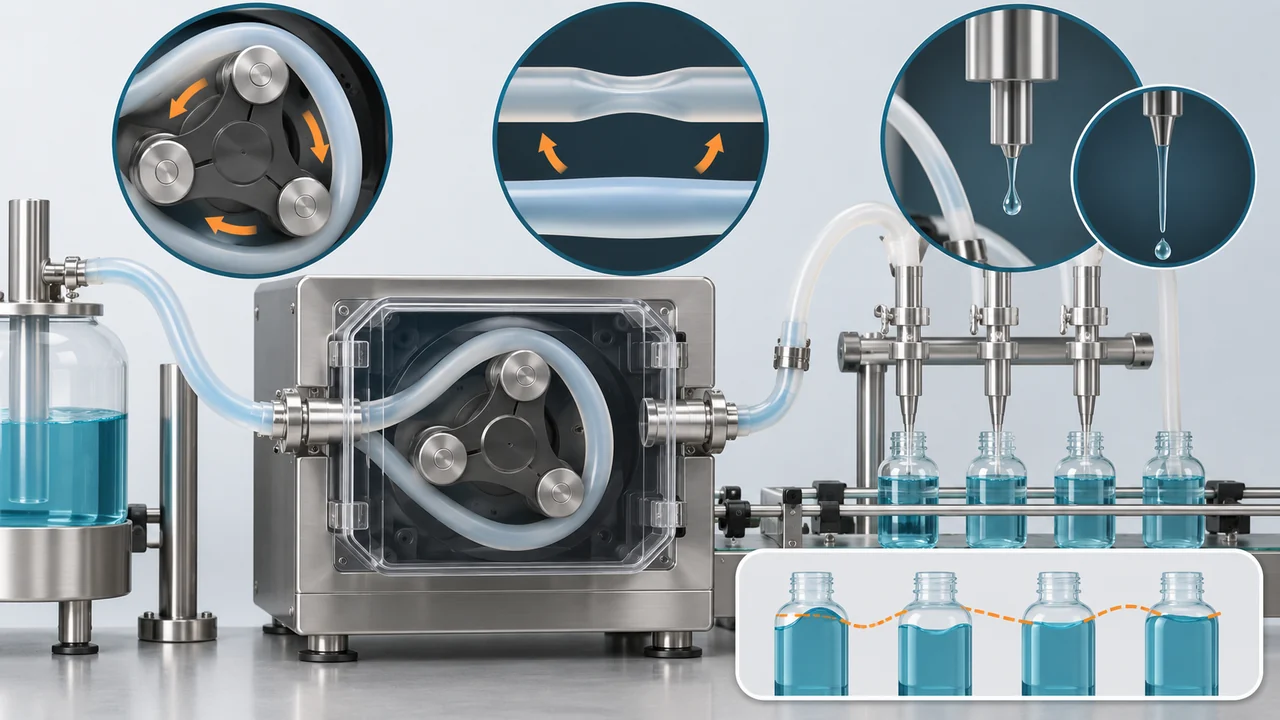
Visible pulses at a peristaltic filling outlet do not, by themselves, explain whether the final dose is acceptable. A peristaltic pump filling machine advances liquid through the repeated compression of tubing, so the delivery event should be interpreted over the supplied filling cycle. Useful observations connect the outlet behavior with quantity results, tubing identity and the actual product path.
Record when the pulses occur, the tube and channel involved, product-feed conditions and individual completed-dose results. Compare against the accepted setup before requesting an authorized change; do not assume that an uneven-looking stream proves unacceptable filling accuracy.
Describe the delivery event before naming a fault
Distinguish a repeated movement within normal delivery from an interrupted supply, a bubble event or an irregular start and finish. Note whether the observation is consistent throughout each cycle or appears unpredictably. This gives the supplier a clear sequence instead of the broad statement that the pump is pulsing.
Keep the final quantity checks with the recording. A video can show the visible event, but it cannot replace the agreed measurement method. Compare appearance and result without assuming that they are always directly related.
Preserve tubing and channel identity
Record the approved tubing reference, installed lot where available, relevant usage history and channel position. The tube is part of the supplied dosing arrangement, and a recent replacement or substitution is important context. Compare unaffected channels where the configuration provides them.
Do not swap tubes between channels simply to make the stream look more uniform. Any controlled comparison must retain identity and follow the supplied installation and product-contact procedure. Otherwise the original observation can no longer be linked reliably to its setup.
Look at the supply path as well as the outlet
Observe product-feed level, replenishment, visible air and the routing of the approved tubing set. A delivery concern that begins after a supply interruption deserves a feed review, not just a pump-speed discussion. Product condition and the way the liquid reached the filler should be included in the record.
Inspection of restrictions, connections or the pump head requires safe access under the equipment instructions. Do not squeeze a moving tube, disconnect a product line or reach into the mechanism to alter the pulse by hand.
Create a diagnosis sheet around comparable cycles
| Observation | Comparison to retain |
|---|---|
| Cycle stage | Start, main delivery and end of dose |
| Channel and tube | Approved reference and any recent change |
| Supply condition | Feed level, visible bubbles and interruption events |
| Recipe identity | Accepted baseline and authorized trial revision |
| Outlet appearance | Repeated pattern versus irregular interruption |
| Completed dose | Individual measured quantities under the agreed method |
Record the bottle and nozzle arrangement too. A changed outlet position or container format can affect what is observed without the pump mechanism having changed.
Treat a proposed adjustment as a controlled comparison
If engineering authorizes a setting change, identify exactly which part of the recipe changed and retain the baseline. Compare equivalent liquid, tubing and bottle conditions. A simultaneous speed, tube and nozzle change makes the technical interpretation much weaker.
Ask what the selected controls can actually vary. Do not assume that every machine has a special smoothing function or that an additional component is a standard remedy. Any proposal must be compatible with the product path, cleaning arrangement and intended filling cycle.
Define the support question clearly
Send H M Pharma Machines a concise sequence description, safe video and the associated quantity checks. Include tubing and channel identities, product properties, supply observations and the last accepted setup. State whether the concern is visible outlet motion, a measured dose problem, neck wetting or another clearly identified result.
That distinction helps the supplier evaluate the actual peristaltic arrangement. The desired outcome is an accepted complete filling event under the intended conditions, rather than a visually smooth stream used as an unsupported substitute for a measurement.
Customer Questions
Does a pulsing-looking stream automatically mean the dose is wrong?
No. Compare the complete-dose result using the agreed measurement method and describe the delivery pattern separately.
Should I squeeze the tubing to change the pulse?
No. Do not manipulate moving tubing or the operating pump. Inspection and adjustments must follow the supplied safe procedure.
What does technical support need besides a video?
Provide measured dose results, tube and channel identity, recipe revision, product conditions and the timeline of any supply or setup change.
Product References and Further Details
These pages describe published equipment arrangements. Review the supplied machine, actual materials and agreed operating requirements when applying the guide.
Discuss Your Machine Requirement
Share your product, container or closure samples, required output, process conditions and line layout with H M Pharma Machines for a technical review.
Request a Technical Review